Description
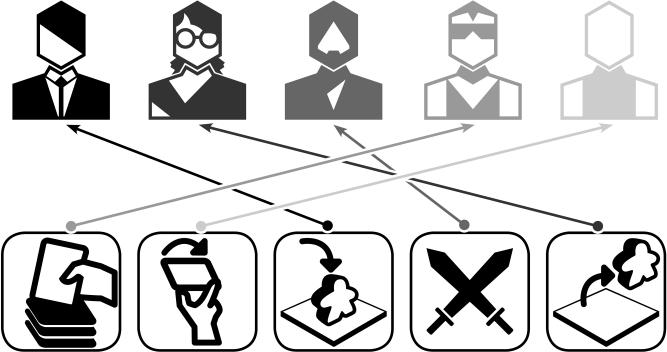
Players select from an assortment of Actions in a shared pool. The available Actions are limited in quantity, and once a player has chosen an Action it may not be chosen again.
Discussion
This mechanism creates player interaction within the Action selection itself. While many games have Actions, typically if an Action is chosen by one player, that does not deny it to another. Action Drafting creates a marketplace for Actions, with players competing to select them. Action Drafting is a very common mechanism that goes by a variety of names, such as Role Selection or Worker Placement. In a Worker Placement mechanism, players place pawns (“workers”) onto Action spaces on a board, perform the Actions, and deny the use of those Action spaces to their opponents. Because of the variety and importance of Worker Placement, we have dedicated Chapter 9 to exploring its considerations and variations. The issues discussed there, such as the strength of the first player advantage, apply to most of the mechanisms discussed here as well. Citadels is an example of a Role Selection implementation of Action Drafting. In Citadels, the start player takes all the role cards (which show their associated actions), selects an Action card, and then passes the remaining cards to the
player to the left. Because the card chosen is secret, this system generates information asymmetry (UNC-05). Puerto Rico and Race for the Galaxy are similar examples of Role Selection, as in each round, every player selects (drafts) a role and gets to perform associated actions. Puerto Rico allows all players to perform a less powerful version of the action the drafting player selected, only the player may select a given role each round (see “Follow, ACT-08” in this chapter). In Race for the Galaxy, players also can Follow with a weaker version of the action another player selected, but multiple players can select the same role and get the stronger version of the action. Frequently this mechanism is implemented with a Dice Pool. At the start of the Action Selection phase, dice are rolled, with results corresponding to a specific action. In La Granja, for example, all the 4s rolled are placed into the “Take 4 Coins” action space. Once all dice are placed in their boxes, the players take turns selecting a die and performing the associated action. In a separate twist, there is an extra die left over after all players have selected two action dice, and every player gets to perform that final action. An Action Drafting system based on a dice pool works against perfect plans, as players need to adapt to whatever actions are available. In addition, it forces players to consider not just their own plans but also what their opponents may need. Players may consider taking a sub-optimal selection in order to deprive their opponents of the option (so-called “hate drafting”). Another variant on this mechanic is found in Dungeon Lords. In this game, players secretly select three out of six possible Action cards, placing them face down in front of them in order. Each player then reveals their first card and places tokens on the corresponding spaces (with ties in order being broken by a Start Player token). The players who claim Action space earlier can perform more powerful versions of the Actions. In War of the Ring, each player has their own pool of action dice and players take turns selecting one of their dice. These systems are not really drafting, in that players are not denying their opponent an Action. However, it does restrict the range of possible Actions, gives players flexibility, and an understanding of the possible Actions available to their opponent.
Sample Games
7 Wonders (Bauza, 2010) Agricola (Rosenberg, 2007) Citadels (Faidutti, 2000)
Coimbra (Brasini and Gigli, 2018) Dungeon Lords (Chvátil, 2008) La Granja (Keller and Odendahl, 2014) Puerto Rico (Seyfarth, 2002) Race for the Galaxy (Lehmann, 2007) War of the Ring (Di Meglio, Maggi, and Nepitello, 2004) Yspahan (Pauchon, 2006)
描述
玩家从共享池中的各类“动作”中进行选择。可用的动作数量有限,一旦有玩家选中了某个动作,其他玩家就无法再次选择该动作。
讨论
这个机制在“动作选择”本身中创造了玩家互动。虽然许多游戏都有动作,但通常如果一个动作被一个玩家选中,并不会阻止其他玩家选择它。动作轮抽(Action Drafting)创造了一个动作市场,玩家通过竞争来选择它们。动作轮抽是一个非常常见的机制,有各种各样的名字,如角色选择(Role Selection)或工人放置(Worker Placement)。在工人放置机制中,玩家将棋子(“工人”)放置在版图上的动作空间上,执行动作,并阻止对手使用这些动作空间。由于工人放置的多样性和重要性,我们专门在第9章探讨其考量和变体。那里讨论的问题,如先手优势的强度,也适用于这里讨论的大多数机制。《富饶之城》(Citadels)是动作轮抽中角色选择实现的一个例子。在《富饶之城》中,起始玩家拿取所有角色卡(显示相关联的动作),选择一张动作卡,然后将剩余的卡传给左边的玩家。
由于选择的卡牌是保密的,这个系统产生了信息不对称(UNC-05)。《波多黎各》(Puerto Rico)和《银河竞逐》(Race for the Galaxy)是角色选择的类似例子,在每一轮中,每个玩家选择(轮抽)一个角色并获得执行相关动作的权利。《波多黎各》允许所有玩家执行轮抽玩家所选动作的一个较弱版本,但每一轮只有该玩家可以选择特定的角色(参见本章中的“跟随,ACT-08”)。在《银河竞逐》中,玩家也可以跟随其他玩家选择的动作执行一个较弱的版本,但多个玩家可以选择同一个角色并获得该动作的较强版本。这种机制经常通过骰子池来实现。在动作选择阶段开始时,投掷骰子,结果对应特定的动作。例如在《农庄》(La Granja)中,所有掷出4的骰子都被放置在“拿取4个硬币”的动作空间中。一旦所有骰子都放置在各自的格子里,玩家轮流选择一个骰子并执行相关动作。在一个独特的转折中,当所有玩家都选择了两个动作骰子后,还会剩下一个额外的骰子,每个玩家都可以执行那个最终动作。基于骰子池的动作轮抽系统不利于完美的计划,因为玩家需要适应任何可用的动作。此外,它迫使玩家不仅要考虑自己的计划,还要考虑对手可能需要什么。玩家可能会考虑做出次优选择,以剥夺对手的选择权(所谓的“仇恨轮抽”)。这种机制的另一个变体出现在《地下城领主》(Dungeon Lords)中。在这个游戏中,玩家秘密地从六张可能的动作卡中选出三张,按顺序面朝下放在面前。然后每个玩家揭示他们的第一张卡并将标记放置在相应的空间上(顺序平局由起始玩家标记打破)。较早主张动作空间的玩家可以执行更强大的动作版本。在《魔戒圣战》(War of the Ring)中,每个玩家都有自己的动作骰子池,玩家轮流选择自己的一个骰子。这些系统并不是真正的轮抽,因为玩家并没有剥夺对手的一个动作。然而,它确实限制了可能动作的范围,给予玩家灵活性,并让他们了解对手可能可用的动作。
游戏范例
7 Wonders (Bauza, 2010) - 《七大奇迹》 Agricola (Rosenberg, 2007) - 《农场主》 Citadels (Faidutti, 2000) - 《富饶之城》
Coimbra (Brasini and Gigli, 2018) - 《科英布拉》 Dungeon Lords (Chvátil, 2008) - 《地下城领主》 La Granja (Keller and Odendahl, 2014) - 《农庄》 Puerto Rico (Seyfarth, 2002) - 《波多黎各》 Race for the Galaxy (Lehmann, 2007) - 《银河竞逐》 War of the Ring (Di Meglio, Maggi, and Nepitello, 2004) - 《魔戒圣战》 Yspahan (Pauchon, 2006) - 《伊斯法罕》