Description
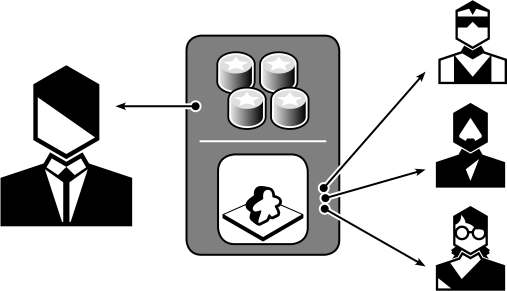
On their turn, the player plays a card that shows Action Points and an Event. Tey must choose to either use the Action Points or perform the Event. If they choose to use the Action Points, typically the Event may be performed by another player.
Discussion
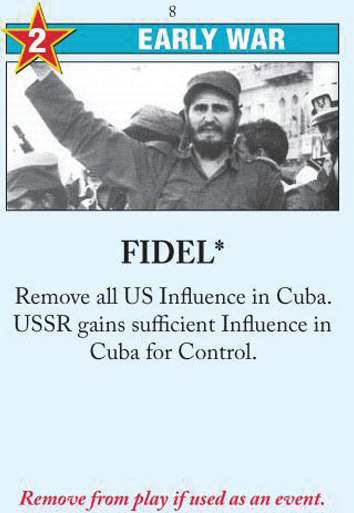
This mechanism builds on a basic Action Point system and allows designers to integrate a lot of flavors and special actions into a system to emphasize the theme. It was pioneered in historical simulations as a way of introducing historical events without unduly adding rules overhead. For example, Twilight Struggle, a simulation of the Cold War, has a card that can be used either for two Action Points or the Fidel event. If the Action Points are chosen, there is a standard list of Actions on which they can be spent (ACT-01) (Illustration 3.3). Many games incorporate an Event Deck (ACT-17), which is another way to include special effects and deeper theming. However, the Action/Event system gives players another layer of choice, rather than simply imposing global effects. Often, games using this system add another layer of player decisionmaking by having some or all events only eligible for specific players. For example, in We the People, a simulation of the American Revolution, certain events may only be performed by the Colonists and others by Great Britain.
If a player is not eligible to use the event on a card, they must use the Action Points. Similarly, some events are dependent on specific locations, control of particular areas, the presence of certain characters, etc. In Empires of the Void II, for example, events can be tied to specific planets, and if those planets are not in play or the planet’s condition does not match the event’s prerequisites, the player may only use the card for its point value, rather than the event. In World War II: Barbarossa to Berlin, there are prerequisite events that must be triggered before other following events may be used. This helps pre-vent anachronisms in games that model historical events. It can also ensure proper cause-and-effect in the narrative flow of a game. Twilight Struggle takes this enforcement of sequencing even further by automatically triggering your opponent’s Event when you play a card featuring such an event for its Action Points. For example, the Warsaw Pact event is a USSR event. If the US player plays the card, he or she must use the three Action Points, but the USSR will still get to perform the Event. On the Illustration 3.3 The “Fidel” card in Twilight Struggle can either be used for two Action Points (the number in the upper left) or for the Fidel event. The Red Star icon shows that the event favors the Soviet player and will trigger even if the US player uses the card for its Action Points.
other hand, if the USSR player plays the card, they must choose between the Event and the Action Points. Generally, used cards are recycled into the deck several times over the course of the game, but some cards are permanently discarded after their event is triggered. Once again, this helps with chronology—Anwar Sadat takes control of Egypt only once—but it also adds complexity to the choice of Action or Event and the sequence of play. It may be better to forgo playing your own Event, and using the Action Points instead, in hopes that the card will reappear in your opponent’s hands and they will be forced to trigger it. Twilight Struggle and We the People are two-player games. This system is extended to multiplayer in The Expanse Board Game, which supports up to four players, each of whom represents a faction. Between two and four factions are eligible for each event, and if a player uses the Action Points, the other players are given the option to perform it, in a priority order. In 1960: The Making of the President, players may trigger their events when their opponent plays a card for its action points by spending a Momentum Marker. However, players may also pre-empt an event from being triggered by their opponent by paying two Momentum Markers when they play the card.
Sample Games
1960: The Making of the President (Leonhard and Matthews, 2007) Empires of the Void II (Laukat, 2018) The Expanse Board Game (Engelstein, 2017) Hannibal: Rome vs Carthage (Simonitch, 1996) Twilight Struggle (Gupta and Matthews, 2005) We the People (Herman, 1993) World War II: Barbarossa to Berlin (Raicer, 2002)
描述
在玩家的回合中,玩家打出一张显示有动作点数和事件的卡牌。玩家必须选择使用动作点数或执行事件。如果选择使用动作点数,该事件通常可由另一位玩家执行。
讨论
这一机制建立在基本的动作点系统之上,允许设计师将丰富的风味和特殊动作整合到系统中以强化主题。它最早出现在历史模拟游戏中,作为一种引入历史事件而不过度增加规则负担的方式。例如,在冷战模拟游戏《冷战热斗》(Twilight Struggle)中,一张卡牌既可以用来获得两个动作点,也可以用来触发”菲德尔”事件。如果选择动作点,玩家可以在标准动作列表(ACT-01)上花费这些点数来执行动作(插图3.3)。许多游戏包含事件牌堆(ACT-17),这是整合特殊效果和深化主题的另一种方式。然而,动作/事件系统为玩家提供了额外的选择层次,而不仅仅是施加全局效果。通常,使用该系统的游戏会增加另一层玩家决策,让部分或全部事件仅对特定玩家生效。例如,在模拟美国独立战争的《我们人民》(We the People)中,某些事件只能由殖民者执行,而其他事件则由英国执行。
如果玩家不符合使用卡牌上事件的资格,他们必须使用动作点。同样,某些事件依赖于特定地点、对特定区域的控制、特定角色的在场等条件。例如在《虚空帝国 II》(Empires of the Void II)中,事件可能与特定行星关联,如果这些行星不在游戏中或行星状况不符合事件的前提条件,玩家只能使用该卡的点数值,而无法使用事件。在《二战:巴巴罗萨到柏林》(World War II: Barbarossa to Berlin)中,某些前提事件必须先被触发,后续事件才能使用。这有助于防止在历史模拟游戏中出现时代错误,也能确保游戏叙事流程中的正确因果关系。《冷战热斗》更进一步,当玩家使用包含对手事件的卡牌作为动作点时,会自动触发对手的事件,以此强制执行顺序。例如,“华沙条约”是一个苏联事件。如果美国玩家打出这张卡,必须使用三个动作点,但苏联玩家仍会获得执行该事件的机会。
插图 3.3 《冷战热斗》中的”菲德尔”卡既可以用于两个动作点(左上角的数字),也可以用于菲德尔事件。红星图标表示该事件有利于苏联玩家,即使美国玩家将该卡用于其动作点,事件仍会触发。
另一方面,如果苏联玩家打出这张卡,他们必须在事件和动作点之间做出选择。通常,使用过的卡牌会在游戏过程中多次回收到牌堆中,但有些卡牌在触发事件后会被永久丢弃。这再次有助于维持时间顺序——安瓦尔·萨达特只掌控埃及一次——同时也增加了选择动作或事件以及游戏顺序的复杂性。有时放弃执行自己的事件转而使用动作点可能更好,期望这张卡会重新出现在对手手中,从而迫使他们触发它。《冷战热斗》和《我们人民》是双人游戏。这个系统在支持最多四名玩家的《苍穹浩瀚:桌游版》(The Expanse Board Game)中扩展到了多人游戏,每位玩家代表一个派系。每个事件有两到四个派系有资格执行,如果一名玩家使用动作点,其他玩家可以按优先顺序选择执行该事件。在《1960:缔造总统》(1960: The Making of the President)中,玩家可以在对手将卡牌用于动作点时,通过花费一个动量标记来触发自己的事件。然而,玩家也可以在打出卡牌时支付两个动量标记,从而预先阻止对手触发事件。
游戏范例
1960: The Making of the President (Leonhard and Matthews, 2007) - 《1960:缔造总统》 Empires of the Void II (Laukat, 2018) - 《虚空帝国 II》 The Expanse Board Game (Engelstein, 2017) - 《苍穹浩瀚:图版游戏》 Hannibal: Rome vs Carthage (Simonitch, 1996) - 《汉尼拔:罗马对迦太基》 Twilight Struggle (Gupta and Matthews, 2005) - 《冷战热斗》 We the People (Herman, 1993) - 《我们人民》 World War II: Barbarossa to Berlin (Raicer, 2002) - 《二战:巴巴罗萨到柏林》