Description
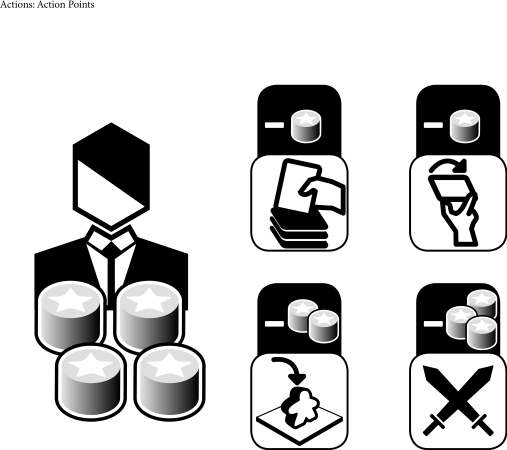
A player receives a number of Action Points on their turn. Tey may spend them on a variety of Actions.
Discussion
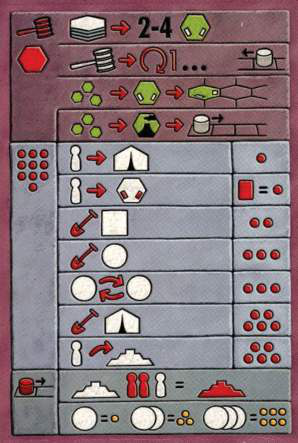
This is a broad mechanism that is isomorphic to a variety of game structures. However, some generalities can be discussed. A common implementation is that a player receives a fixed number of Action Points on their turn and can spend them on any combination of Actions, each of which spends one of those points. Pandemic, for example, gives a player four Action Points each turn, which can be spent on several Actions, such as moving to another city or removing a disease cube. Tikal takes a similar approach, but Actions may cost more than one Action Point. Each player gets ten Action Points for the turn, and the cost of Actions ranges from one to four. This can dramatically increase the decision space for players, so the designer needs to be cognizant of the additional weight this will add to the game (Illustration 3.1).
A game may have multiple currencies of Action Points. Trough the Ages: A Story of Civilization has two types of Action Points: Civil and Military. Each may only be spent on specific types of Actions. Variations of this mechanism may also limit players to only performing an Action one time per turn. Some allow players to leave some Action Points unused to be carried over to the next turn, and others require that all be spent or lost. Many games use this mechanism without explicitly awarding Action Points to the players. For example, the game may simply tell players that they may take two out of three possible Actions, or even one. In Feudum, each player simultaneously selects four out of eleven Action cards available in a personal pool to use each turn. This makes it obvious whether an Action can be performed multiple times, or just once, depending on how many copies of the same Action card are in the deck. A variant Action Point system is found in Starship Samurai. Here, players select the Action they wish to perform from a limited menu. Tey must also use one of their order counters, which are numbered from one to four. The number determines the number of times the Action may be executed. For example, if players choose the Move Action and use their “3” token, they get to move 3 units. Illustration 3.1 The Action reference from Tikal. The cost of each action is indicated by the small red circles to the right. Players have ten Action Points to spend each turn.
Action Point systems give the players a lot of flexibility in how they approach their turn. The pace of the game can be controlled by the designer by changing the number of Action Points available each turn. Small values will lead to quicker turns. Larger values will lengthen turns but also open up more space for combos.
Sample Games
Android Netrunner (Garfield and Litzsinger, 2012) Feudum (Swanson, 2018) Forbidden Island (Leacock, 2010) Kemet (Bariot and Montiage, 2012) Pandemic (Leacock, 2008) Starship Samurai (Vega, 2018) Trough the Ages: A Story of Civilization (Chvátil, 2006) Tikal (Kiesling and Kramer, 1999)
描述
玩家在他们的回合会收到一定数量的动作点(Action Points)。他们可以将这些点数花费在各种不同的动作上。
讨论
这是一个广泛的机制,与各种游戏结构同构。然而,我们可以讨论一些共性。一种常见的实现方式是,玩家在其回合获得固定数量的动作点,并且可以将其花费在动作的任意组合上,每个动作花费其中一点。例如《瘟疫危机》(Pandemic)每回合给予玩家4个动作点,这些点可以花费在几个动作上,例如移动到另一个城市或移除一个疾病方块。《提卡尔》(Tikal)采取了类似的方法,但动作可能会花费超过一个动作点。每个玩家这回合获得10个动作点,动作的费用从1到4不等。这会极大地增加玩家的决策空间,因此设计师需要意识到这将给游戏增加的额外负担(插图3.1)。
一个游戏可能有多种动作点货币。《历史巨轮》(Through the Ages: A Story of Civilization)有两种类型的动作点:内政和军事。每种只能花费在特定类型的动作上。这种机制的变体也可能限制玩家每回合只能执行一次某种动作。有些允许玩家保留一些未使用的动作点到下一回合,而另一些则要求必须全部用完或作废。许多游戏使用这种机制,但没有明确地奖励玩家动作点。例如,游戏可能只是告诉玩家他们可以从三个可能的动作中采取两个,甚至一个。在《封地》(Feudum)中,每个玩家每回合同时从个人池中可用的11张动作卡中选择4张使用。这使得动作是可以执行多次还是仅一次变得显而易见,具体取决于牌堆中有多少张相同的动作卡副本。在《星舰武士》(Starship Samurai)中发现了一种变体的动作点系统。在这里,玩家从有限的菜单中选择他们希望执行的动作。他们还必须使用他们的一个命令标记,这些标记编号从1到4。数字决定了动作可以执行的次数。例如,如果玩家选择移动动作并使用他们的“3”标记,他们可以移动3个单位。
插图 3.1 《提卡尔》的动作参考。每个动作的成本由右侧的小红圈指示。玩家每回合有10个动作点可以花费。
动作点系统在玩家如何处理他们的回合方面给予了很大的灵活性。设计师可以通过改变每回合可用的动作点数量来控制游戏的节奏。较小的值会导致回合更快。较大的值会通过延长回合,但也为连击打开了更多空间。
游戏范例
Android Netrunner (Garfield and Litzsinger, 2012) - 《安卓纪元:矩阵潜袭》 Feudum (Swanson, 2018) - 《封地》 Forbidden Island (Leacock, 2010) - 《禁岛》 Kemet (Bariot and Montiage, 2012) - 《凯麦特》 Pandemic (Leacock, 2008) - 《瘟疫危机》 Starship Samurai (Vega, 2018) - 《星舰武士》 Trough the Ages: A Story of Civilization (Chvátil, 2006) - 《历史巨轮》 Tikal (Kiesling and Kramer, 1999) - 《提卡尔》