Description
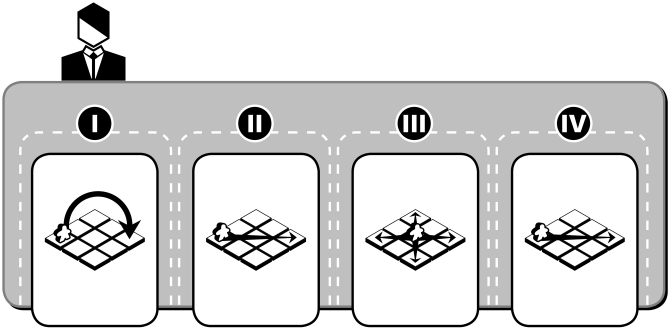
Players create Action Queues and perform them in sequence.
Discussion
While this mechanism has many different implementations, at its core, the idea is that players must plan their actions and commit to a specific sequence of execution. For example, players may have to plot the movement of a robot by placing three Action cards in sequence that may, for example, cause the robot to move forward two spaces, then turn left, and then move one more space. The types of actions, the way they are revealed and resolved, and other specifics have several variations (Illustration 3.5). Action Queues emphasize planning but can also introduce chaos as players commit to a course of action several steps or turns in advance, keep them hidden from the other players, and have limited opportunity to change the plan. This introduces Yomi (UNC-01), as players try to guess what other players will do and what the board state may look like in the future. Actions are typically represented by cards, as they can contain a lot of information about the preconditions and resolutions. Tiles can also be used but need to be simpler. Queues can either be Rolling, where the Action at the head of the queue is revealed and performed as a new Action is added to the end, or Batch, where a set number of cards are added to the queue at one time and then all are resolved in order.
One of the earliest uses of a Rolling Queue is the 1965 game Nuclear War. In this game, each player has a queue of two cards in front of them. On their turn, they add a card to the end of the queue, and then turn up and execute the card at the queue head. In Nuclear War, the players start at peace and may perform certain peace actions, but when someone launches a missile, only war actions may be taken. The delayed Action Queue gives the game tremendous tension, as players need to decide if they can continue to perform peace actions or want to be the first to declare war. RoboRally uses a Batch Queue. The players fully plan an entire series of actions and then resolve them using an Interleaved turn structure, with each player revealing and performing the action in the first slot, then each player doing the second action, etc. Swashbuckler, instead of using cards, has players record their actions on a record sheet, in blocks of six time steps. Players then resolve each time step. RoboRally only allows players to queue Movement actions, with other actions (such as shooting) being done on the fly as the opportunity permits. In contrast, Swashbuckler allows players the full suite of movement, combat, and other actions. Twin Tin Bots uses a Batch Queue approach, but the entire queue does not get replaced at once. Players may only replace one Action in the queue each turn. The others remain and are performed. This obviously adds more complexity to the programming step as players need to play further ahead about how they may change their queues. Mechs vs. Minions is a similar example of this system. When queues get longer, and particularly when movement and rotation actions are included in the available actions, players need to visualize where they will be as they progress through the queue. Visualizing spatial Illustration 3.5 A sample queue Space Alert. Coordinating the time step with other players is important, so players are allowed to leave blank steps—steps 2 and 5 in this example.
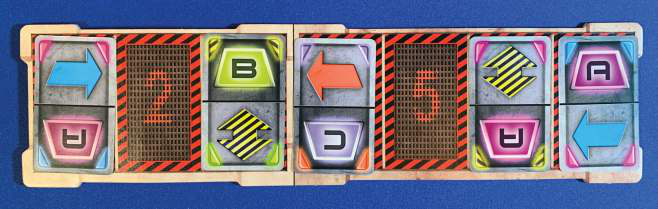
relationships is cognitively taxing and tends to lead to a chaotic board state. This combination may not be well received by some players, because of the contrast between the cognitive effort expended and the seemingly unpredictable outcomes of the game. Some games, however, such as RoboRally and Space Alert, are built on this precise dynamic and experience. Other games, such as Colt Express, address this challenge by limiting the size of the play area. In Colt Express, players can move to the head or rear of a short train of cars, or between the inside and the top of those cars. Each player can move to one of three spaces per turn, and the whole board is about ten spaces in a 2-by-5 array (depending on player count), increasing the likelihood of player collisions and interactions, while decreasing the cognitive load on players. Root has a unique take on the Action Queue. One of the player-controlled factions must add a new Action to its queue each turn (in any position) and perform all the Actions in sequence. If an Action cannot be executed, the player loses victory points and all Action cards in the queue are discarded. Another variation is in Valparaiso. Players simultaneously plan their actions in a queue and then execute them in order. However, as the turn unfolds, they may pay gold to perform an action in their queue sooner than planned.
Sample Games
Rolling Queue The Dragon & Flagon (Engelstein, Engelstein, and Engelstein, 2016) Killer Bunnies and the Quest for the Magic Carrot (Bellinger, 2002) Nuclear War (Malewicki, 1965) Batch Queue Colt Express (Raimbault, 2014) Gunslinger (Hamblen, 1982) Mechs vs. Minions (Cantrell, Ernst, Librande, Saraswat, and Tiras, 2016) RoboRally (Garfield, 1994) Root (Wehrle, 2018) Space Alert (Chvátil, 2008) Twin Tin Bots (Keyaerts, 2013) Valparaiso (Malz and Malz, 2018)
描述
玩家创建“动作队列”(Action Queues)并按顺序执行它们。
讨论
虽然这个机制有许多不同的实现,但核心思想是玩家必须计划他们的动作并承诺以特定的顺序执行。例如,玩家可能必须通过按顺序放置三张动作卡来规划机器人的移动,这些卡可能导致机器向前移动两格,然后左转,然后再移动一格。动作的类型、揭示和解决的方式以及其他细节有多种变体(插图3.5)。动作队列强调规划,但也可能引入混乱,因为玩家提前几步或几回合承诺了一系列动作,将其对其他玩家隐藏,并且改变计划的机会有限。这引入了“读心/博弈”(Yomi, UNC-01),因为玩家试图猜测其他玩家会做什么以及未来的棋盘状态会是什么样子。动作通常由卡牌表示,因为它们可以包含大量关于前提条件和解决的信息。也可以使用板块,但需要更简单一些。队列可以是“滚动式”(Rolling),即队列头部的动作被揭示并执行,而新的动作被添加到末尾;或者是“批次式”(Batch),即一次将一定数量的卡牌添加到队列中,然后按顺序全部解决。
滚动队列最早的应用之一是1965年的游戏《核战争》(Nuclear War)。在这个游戏中,每个玩家面前都有两张牌的队列。在他们的回合,他们将一张牌加到队列末尾,然后翻开并执行队列头部的牌。在《核战争》中,玩家开始时处于和平状态,可以执行某些和平动作,但是当有人发射导弹时,只能采取战争动作。延迟的动作队列给游戏带来了巨大的紧张感,因为玩家需要决定他们是否可以继续执行和平动作,还是想成为第一个宣战的人。《机器人拉力赛》(RoboRally)使用批次队列。玩家完全计划一系列动作,然后使用交错回合结构解决它们,每个玩家揭示并执行第一个槽位的动作,然后每个玩家做第二个动作,依此类推。《虚张声势》(Swashbuckler)不使用卡牌,而是让玩家在记录表上以六个时间步长为一组记录他们的动作。然后玩家解决每个时间步长。《机器人拉力赛》只允许玩家排队移动动作,其他动作(如射击)则是在机会允许的情况下即时完成的。相比之下,《虚张声势》允许玩家进行全套移动、战斗和其他动作。《双子机器人》(Twin Tin Bots)使用批次队列方法,但整个队列不会一次性全部更换。玩家每回合只能更换队列中的一个动作。其他的保留并被执行。这显然增加了编程步骤的复杂性,因为玩家需要更长远地考虑他们可能如何改变他们的队列。《机甲与小兵》(Mechs vs. Minions)是该系统的一个类似例子。当队列变长时,特别是当可用动作中包含移动和旋转动作时,玩家需要在通过队列时可视化他们将在哪里。
插图 3.5 一个《太空警报》(Space Alert)的队列示例。与其他玩家协调时间步长很重要,所以玩家被允许留下空白步骤——本例中的步骤2和5。
可视化空间关系在认知上是繁重的,往往导致混乱的棋盘状态。这种组合可能不会被一些玩家接受,因为花费的认知努力与游戏看似不可预测的结果之间存在反差。然而,有些游戏,如《机器人拉力赛》和《太空警报》,正是建立在这种动态和体验之上的。其他游戏,如《柯尔特快车》(Colt Express),通过限制游戏区域的大小来解决这一挑战。在《柯尔特快车》中,玩家可以移动到一列短火车的头部或尾部,或者在车厢内部和顶部之间移动。每位玩家每回合可以移动到三个空间中的一个,整个棋盘大约是2乘5阵列中的十个空间(取决于玩家人数),增加了玩家碰撞和互动的可能性,同时减少了玩家的认知负荷。《茂林源记》(Root)对动作队列有独特的见解。其中一个玩家控制的派系必须每回合在其队列中添加一个新的动作(在任何位置),并按顺序执行所有动作。如果一个动作无法执行,玩家将失去胜利点数,队列中的所有动作卡都将被丢弃。另一个变体是在《瓦尔帕莱索》(Valparaiso)中。玩家同时也规划他们在队列中的动作,然后按顺序执行它们。然而,随着回合的展开,他们可以支付金币来比计划更早地执行队列中的动作。
游戏范例
Rolling Queue The Dragon & Flagon (Engelstein, Engelstein, and Engelstein, 2016) Killer Bunnies and the Quest for the Magic Carrot (Bellinger, 2002) - 《杀手兔与魔力胡萝卜的探索》 Nuclear War (Malewicki, 1965) - 《核战争》 Batch Queue Colt Express (Raimbault, 2014) - 《柯尔特快车》 Gunslinger (Hamblen, 1982) - 《神枪手》 Mechs vs. Minions (Cantrell, Ernst, Librande, Saraswat, and Tiras, 2016) - 《机甲与小兵》 RoboRally (Garfield, 1994) - 《机器人拉力赛》 Root (Wehrle, 2018) - 《茂林源记》 Space Alert (Chvátil, 2008) - 《太空警报》 Twin Tin Bots (Keyaerts, 2013) - 《双子机器人》 Valparaiso (Malz and Malz, 2018) - 《瓦尔帕莱索》