Description
Each player has a set of Actions available to them, represented by cards, tokens, or some other component. Once the Action is performed, the component is spent and the Action may not be performed again until the component is retrieved. Action Retrieval may be an Action taken as part of a turn or it may consume an entire turn.
Discussion
Action Retrieval rewards efficiency. Because retrieving the used cards takes an Action, players that retrieve more frequently will be at a disadvantage, as they will conduct fewer Actions that advance their cause. The Actions available to players usually span a gamut of discrete options that affect different aspects of the game. For example, Assault of the Giants has the actions Move, Attack, Recruit, Make Alliance, and Leader. Once players use Move, they cannot play it again until they take a Retrieve turn, which restores all action cards used since the last Retrieve. This stops players from repeatedly selecting a specific Action over and over again, forcing them to adopt balanced
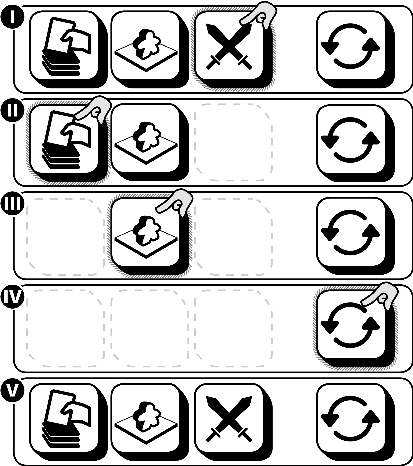
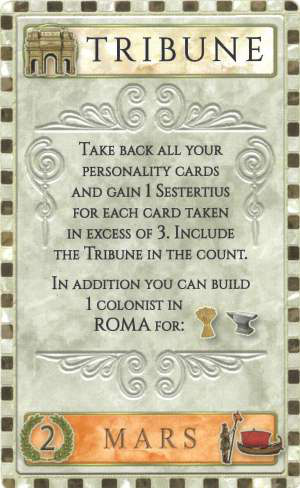
strategies, and to plan several turns ahead. Terefore, a game that incorporates this mechanism will have a much more strategic feel. Action Retrieval also allows for additional tactical play, as your opponents will know, for example, that you do not have a Move action available and will not be able to respond to opponents moving to different areas (Illustration 3.2). Many games introduce additional wrinkles to reward planning and sequencing. Assault of the Giants, for example, makes Actions more powerful as more Actions are played. For example, if the Move card is played as the first card after a Retrieve, only one unit can move. But if Recruit and Attack have been played before Move, then three units may move. In Champions of Hara, cards have a “play” effect and a “retrieval” effect. An action is required to play them from the hand, which triggers the play effect. In a future turn, an action must be used to retrieve the card back into the player’s hand, at which time, the card’s retrieval effect is triggered. Another variation on this mechanism is a mix of one-time and recoverable cards. Gloomhaven has some action cards that can only be used one time during a scenario. Others may be recovered by having a character Rest. Illustration 3.2 When the Tribune card is played in Concordia, the player retrieves their action cards and gains a bonus. The more cards played prior to retrieval, the larger the bonus.
Sample Games
Assault of the Giants (Parks, 2017) Century: Spice Road (Matsuuchi, 2017) Champions of Hara (Barber, VanNest, and Zimmerman, 2018) Concordia (Gerdts, 2013) Gloomhaven (Childres, 2017) Spirit Island (Reuss, 2017)
描述
每个玩家都有一组可用的“动作”,以卡牌、标记或其他组件表示。一旦执行了该动作,该组件即被消耗,并且在回收该组件之前,不得再次执行该动作。“动作回收”(Action Retrieval)可以作为回合的一部分采取的动作,也可以消耗整个回合。
讨论
动作回收奖励效率。因为回收使用过的卡牌需要一个动作,所以回收频率较高的玩家将处于不利地位,因为他们将执行较少的推进其事业的动作。玩家可用的动作通常涵盖影响游戏不同方面的各种离散选项。例如,《巨人的攻击》(Assault of the Giants)具有移动、攻击、招募、结盟和领袖等动作。一旦玩家使用了移动,他们在进行回收回合之前就不能再次使用它,回收回合会恢复自上次回收以来使用的所有动作卡。这阻止了玩家一遍又一遍地重复选择特定的动作,迫使他们采取平衡的策略,并提前计划几回合。因此,包含这种机制的游戏将具有更强的战略感。动作回收还允许额外的战术玩法,因为你的对手会知道,例如,你没有可用的移动动作,因此无法对移动到不同区域的对手做出反应(插图3.2)。许多游戏引入了额外的波折来奖励计划和顺序。例如,《巨人的攻击》使动作随着更多动作的打出而变得更强大。例如,如果移动卡在回收后作为第一张卡打出,只有一个单位可以移动。但是,如果在移动之前已经打出了招募和攻击,那么三个单位可以移动。在《哈拉勇士》(Champions of Hara)中,卡牌具有“打出”效果和“回收”效果。从手中打出它们需要一个动作,这会触发打出效果。在未来的回合中,必须使用一个动作将卡回收回玩家手中,此时,会触发卡牌的回收效果。甚至这种机制的另一个变体是混合了一次性和可恢复卡牌。《幽港迷城》(Gloomhaven)有一些动作卡在场景中只能使用一次。其他的可以通过角色“休息”来恢复。
插图 3.2 当在《协和号》(Concordia)中打出论坛卡时,玩家回收他们的动作卡并获得奖励。回收前打出的卡牌越多,奖励越大。
游戏范例
Assault of the Giants (Parks, 2017) - 《巨人的攻击》 Century: Spice Road (Matsuuchi, 2017) - 《香料之路》 Champions of Hara (Barber, VanNest, and Zimmerman, 2018) - 《哈拉勇士》 Concordia (Gerdts, 2013) - 《协和号》 Gloomhaven (Childres, 2017) - 《幽港迷城》 Spirit Island (Reuss, 2017) - 《灵迹岛》