Description
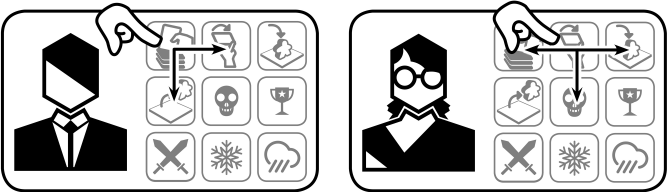
Players are restricted in which actions they may choose.
Discussion
There are a wide variety of mechanisms that have been used to force players to choose less than optimal actions or even ones that are detrimental. Some of the more popular mechanisms have been included in their own section: Action Drafting, Action Retrieval, Rondels, and Command Cards are all examples. However, there are many approaches to this that have been used in only one game. Several of these are collected in this section. In Kemet, the possible actions are laid out in a pyramid. Players must select at least one option from each pyramid level. In Goa, action tiles are laid out on a grid. The start player places a marker on the grid, taking that tile. Each player in turn then places their marker adjacent to the previous one played, onto another tile, either orthogonally or diagonally. Players need to consider how they may be helping their opponent by placing next to a tile they need. In Noria, players place action tokens on concentric wheels. Only tokens in certain portions of the wheels may be used, and the wheels rotate at different speeds. Tzolk’in: The Mayan Calendar also uses rotating gears, and the longer workers remain on the gears the more powerful the actions they can perform. In Calimala, players place disks between two actions on a grid and can perform both connected actions. Manitoba has a tower of disks of different colors, and the active player selects part of the stack which controls what map regions and tracks may be used for actions.
In Keyforge: Call of the Archons, in each turn, a player picks what “house” they will use, and only cards (actions) that belong to that house may be used. Looking for novel ways to limit the actions that players can take is a constant source of innovation in game design. Warpgate gives players a hand of Action cards, each of which has two possible Actions that can be performed. When playing a card, the player may select which half to use. It has the additional twist that cards become more powerful the later they are played in the round. Bonfire and Honey Buzz combine action selection with tile placement. Both games have players selecting tiles with multiple actions on them and placing them on a player board. In Bonfire, the actions are triggered on placement, and action placed adjacent to the same action tile gain a bonus. In Honey Buzz, if the hexagonal tiles completely surround a single empty space, the action on all six surrounding spaces is triggered.
Sample Games
Bonfire (Feld, 2020) Calimala (Lopiano, 2017) Forum Trajanum (Feld, 2018) Goa (Dorn, 2004) Honey Buzz (Salomon, 2020) Kemet (Bariot and Montiage, 2012) Keyforge: Call of the Archons (Garfield, 2018) Manitoba (Conzadori and Pranzo, 2018) Noria (Wagner, 2017) Tzolk’in: The Mayan Calendar (Luciani and Tascini, 2012) Warpgate (Nichipurov, 2018)
描述
玩家在选择动作时受到限制。
讨论
有各种各样的机制被用来迫使玩家选择次优的动作,甚至是有害的动作。一些较流行的机制已包含在它们自己的部分中:动作轮抽、动作回收、轮盘和命令卡都是例子。然而,有许多方法仅在一种游戏中使用。本节收集了其中一些。在《凯麦特》(Kemet)中,可能的动作排列成金字塔状。玩家必须从每个金字塔层级中至少选择一个选项。在《果阿》(Goa)中,动作板块排列在网格上。起始玩家将标记放在网格上,拿走该板块。每位玩家依次将他们的标记放置在与前一个标记相邻的另一个板块上,可以是正交或对角线方向。玩家需要考虑他们放到对手需要的板块旁边是否会帮助到对手。在《诺利亚》(Noria)中,玩家将动作标记放置在同心轮上。只有位于轮子特定部分的标记才能使用,并且轮子以不同的速度旋转。《卓尔金历》(Tzolk’in: The Mayan Calendar)也使用旋转齿轮,工人留在齿轮上的时间越长,他们可以执行的动作就越强大。在《卡利马拉》(Calimala)中,玩家将圆盘放置在网格上的两个动作之间,并且可以执行两个连接的动作。《马尼托巴》(Manitoba)有一个不同颜色圆盘的塔,活跃玩家选择堆栈的一部分,这一部分控制哪些地图区域和轨迹可用于动作。
在《熔钥:御司的呼唤》(Keyforge: Call of the Archons)中,每一回合,玩家选择他们将要使用的“家族”,并且只能使用属于该家族的卡牌(动作)。寻找限制玩家可以采取的动作的新颖方法是游戏设计中创新的源泉。《传送门》(Warpgate)给玩家一手动作卡,每张卡有两个可能的动作可以执行。打出一张卡时,玩家可以选择使用哪一半。它还有一个额外的转折,即卡牌在回合中打出得越晚越强大。《篝火》(Bonfire)和《蜂蜜嗡嗡》(Honey Buzz)将动作选择与板块放置结合起来。两款游戏都让玩家选择带有多个动作的板块并将其放置在玩家版图上。在《篝火》中,动作在放置时触发,放置在相同动作板块旁边的动作获得奖励。在《蜂蜜嗡嗡》中,如果六角形板块完全包围一个单独的空位,则触发所有六个周围空间上的动作。
游戏范例
Bonfire (Feld, 2020) - 《篝火》 Calimala (Lopiano, 2017) - 《卡利马拉》 Forum Trajanum (Feld, 2018) - 《图拉真广场》 Goa (Dorn, 2004) - 《果阿》 Honey Buzz (Salomon, 2020) - 《蜂蜜嗡嗡》 Kemet (Bariot and Montiage, 2012) - 《凯麦特》 Keyforge: Call of the Archons (Garfield, 2018) - 《熔钥:御司的呼唤》 Manitoba (Conzadori and Pranzo, 2018) - 《马尼托巴》 Noria (Wagner, 2017) - 《诺利亚》 Tzolk’in: The Mayan Calendar (Luciani and Tascini, 2012) - 《卓尔金历》 Warpgate (Nichipurov, 2018) - 《传送门》