Description
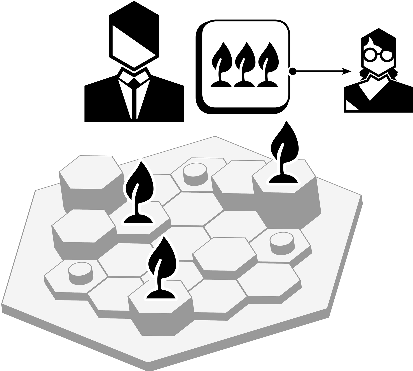
One player has a token that permits them to perform a special Action or modify an Action. Once used, the token passes to another player.
Discussion
This is a meta-mechanism of Action Selection, as it determines what Actions may be available to a player. Originally introduced in the 1981 game Storm over Arnhem as the “Tactical Advantage” token, it represents the ebb and flow of a conflict. In Storm, the controlling player could use it to re-resolve combat or to force a turn to continue when it would otherwise end. After being used in this way, it is passed to the other player, who receives the same options. This introduces another consideration for the player, as the value of using the Tactical Advantage must be weighed against its loss and the possible use of it by the opponent. Similar to Once-Per-Game Actions (ACT-13), a timing dimension is added to the decision-making. Normally, Variable Player Powers (ACT-12) are always on, so if you can use them, you should. But that is not the case with this mechanism. Twilight Struggle uses this mechanism more thematically than Storm over Arnhem in the guise of The China Card, an actual card that is passed between players when it is used. It is a powerful card that is even more powerful when
used to perform actions in Asia, but after use, it is given to the opponent. Again, consideration must be given to the timing and whether to use the card or simply hold on to it and deny its use to the opponent. Advantage Tokens can also be used to give ongoing benefits to the owning player that do not require surrender. In Storm, for example, the player controlling the token gets to go first in a turn and decides the order of resolution of conflict situations. Many games use this system less overtly for tie-breaking. In a Sealed Bid Auction for example (AUC-04), ties may be broken by a Priority Token. Ten, the token is given to the player who lost the tiebreaker. This is different from the standard implementation of this mechanism, as the transfer is not controlled by the player. It simply designates who wins a tie, and its transfer is never a choice. In another variant of this mechanism, the A Game of Trones board game features an Iron Trone token that is awarded to the winner of the turn-order auction. The holder of the Trone determines how all noncombat ties among all players are to be decided. The recurring turnorder auction is the means by which possession of the token moves around, rather than by its use. The Advantage Token mechanism gives the designer an opportunity to give the players more control over certain random aspects of the game, such as combat resolution in Storm over Arnhem or card draw in Twilight Struggle. As such, it can make a game feel more strategic, without a lot of rules overhead.
Sample Games
Breakout: Normandy (Greenwood and Stahler, 1992) The Fog of War (Engelstein, 2016) A Game of Trones (Petersen and Wilson, 2003) Storm over Arnhem (Allen, 1981) Twilight Struggle (Gupta and Matthews, 2005)
描述
一名玩家持有一个标记,允许他们执行特殊动作或修改动作。一旦使用,令牌将传递给另一名玩家。
讨论
这是动作选择的一种元机制,因为它决定了玩家可以使用哪些动作。最初在1981年的游戏《阿纳姆战役》(Storm over Arnhem)中作为“战术优势”标记引入,它代表了冲突的起伏。在《阿纳姆战役》中,控制玩家可以使用它来重新解决战斗或强制回合继续,否则回合就会结束。以这种方式使用后,它被传递给另一名玩家,后者获得相同的选项。这为玩家引入了另一个考虑因素,因为必须权衡使用战术优势的价值与其损失以及对手可能使用它的情况。类似于“每局一次及其它”动作(ACT-13),决策中增加了一个时间维度。通常,可变玩家能力(ACT-12)总是开启的,所以如果你能使用它们,你就应该使用。但这种机制并非如此。《冷战热斗》(Twilight Struggle)比《阿纳姆战役》更具主题性地使用了这种机制,即“中国牌”,这实际上是一张在使用时在玩家之间传递的卡牌。它是一张强大的卡牌,当被用于在亚洲执行动作时甚至更强大,但使用后,它会被交给对手。同样,必须考虑时机以及是使用该卡还是仅仅持有它并拒绝对手使用它。优势标记也可以用来给予拥有玩家持续性的利益,而不需要交出。例如,在《阿纳姆战役》中,控制标记的玩家可以在回合中先手,并决定冲突情况的解决顺序。许多游戏将此系统不太明显地用于打破平局。例如,在密封竞价拍卖(AUC-04)中,平局可能由优先级标记打破。然后,该标记被给予输掉决胜局的玩家。这与这种机制的标准实现不同,因为转移不是由玩家控制的。它只是指定谁赢得平局,其转移从来不是一种选择。而在该机制的另一个变体中,《权力的游戏》(A Game of Thrones)版图游戏具有一个铁王座标记,授予回合顺序拍卖的获胜者。铁王座的持有者决定如何解决所有玩家之间的所有非战斗平局。周期性的回合顺序拍卖是拥有权转移的方式,而不是通过其使用。优势标记机制让设计师有机会让玩家对游戏的某些随机方面有更多的控制权,例如《阿纳姆战役》中的战斗解决或《冷战热斗》中的抽牌。因此,它可以使游戏感觉更具战略性,而没有过多的规则开销。
游戏范例
Breakout: Normandy (Greenwood and Stahler, 1992) - 《突围:诺曼底》 The Fog of War (Engelstein, 2016) - 《战争迷雾》 A Game of Trones (Petersen and Wilson, 2003) - 《权力的游戏》 Storm over Arnhem (Allen, 1981) - 《阿纳姆战役》 Twilight Struggle (Gupta and Matthews, 2005) - 《冷战热斗》