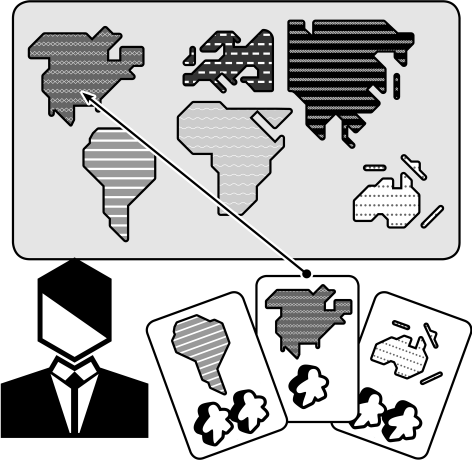
Description
Players have a hand of cards that allows them to activate and perform actions with a subset of their units.
Discussion
Players have a hand of cards that represent different geographic regions or unit types and must play one each turn. When a geographic region card is played, units in the region(s) indicated may take Actions. If a Unit Type card is played, only units of that type may take Actions. In Memoir ’44 the cards represent the center, left flank, or right flank; or a set of units, for example, all Tank units. Players can plan their future actions based on the cards in their hands. Hand-size limits help define the information horizon and amount of look-ahead players can engage in. Players may try to build a bank of cards in a particular sector to orchestrate a multi-pronged attack, or they may riskily move a unit out of cover to take a better shot, despite not having another card in hand to move the unit to safety the next turn. Like in real battles, players may not be able to execute the tactics
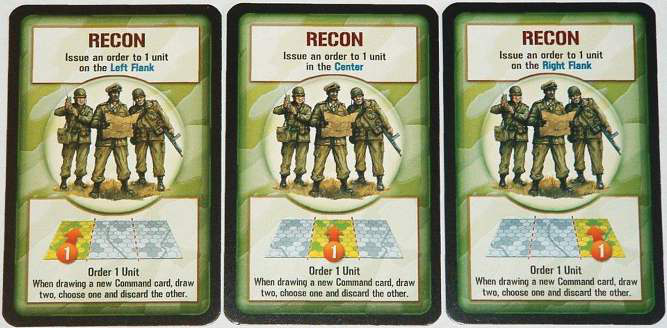
they believe are best. The system is quite elegant as an abstraction of breakdowns in communication and command-and-control that occur in warfare (Illustration 3.4). In a traditional war game, players can take actions with all of their units each turn. Command Card systems limit this to a subset of units, which reduces the length of turns and simplifies decision-making, giving the game a lighter feel. Some games, such as Risk: Star Wars Edition, give players a range of one to three possible activation choices, building in greater flexibility and planning. In the extreme limit, with one unit at a time being activated, this mechanism reduces to a Chit Draw system (TRN-11).
Sample Games
Battle Cry (Borg, 2000) BattleLore (Borg, 2006) C&C Ancients, Napoleonics, etc. (Borg, 2006–2018) Combat Commander: Europe (Jensen, 2006) Memoir ’44 (Borg, 2004) Risk: Star Wars Edition (D’Aloisio, Rucker, and Van Ness, 2015)
Illustration 3.4 Command Cards from Memoir ’44. While all are Recon cards, each may only activate units in the highlighted region.
描述
玩家持有一手牌,允许他们激活一部分单位并执行动作。
讨论
玩家持有一手牌,代表不同的地理区域或单位类型,并且每回合必须打出一张。当打出地理区域卡时,指定区域中的单位可以采取动作。如果打出单位类型卡,则只有该类型的单位可以采取动作。在《大战回忆录》(Memoir ‘44)中,卡牌代表中央、左翼或右翼;或者是单位集合,例如所有坦克单位。玩家可以根据手中的卡牌计划他们未来的动作。手牌上限有助于定义信息视界和玩家可以进行的预判量。玩家可能会尝试在特定区域积累这套卡牌以策划多管齐下的攻击,或者他们可能会冒险将单位移出掩体以获得更好的射击机会,尽管手中没有另一张卡可以下一回合将单位移至安全地带。就像在真正的战斗中一样,玩家可能无法执行战术
他们认为最好的。该系统作为对战争中发生的通讯和指挥控制中断的抽象非常优雅(插图3.4)。在传统的战争游戏中,玩家每回合可以对所有单位采取动作。命令卡(Command Cards)系统将其限制为单位的一个子集,从而减少回合长度并简化决策,使游戏感觉更轻松。有些游戏,如《风险:星球大战版》(Risk: Star Wars Edition),给玩家一到三个可能的激活选择范围,建立更大的灵活性和规划。在极端限制下,一次激活一个单位,此机制退化为名为“抽签”(Chit Draw, TRN-11)的系统。
游戏范例
Battle Cry (Borg, 2000) - 《战吼》 BattleLore (Borg, 2006) - 《战争之道》 C&C Ancients, Napoleonics, etc. (Borg, 2006–2018) - 《指挥与军旗:古代篇》、《拿破仑篇》等 Combat Commander: Europe (Jensen, 2006) - 《战斗指挥官:欧洲》 Memoir ’44 (Borg, 2004) - 《大战回忆录》 Risk: Star Wars Edition (D’Aloisio, Rucker, and Van Ness, 2015) - 《风险:星球大战版》
插图 3.4 《大战回忆录》中的命令卡。虽然都是侦察卡,但每张只能激活高亮区域的单位。