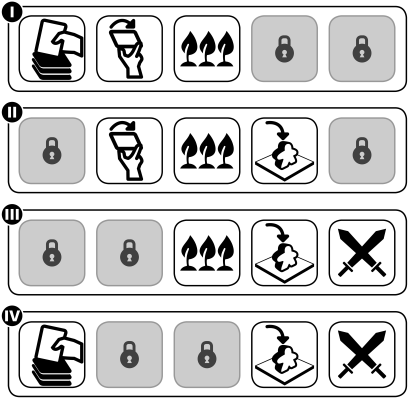
Description
At certain points in the game, new actions are made available to the players. Actions may become available by a variety of means, including reaching a certain turn or game stage. Depleting a shared pool or bringing some track past a threshold level through the cumulative effects of the actions of all the players is another common approach to triggering unlocks. The mechanism is not limited to gating actions. Game events and narrative breaks may also be gated and unlocked through this type of triggering mechanism
Discussion
This is a meta-mechanism of Action Selection, as it affects the availability of Actions, rather than how they are selected. It may be used with any of the Action Selection mechanisms. The newly available Actions can introduce new resources, offer better or more efficient options than the older Actions, and introduce completely new mechanics. Agricola does all three of these. After each round, a new Action card is added to the game board. Some of these introduce new resources, such as Cattle or Boar, some provide a larger quantity of a resource than
previously available Action cards, and others introduce a completely new Action, such as Family Growth. Adding available actions as the game progresses can help the designer control complexity. Early in the game, actions can be simple and limited, giving the players a chance to understand the system without being overwhelmed. As the game progresses, more complex actions and combos can be introduced. Good candidates for this approach are actions that are difficult or impossible to perform early in the game or are tactically inappropriate. This helps give players a positive first experience by preventing them from making poor early choices or pursuing the wrong goals. In addition to controlling complexity, adding actions also gives a sense of forward momentum and narrative arc. New options are introduced to the players, giving the game a progressively more advanced feel as it goes. Adding spaces that grant more resources or that allow earlier actions to be performed more efficiently accelerates player progress and makes player turns more powerful. The 18xx series of railroad games, such as 1830, has a strong gating system that is a critical part of the player strategy. Trains must be bought in order of power. As train levels are exhausted, a variety of game effects are triggered. Upgraded and more powerful track tiles become available, and older trains disappear. Understanding and predicting the timing of these transitions is a critical skill in 18xx games and is one of the reasons they are unforgiving for new players as these transitions accelerate as the game progresses, so timing can be tricky. Trough the Ages has the players’ progress through a variety of Age decks, with upgraded technologies, abilities, and leaders. As each deck is exhausted, players must discard cards from older Ages and increase their per-turn food upkeep costs. Like in 1830, the timing and anticipation of these transitions become a skill for players to master. SpaceCorp also has three Ages (called Eras), but the transition is more extreme as each is played on a completely separate board, with only some advantages carrying over from one Era to the next. Gating and unlocking is a useful mechanism for scaling power curves. This is particularly true in the context of cooperative game engines. For example, in Forbidden Island, the pace at which island tiles are flooded each turn is controlled by “Waters Rise” cards drawn from a deck of artifact cards. With each Waters Rise card drawn, a marker is advanced on a track. After a few track advances, the number of island tiles that get flooded each turn
increases by one, accelerating the sinking of the island and the danger facing the players. Pairing a player power unlock with a penalty or disadvantage is another common pattern for this mechanism. In Zombie Teenz Evolution, players can unlock character powers such as the ability to build a blockade or to reroll a die. However, on that character’s turn, players must also roll an additional die that can summon more zombies onto the board. More generally, legacy games take the fullest advantage of gating and unlocking to introduce new powers, mechanisms, threats, opportunities, and narrative developments, whether during the course of a single game or in between sessions of the same campaign.
Sample Games
1830 (Tresham, 1986) Agricola (Rosenberg, 2007) The Expanse Board Game (Engelstein, 2017) Lords of Waterdeep (Lee and Tompson, 2012) Mechs vs. Minions (Cantrell, Ernst, Librande, Saraswat, and Tiras, 2016) SpaceCorp: 2025-2300 AD (Butterfield, 2018) Trough the Ages: A Story of Civilization (Chvátil, 2006)
描述
在游戏的某些时刻,新的动作会对玩家开放。动作可以通过多种方式变得可用,包括达到特定的回合或游戏阶段。耗尽共享池或通过所有玩家动作的累积效应使某个轨道超过阈值水平是触发解锁的另一种常见方法。该机制不限于门控(Gating)动作。游戏事件和叙事中断也可以通过这种类型的触发机制进行门控和解锁。
讨论
这是动作选择的一种元机制,因为它影响动作的可用性,而不是如何选择动作。它可以与任何动作选择机制一起使用。新可用的动作可以引入新资源,提供比旧动作更好或更有效的选择,并引入全新的机制。《农场主》(Agricola)做到了这三点。每一轮之后,一张新的动作卡被添加到游戏版图中。其中一些引入了新资源,如牛或野猪,一些提供了比
以前可用的动作卡更大量的资源,而另一些则引入了全新的动作,如家庭增长。随着游戏的进行增加可用动作可以帮助设计师控制复杂性。在游戏初期,动作可以是简单有限的,让玩家有机会在不知所措的情况下理解系统。随着游戏的进行,可以引入更复杂的动作和组合。这种方法的良好候选者是在游戏早期难以或不可能执行或在战术上不合适的动作。这有助于通过防止玩家做出糟糕的早期选择或追求错误的目标来给玩家带来积极的初次体验。除了控制复杂性,增加动作还能给人一种前进的动力和叙事弧线感。向玩家引入新选项,使游戏随着进行感觉逐渐更高级。增加给予更多资源或允许更有效地执行早期动作的空间,加速了玩家的进步,使玩家的回合更强大。18xx系列铁路游戏,如《1830》,有一个强大的门控系统,是玩家策略的关键部分。火车必须按动力顺序购买。随着火车等级耗尽,会触发各种游戏效果。升级的和更强大的轨道板变得可用,旧火车消失。理解和预测这些转变的时机是18xx游戏中的一项关键技能,也是因为这些转变随着游戏的进行而加速,所以时机可能很棘手,这也是它们对新玩家无情的原因之一。《历史巨轮》(Through the Ages)让玩家通过各种时代牌堆进步,拥有升级的技术、能力和领袖。当每个牌堆耗尽时,玩家必须丢弃旧时代的卡牌并增加每回合的食物维护成本。就像在《1830》中一样,这些转变的时机和预期成为玩家掌握的一项技能。《太空公司》(SpaceCorp)也有三个时代(称为Eras),但转变更加极端,因为每个时代都在完全独立的版图上进行,只有一些优势从一个时代延续到下一个时代。门控和解锁是扩展功率曲线的有用机制。在合作游戏引擎的背景下尤其如此。例如,在《禁岛》(Forbidden Island)中,每回合岛屿板块被淹没的速度由从神器卡堆中抽取的“水涨”卡控制。每抽取一张水涨卡,标记就会在轨道上前进。在几次轨道前进后,每回合被淹没的岛屿板块数量
增加一个,加速了岛屿的下沉和玩家面临的危险。将玩家能力解锁与惩罚或劣势配对是此机制的另一种常见模式。在《僵尸少年:进化》(Zombie Teenz Evolution)中,玩家可以解锁角色能力,如建立封锁线或重掷骰子的能力。然而,在该角色的回合,玩家还必须额外掷一个骰子,这可能会在版图上召唤更多僵尸。更普遍地说,传承游戏充分利用门控和解锁来引入新的力量、机制、威胁、机会和叙事发展,无论是在单场游戏中还是在同一战役的场次之间。
游戏范例
1830 (Tresham, 1986) - 《1830》 Agricola (Rosenberg, 2007) - 《农场主》 The Expanse Board Game (Engelstein, 2017) - 《苍穹浩瀚:图版游戏》 Lords of Waterdeep (Lee and Tompson, 2012) - 《深水城领主》 Mechs vs. Minions (Cantrell, Ernst, Librande, Saraswat, and Tiras, 2016) - 《机甲与小兵》 SpaceCorp: 2025-2300 AD (Butterfield, 2018) - 《太空公司》 Trough the Ages: A Story of Civilization (Chvátil, 2006) - 《历史巨轮》