Description
Components are placed above other components and can overlap in various ways. Only the topmost visible icons/areas are active.
Discussion
This mechanism is usually implemented with cards, because they afford easy stacking. To organize the layering, the cards are laid out with grids. Patchistory and Circle the Wagons, for example, use a 4×4 grid.
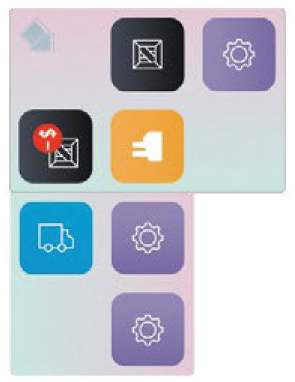
As cards are added to a player’s tableau, they may overlay cards that were played previously. Some games have specific rules about overlap—such as at least two squares must be overlaid—while others are more freeform. The rules for overlapping are typically driven by how the visible icons are used. In Patchistory, for example, the icons give you resources or actions. The most efficient way to build would be to not overlap at all, as that will leave the most visible icons. Terefore, there is a rule that you must overlap, with certain rules about overlapping (e.g., water squares may not be built on) and maximum grid size that create interesting decisions for the players. In Circle the Wagons, the player scores by having contiguous groups of the same color, so just sprawling outwards is rarely the best play. By cleverly over-lapping the cards, players can form large groups. Terefore, there are very few rules governing how cards can be placed. While cards to be placed are usually the same size, sometimes they are not. Smartphone Inc. has players overlap two 2×3 grids of icons (cleverly themed to look like apps on a phone screen) to determine which actions they will perform. Some icons, such as raise or lower prices, cancel each other, so careful orientation is important. During the game, players may earn Improvements, which are small extra tiles with a 1×2 grid of icons that can be placed over the main grids. This gives the players more flexibility and an upgrade path, while preserving the central nature of the main grids (Illustration 3.9). Illustration 3.9 A sample action configuration formed by overlaying two cards in Smartphone, Inc. The visible icons are executed.
The layering mechanism, tile placement, and jigsaw puzzles appeal in similar ways. All have a spatial element that involves twisting and matching up pieces, and all give the players the feeling that there is an answer and a “best” placement. However, layering is typically more complex than tile placement, as there are more options for placement, and the overlapping can be more challenging to visualize than, for example, the edge matching in most tile games, such as Carcassonne. The physical implementation of this mechanism requires careful consideration. Cards are typically best because they are easiest to stack in uneven and irregular patterns and are unlikely to become unbalanced and topple over. However, even cards have a thickness, and the stacked tableau can get messy. Cards can slide and shift once the stack goes above three or four cards deep. Ticker cards or tiles will have even more of an issue as they are stacked. The sample games discussed so far are about building up the layers as the game progresses. However, a game can start with layers already built, and gameplay then proceeds with removing cards. There are many traditional solitaire games, such as Klondike (Patience) and Pyramid, that start with the cards layered on top of each other. The player is only allowed to remove cards that have no other cards covering them. This mechanism is also used in 7 Wonders Duel, where the cards are laid out in a pyramid, and Dragon Castle, which has Mahjong-style tiles placed in a stack, with only the top-most ones available for play. In this implementation, layering limits the Actions available to players. Where the tableau is shared, it also presents a level of interaction, as removing an item will uncover other items for your opponents. Another expression of this system uses transparent cards so that icons on earlier cards are still visible and have an effect. Gloom and Mystic Vale are examples of this technique. Unlike the earlier games discussed, transparent cards are typically layered exactly on top of each other, not rotated or staggered. Icons are placed strategically at specific locations so newly placed cards can cover or leave revealed certain symbols. In Mystic Vale, these transparent cards are placed into plastic sleeves, to combine into a single playable card. Tey are “constructible” in that players can choose how to combine the transparent elements to form very powerful single cards. The horror game Hecatomb has pentagonal creature cards with transparent edges. Players stack the cards to create hybrid Abominations that combine powers.
In Gloom, players try to make their own characters as unhappy as possible, while cheering up those of their opponents. The transparent cards can be used to cover up undesirable icons while leaving desirable ones behind. Cards are not removed, so the stack of cards can be looked at after the game, as they preserve a history of that character’s life. This meshes nicely with the game’s intended experience of having players generate stories about these characters and their odd lives. Transparent cards are more expensive to produce and the printing on them is not as bright. Care has to be taken to ensure visibility through whatever stack depth is required for your game. Splaying is a subset of Layering. In Splaying, cards are typically arranged so that one side of a lower card pokes out of the side of a card above it, revealing icons along that edge. This can give the player a choice of which edge they wish to have exposed (related to CAR-08 Multi-Use Cards), or the main power of the lower card (located in the center) is covered up, leaving a residual power along the edge. Innovation cards have icons on three edges, and deciding which to splay out is a key strategy. Similarly, the letter cards in Paperback Adventures have symbols on both right and left sides, and when spelling and playing a word, the player needs to decide whether to splay to the left or right, gaining the effect of the revealed icons. In …and then, we held hands, players must re-splay their entire tableau to match their position on the board: if they are on the left side of the board, they may only see and use the left side of their tableau and vice-versa. In Lotus, cards are splayed in sets to look like flowers, which achieves a beautiful visual effect, albeit without any gameplay effects. A distantly related implementation of this mechanism can be found in the game Fold-It. Each player has a cloth with a 4×4 grid of food items on each side. A target card is flipped, which shows three or four food icons. Players must then race to fold their clothes along the grid lines to be able to only have those exact icons showing. The players, in essence, are using folding to create layers that hide the icons they do not want to show.
Sample Games
…and then, we held hands (Chircop and Massa, 2015) 7 Wonders Duel (Bauza and Cathala, 2015) Circle the Wagons (Aramini, Devine, Kluka, 2017) Dragon Castle (Hach, Ricci, Silva, 2017) Fold-it (Goh, 2016)
Gloom (Baker, 2005) Hecatomb (Elliott and Tweet, 2005) Innovation (Chudyk, 2010) Klondike Solitaire (Unknown, 1783) Lotus (Goddard and Goddard, 2016) Mystic Vale (Clair, 2016) Paperback Adventures (Fowers, Larsen, 2022) Patchistory (Jung and Kim, 2013) Pyramid Solitaire (Unknown) Smart Phone, Inc. (Lashin, 2018)
描述
组件放置在其他组件之上,可以以各种方式重叠。只有最上面可见的图标/区域是活动的。
讨论
这种机制通常用卡牌实现,因为它们容易堆叠。为了组织分层,卡牌通常以网格布局。《历史补丁》(Patchistory)和《大篷车》(Circle the Wagons)例如使用4×4网格。
当卡牌被添加到玩家的画面(tableau)时,它们可能会覆盖以前打出的卡牌。有些游戏对重叠有特定的规则——例如至少必须覆盖两个方块——而其他游戏则更自由。重叠规则通常由可见图标的使用方式决定。例如在《历史补丁》中,图标给你资源或动作。最有效的建设方式是完全不重叠,因为这样会留下最多的可见图标。因此,有一条规则是你必须重叠,并且有一些关于重叠的规则(例如,水方块不能被建造)和最大网格尺寸,这为玩家创造了有趣的决策。在《大篷车》中,玩家通过拥有相同颜色的连续群组得分,所以仅仅向外扩张很少是最佳打法。通过巧妙地重叠卡牌,玩家可以形成大型群组。因此,几乎没有规则限制卡牌的放置方式。虽然放置的卡牌通常大小相同,但有时也不同。《智能手机公司》(Smartphone Inc.)让玩家重叠两个2×3的图标网格(巧妙地设计成看起来像手机屏幕上的应用程序)来决定他们将执行哪些动作。有些图标,如提高或降低价格,会相互抵消,所以小心的方向很重要。在游戏过程中,玩家可能会获得改进,这是带有1×2图标网格的小额外板块,可以放置在主网格之上。这给了玩家更多的灵活性和升级途径,同时保留了主网格的中心性质(插图3.9)。
插图 3.9 《智能手机公司》中通过重叠两张卡片形成的示例动作配置。可见图标被执行。
分层机制、板块放置和拼图游戏以类似的方式吸引人。所有这些都有一个涉及扭曲和匹配碎片的空间元素,并且都给玩家一种有答案和“最佳”放置的感觉。然而,分层通常比板块放置更复杂,因为放置选项更多,而且重叠比大多数板块游戏(如《卡卡颂》)中的边缘匹配更难可视化。这种机制的物理实现需要仔细考虑。卡牌通常是最好的,因为它们最容易以不均匀和不规则的模式堆叠,并且不太可能变得不平衡和倒塌。然而,即使是卡牌也有厚度,堆叠的画面可能会变得混乱。一旦堆叠深度超过三四张卡牌,卡牌就会滑动和移动。更厚的卡或板块在堆叠时会有更多的问题。到目前为止讨论的示例游戏都是关于随着游戏的进行建立层级。然而,游戏也可以从已经建立的层级开始,然后通过移除卡牌进行游戏。有许多传统的单人纸牌游戏,如《克朗代克》(Klondike,即Patience)和《金字塔》(Pyramid),开始时卡牌彼此重叠。玩家只被允许移除没有其他卡牌覆盖的卡牌。这种机制也用于《七大奇迹:对决》(7 Wonders Duel),其中卡牌排列成金字塔状,以及《龙城》(Dragon Castle),其中麻将风格的牌块堆叠在一起,只有最上面的牌块可供使用。在这个实现中,分层限制了玩家可用的动作。在共享画面的情况下,它也呈现了一定程度的互动,因为移除一个项目会为你的对手揭示其他项目。该系统的另一种表达方式是使用透明卡牌,以便早期卡牌上的图标仍然可见并产生效果。《晦暗世界》(Gloom)和《神秘谷》(Mystic Vale)是这种技术的例子。与前面讨论的游戏不同,透明卡牌通常完全重叠,不旋转或交错。图标战略性地放置在特定位置,以便新放置的卡牌可以覆盖或保留某些符号。在《神秘谷》中,这些透明卡牌被放入塑料卡套中,组合成一张可玩的卡牌。它们是“可构造的”,因为玩家可以选择如何组合透明元素以形成非常强大的单张卡牌。恐怖游戏《百鬼夜行》(Hecatomb)有透明边缘的五边形生物卡。玩家堆叠卡牌以创造结合力量的混合憎恶。
在《晦暗世界》中,玩家试图让他们自己的角色尽可能不快乐,同时让对手的角色振作起来。透明卡牌可以用来掩盖不受欢迎的图标,同时留下理想的图标。卡牌不会被移除,因此游戏结束后可以查看卡牌堆,因为它们保留了该角色生活的历史。这与游戏的预期体验很好地吻合,即让玩家生成关于这些角色及其古怪生活的故事。透明卡牌生产成本更高,上面的印刷也不那么亮。必须注意确保通过游戏所需的任何堆叠深度都能看到。展开(Splaying)是分层的一个子集。在展开中,卡牌通常排列成下层卡的一侧从上层卡的一侧伸出,露出沿该边缘的图标。这可以让玩家选择他们希望暴露哪个边缘(与CAR-08多用途卡相关),或者下层卡的主要力量(位于中心)被覆盖,在此边缘留下剩余力量。《创新》(Innovation)卡牌在三个边缘有图标,决定展开哪个是一个关键策略。同样,《平装本冒险》(Paperback Adventures)中的字母卡在左右两侧都有符号,当拼写和打出一个单词时,玩家需要决定是向左还是向右展开,从而获得揭示图标的效果。在《……牵手》(…and then, we held hands)中,玩家必须重新展开他们的整个画面以匹配他们在版图上的位置:如果他们在版图的左侧,他们只能看到和使用他们画面的左侧,反之亦然。在《莲花》(Lotus)中,卡牌成组展开看起来像花朵,这实现了美丽的视觉效果,尽管没有任何游戏效果。这种机制的一个远亲实现可以在游戏《折叠》(Fold-It)中找到。每个玩家都有一块布,每面都有4×4的食物项目网格。翻转一张目标卡,显示三个或四个食物图标。然后玩家必须争相沿着网格线折叠他们的衣服,以便只显示那些确切的图标。本质上,玩家正在使用折叠来创建隐藏他们不想显示的图标的层。
游戏范例
…and then, we held hands (Chircop and Massa, 2015) - 《……牵手》 7 Wonders Duel (Bauza and Cathala, 2015) - 《七大奇迹:对决》 Circle the Wagons (Aramini, Devine, Kluka, 2017) - 《大篷车》 Dragon Castle (Hach, Ricci, Silva, 2017) - 《龙城》 Fold-it (Goh, 2016) - 《折叠》
Gloom (Baker, 2005) - 《晦暗世界》 Hecatomb (Elliott and Tweet, 2005) - 《百鬼夜行》 Innovation (Chudyk, 2010) - 《创新》 Klondike Solitaire (Unknown, 1783) - 《克朗代克纸牌》 Lotus (Goddard and Goddard, 2016) - 《莲花》 Mystic Vale (Clair, 2016) - 《神秘谷》 Paperback Adventures (Fowers, Larsen, 2022) - 《平装本冒险》 Patchistory (Jung and Kim, 2013) - 《历史补丁》 Pyramid Solitaire (Unknown) - 《金字塔纸牌》 Smart Phone, Inc. (Lashin, 2018) - 《智能手机公司》