Description
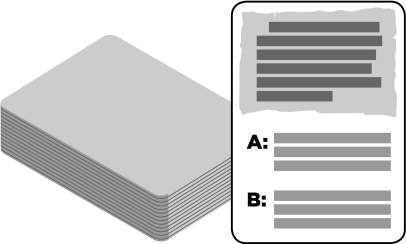
Multiple action options are presented to the players via a narrative format.
Discussion
With the rise of Dungeons & Dragons in the 1970s, game designers looked for new ways to incorporate storytelling into game design. One of the earliest to do this was the late-1970s Choose Your Own Adventure book series, which began with The Cave of Time. In this series, at the end of short chapters, the reader would be presented with a series of choices, which would lead to other pages, and ultimately a good or bad conclusion. This system has been adopted as part of more traditional tabletop games, with an early example being Tales of the Arabian Nights. In this game, after moving to a space, players are directed to read a numbered paragraph in a large book to reveal what adventure the character is experiencing. These vignettes offer choices of actions for the players, for example, “Bribe the Guard” or “Fight Your Way In.” These lead to other numbered paragraphs, which give the result, and their impact on the game state. Frequently, these systems use Stat Checks (RES-02) to determine the out-come. For example, if you choose to “Fight Your Way In,” you may need to make a check against Strength or some other ability. You will proceed to different paragraphs depending on the outcome. Sometimes, not all the actions will be available to you unless you previously found some item or built up some stat to a sufficient level.
The strength of this mechanism is in the ability to bring a more structured narrative and flavor to the game, without the players needing to create a narrative from abstract game elements. However, the weakness of Narrative Choice systems is that the adventures they present can be disconnected from the main course of the game and thus can lack context. Arabian Nights ties the adventure to the player through the use of different environments (sea, desert, etc.) and player status (married, despondent, cursed) that impact the adventures. But the adventures themselves do not combine into a single coherent narrative. Dead of Winter: A Crossroads Game attempts to deal with this contextual issue by the Crossroads mechanism. The player to the right of the active player draws a Crossroads card that applies to that turn. The card begins with an action trigger, such as entering a certain location, which is not revealed to the phasing player. If the player takes the trigger action, the Crossroads cardholder interrupts the action and presents the mini-adventure to the player. This means that the game designer can write an adventure knowing, for example, that it will specifically take place at a certain location. This mechanism has two different implementations that are worth noting. In the tabletop version, the Crossroads cards were written so that players were told what the outcome of each choice would be prior to making the choice. In a digital implementation, the outcome of each choice is hidden from the players. This is another example of input vs. output randomness, but in the context of making a meaningful narrative choice, hiding the mechanical, in-game out-comes creates a more character-driven experience. Games such as Ambush! and Action Castle maintain narrative cohesion at the expense of replayability. In these games, players are presented with specific triggers or situations. For example, in Ambush!, moving into a specific space during a certain stage of the mission will always trigger the same paragraph to be read. Action Castle emulates computer adventure games and has players interact with the game via short phrases (such as “take sword”), but the same phrases will always work the same way in the same situation. Other games strive to maintain cohesion by locking narrative choices so they only appear at specified times. In Near and Far, some of the narrative passages are tied to the game’s campaign mode to preserve a more cohesive story. Risk Legacy uses a gating mechanism (see “ACT-15” in this chapter) to ensure that specific story beats are only revealed once players have progressed the campaign sufficiently to make the story fit. Legacy of Dragonholt, a role-playing-style game, is built nearly entirely on the Narrative Choice mechanism. A tracker sheet for both the characters and the scenario allows for lots of stat-checking to determine progress. Scenarios often
come with a map of areas to visit. Each area, when visited, will have different options open to the players based on a few factors. If you come to a store at night, the store will be closed. If you go to market on market day, there will be lots to explore. In addition to tracking time of day and day of the week, players also track when they complete specific story points, as instructed by the game book. These story points create a kind of memory for the system, so options presented to players may depend on their having marked a specific story point. If, for example, the innkeeper goes missing, the game will instruct players to mark, say, story point B7. Later options might direct players to read different texts if point B7 is marked, to ensure that there is story continuity and that the innkeeper who went missing isn’t behind the bar the next morning. Legacy of Dragonholt shares more in common with pencil-and-paper interactive fiction books than with traditional tabletop board games, but it is an excellent example of how flexible the Narrative Choice mechanism can be.
Sample Games
Above and Below (Laukat, 2015) Action Castle (Soren, 2009) Ambush! (Butterfield and Smith, 1983) The Cave of Time (Packard, 1979) Choose Your Own Adventure: House of Danger (Uncredited, 2018) Dead of Winter: A Crossroads Game (Gilmour and Vega, 2014) Dungeons & Dragons (Arneson and Gygax, 1977) Legacy of Dragonholt (Valens, Clark, Flanders, Mitsoda, and Spyridis, 2017) Near and Far (Laukat, 2017) Risk Legacy (Daviau and Dupuis, 2011) Tales of the Arabian Nights (Freeman, Goldberg, Kaufman, Maroney, and Rolston, 1985)
描述
通过叙事格式向玩家展示多个动作选项。
讨论
随着20世纪70年代《龙与地下城》(Dungeons & Dragons)的兴起,游戏设计师寻找将故事讲述融入游戏设计的新方法。这方面最早的尝试之一是70年代后期的《惊险岔路口》(Choose Your Own Adventure)系列丛书,该系列始于《时间之洞》(The Cave of Time)。在这个系列中,在短章的结尾,读者会面临一系列选择,这会导致其他页面,并最终导致好或坏的结局。该系统已被采纳为更传统的桌面游戏的一部分,早期的例子是《一千零一夜》(Tales of the Arabian Nights)。在这个游戏中,移动到一个空间后,玩家被指示阅读一本大书中的编号段落,以揭示角色正在经历什么冒险。这些小插图为玩家提供动作选择,例如“贿赂守卫”或“杀进去”。这些导致其他编号段落,给出结果及其对游戏状态的影响。通常,这些系统使用统计检查(Stat Checks, RES-02)来确定结果。例如,如果你选择“杀进去”,你可能需要对力量或其他能力进行检查。根据结果,你将进入不同的段落。有时,除非你之前找到了某些物品或将某些属性提升到足够水平,否则并非所有动作都对你可用。
这种机制的优势在于能够为游戏带来更有条理的叙事和风味,而无需玩家通过抽象的游戏元素创造叙事。然而,叙事选择系统的弱点在于他们呈现的冒险可能与游戏的主要进程脱节,因此可能缺乏背景。《一千零一夜》通过使用不同的环境(海洋、沙漠等)和影响冒险的玩家状态(已婚、沮丧、诅咒)将冒险与玩家联系起来。但冒险本身并没有结合成一个连贯的叙事。《死冬:十字路口游戏》(Dead of Winter: A Crossroads Game)试图通过十字路口机制来解决这个背景问题。活跃玩家右边的玩家抽取一张适用于该回合的十字路口卡。卡片以一个动作触发器开始,例如进入某个位置,这对当前玩家不透露。如果玩家采取触发动作,十字路口持卡人打断动作并将迷你冒险呈现给玩家。这意味着游戏设计师可以编写冒险,例如知道它将专门发生在某个位置。这个机制有两个值得注意的不同实现。在桌面版本中,十字路口卡的编写方式是,在做出选择之前告诉玩家每个选择的结果是什么。在数字实现中,每个选择的结果对玩家是隐藏的。这是输入与输出随机性的另一个例子,但在做出有意义的叙事选择的背景下,隐藏游戏内的机械结果创造了更多角色驱动的体验。诸如《埋伏!》(Ambush!)和《行动城堡》(Action Castle)之类的游戏以牺牲可重玩性为代价保持叙事连贯性。在这些游戏中,玩家会面临特定的触发器或情况。例如,在《埋伏!》中,在任务的某个阶段进入特定空间总是会触发阅读同一段落。《行动城堡》模仿计算机冒险游戏,让玩家通过短语(如“拿剑”)与游戏互动,但在相同的情况下,相同的短语总是以相同的方式工作。其他游戏努力通过锁定叙事选择来保持连贯性,使它们只在指定时间出现。在《近远》(Near and Far)中,一些叙事段落与游戏的战役模式相关联,以保留更具凝聚力的故事。《风险:传承》(Risk Legacy)使用门控机制(见本章中的“ACT-15”)来确保特定的故事节拍仅在玩家充分推进战役以使故事适合时才被揭示。《巨龙霍尔特的遗产》(Legacy of Dragonholt)是一款角色扮演风格的游戏,几乎完全建立在叙事选择机制之上。角色和场景的追踪表允许大量的统计检查来确定进度。场景通常
随附一张要访问的区域地图。每个区域在被访问时,会根据几个因素向玩家开放不同的选项。如果你在晚上来到商店,商店会关门。如果你在集市日去市场,会有很多东西可以探索。除了跟踪一天中的时间和星期几外,玩家还按照游戏书的指示跟踪他们何时完成特定的故事点。这些故事点为系统创造了一种记忆,因此呈现给玩家的选项可能取决于他们是否标记了特定的故事点。例如,如果店主失踪了,游戏会指示玩家标记,比如说,故事点B7。稍后的选项可能会指示玩家在标记了点B7的情况下阅读不同的文本,以确保故事的连续性,并确保失踪的店主第二天早上不在酒吧后面。《巨龙霍尔特的遗产》与纸笔互动小说书的共同点比与传统桌面棋盘游戏的共同点更多,但它是叙事选择机制有多灵活的一个很好的例子。
游戏范例
Above and Below (Laukat, 2015) - 《地上地下》 Action Castle (Soren, 2009) - 《行动城堡》 Ambush! (Butterfield and Smith, 1983) - 《埋伏!》 The Cave of Time (Packard, 1979) - 《时间之洞》 Choose Your Own Adventure: House of Danger (Uncredited, 2018) - 《仅仅是冒险:险屋》 Dead of Winter: A Crossroads Game (Gilmour and Vega, 2014) - 《死冬:十字路口游戏》 Dungeons & Dragons (Arneson and Gygax, 1977) - 《龙与地下城》 Legacy of Dragonholt (Valens, Clark, Flanders, Mitsoda, and Spyridis, 2017) - 《巨龙霍尔特的遗产》 Near and Far (Laukat, 2017) - 《近远》 Risk Legacy (Daviau and Dupuis, 2011) - 《风险:传承》 Tales of the Arabian Nights (Freeman, Goldberg, Kaufman, Maroney, and Rolston, 1985) - 《一千零一夜》