Description
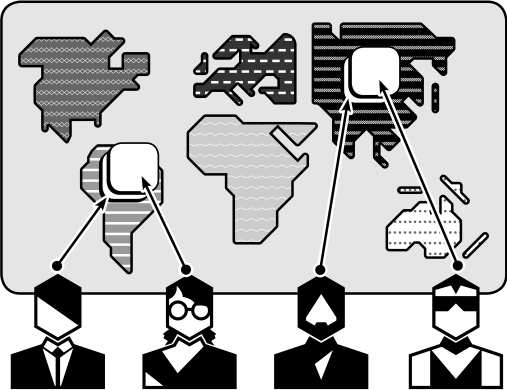
Players place Order Tokens into regions, indicating what they want to do in that particular region of the board. After all the tokens are placed, they are executed in sequence.
Discussion
This mechanism combines an Interleaved Turn Structure (TRN-15) with an Action Queue. Players are in essence creating multiple Interleaved Action Queues during a planning step and then resolving them. The tokens are typically placed face down, so opponents know where you are planning to act but not which actions you will take. If more than one order may be placed in a location, tokens are stacked to indicate their sequence. Because players alternate placing orders into different areas, they must balance a variety of factors. Which actions do they wish to perform early? Will committing to a region alert an opponent to your intentions to operate there? What actions are the opponents planning? The resolution of the Order Token stacks can be performed in several ways. First, they may either be resolved from the top down, so that tokens that were placed last are resolved first (LIFO, Last-In-First-Out),
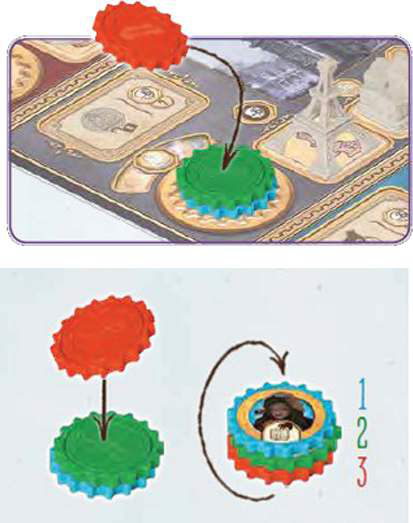
or the token stack may be flipped over, so that the earliest tokens are resolved first (FIFO, First-In-First-Out). Some games (such as A Game of Trones: The Board Game) don’t consider the placement order of the tokens and simply turn them all over and resolve them in turn order, over the course of three phases. Only tokens of particular types may be resolved in each phase, so in the Raid phase, only Raid tokens may be executed, and players who have not played any Raids are skipped in the turn order (Illustration 3.6). Resolution order has a great impact on the strategy and feel for placement. LIFO gives the game a “chicken” feel, as players want to be the last into a region with key actions so that they are executed first, but it also increases cognitive load, as players need to remember the reverse order of tokens in the stack and modify their plans as they go. With a FIFO structure, players can gradually just build up their plans in their minds as they proceed, which is less cognitively taxing. Illustration 3.6 In Victorian Masterminds, players place order tokens face down in different areas, stacking them on top of other tokens already there. When there are three tokens in an area (image 2), the stack is flipped over, and they are resolved in a first-in-first-out order.
Either way, this is a moderately complex mechanism, which is best reserved for heavier strategy games.
Sample Games
Forbidden Stars (Bailey, Kniffen, and Konieczka, 2015) A Game of Trones (Petersen and Wilson, 2003) Starcraft: The Board Game (Konieczka and Petersen, 2007) Victorian Masterminds (Bauza and Lang, 2019)
描述
玩家将命令标记(Order Tokens)放置到区域中,表明他们想在版图的特定区域做什么。所有标记放置完毕后,按顺序执行。
讨论
这一机制结合了交错回合结构(TRN-15)与动作队列。玩家本质上是在规划步骤中创建多个交错动作队列,然后解决它们。标记通常面朝下放置,因此对手知道你计划在哪里行动,但不知道你会采取哪些行动。如果可以在一个位置放置多个命令,则堆叠标记以指示其顺序。因为玩家轮流将命令放置到不同区域,他们必须平衡各种因素。他们希望尽早执行哪些行动?致力于一个区域是否会警示对手你打算在那里行动?对手计划什么行动?命令标记堆的解决可以通过几种方式进行。首先,它们可以从上到下解决,这样最后放置的标记最先解决(后进先出,LIFO),
或者标记堆可以翻转过来,以便最早的标记最先解决(先进先出,FIFO)。有些游戏(如《权力的游戏:版图版》)不考虑标记的放置顺序,只是将它们全部翻转并在三个阶段的过程中按回合顺序解决。每个阶段只能解决特定类型的标记,因此在袭击阶段,只能执行袭击标记,没有打出任何袭击的玩家在回合顺序中被跳过(插图3.6)。解决顺序对策略和放置感觉有很大影响。后进先出(LIFO)给游戏一种“胆小鬼博弈”(chicken)的感觉,因为玩家想成为最后一个进入关键行动区域的人,以便它们最先执行,但这同时也增加了认知负荷,因为玩家需要记住堆栈中标记的反向顺序并在进行时修改他们的计划。使用先进先出(FIFO)结构,玩家可以随着进行在脑海中逐渐建立他们的计划,这在认知上不那么繁重。
插图 3.6 在《维多利亚主谋》(Victorian Masterminds)中,玩家将命令标记面朝下放置在不同区域,堆叠在该处已有的其他标记之上。当一个区域有三个标记时(图2),堆栈翻转过来,并按先进先出的顺序解决。
无论哪种方式,这都是一种中等复杂的机制,最好留给较重度的策略游戏。
游戏范例
Forbidden Stars (Bailey, Kniffen, and Konieczka, 2015) - 《禁星》 A Game of Trones (Petersen and Wilson, 2003) - 《权力的游戏》 Starcraft: The Board Game (Konieczka and Petersen, 2007) - 《星际争霸:图版游戏》 Victorian Masterminds (Bauza and Lang, 2019) - 《维多利亚主谋》