Description
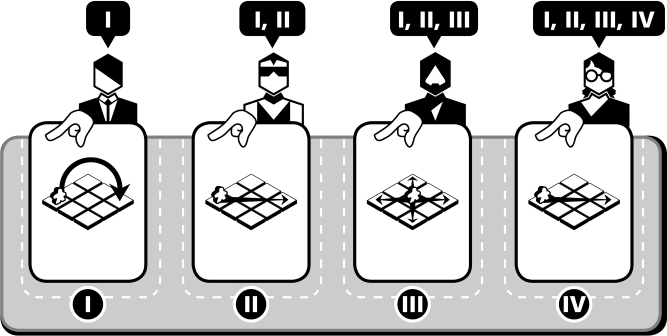
All players add Actions to a central Action Queue. Actions in the Queue are performed by all players.
Discussion
This is a variation on the standard Action Queue mechanism. Here, on their turn, a player adds one or more Actions to the end of a queue shared by all players and then executes the full queue from start to finish. This system increases interactivity, as players plan actions not just for themselves but also for their opponents. It gives a different flavor of strategic options, as players attempt to plan actions that will benefit them more than their opponents. Sequencing may also play a role, as players may be out of position to execute an earlier action, a deficiency that cascades throughout the queue, as the effectiveness of later actions depends on having executed the earlier actions. The two-player game Major General: Duel of Time takes this a step further by including two actions on each card played, one for each player. It is also unique in that actions may be placed anywhere in the queue, not just at the end. After playing an action, the player executes actions from the end of the queue closest to them. On their opponent’s turn, they will resolve the actions in the opposite order and using the other actions on the cards.
Each turn in Mottainai, a player plays a card in front of them that allows the taking of a particular action. However, before performing it, the player first performs the actions in front of each opponent, going clockwise and ending with themselves. This is similar to Follow (ACT-08), except that the opponent’s chosen actions are executed on your turn, not on the opponent’s turn. A variation on a Shared Action Queue is used in Kraftwagen, which has a queue of action tokens, trailed by a queue of player markers. The player at the end of the queue may move to any position and execute the Action of the token in that position. However, the farther ahead the person moves, the longer it will be until they are once again at the end, and in position to take a new action. Kraftwagen blends a Shared Action Queue with a Time Track (TRN-13).
Sample Games
Impulse (Chudyk, 2013) Kraftwagen (Cramer, 2015) Major General: Duel of Time (Liu, Moorman, Yeong, and Zhao, 2017) Mottainai (Chudyk, 2015)
描述
所有玩家向中央动作队列添加动作。队列中的动作由所有玩家执行。
讨论
这是标准动作队列机制的一种变体。在这里,在他们的回合中,玩家将一个或多个动作添加到所有玩家共享的队列末尾,然后从头到尾执行完整的队列。该系统增加了互动性,因为玩家不仅为自己也为对手计划动作。它赋予了不同的战略选择风味,因为玩家试图计划比对手受益更多的动作。排序也可能发挥作用,因为玩家可能位置不佳无法执行较早的动作,这种缺陷会在整个队列中级联,因为较后动作的有效性取决于执行了较早的动作。双人游戏《少将:时间决斗》(Major General: Duel of Time)通过在每张打出的牌上包含两个动作(每个玩家一个)更进了一步。它的独特之处还在于动作可以放置在队列的任何位置,而不仅是末尾。打出一个动作后,玩家从离他们最近的队列末端执行动作。在对手的回合,他们将以相反的顺序解决动作并使用卡牌上的另一个动作。
在《Mottainai》的每一回合,玩家在自己面前打出一张牌,允许采取特定的动作。然而,在执行它之前,玩家首先执行每个对手面前的动作,顺时针方向,最后以自己结束。这类似于跟随(ACT-08),除了对手选择的动作是在你的回合执行,而不是在对手的回合。在《汽车制造厂》(Kraftwagen)中使用了共享动作队列的一种变体,它有一个动作标记队列,后面跟着一个玩家标记队列。队列末尾的玩家可以移动到任何位置并执行该位置标记的动作。然而,人移动得越远,直到他们再次处于末尾并处于采取新动作的位置所需的时间就越长。《汽车制造厂》将共享动作队列与时间轨迹(TRN-13)混合在一起。
游戏范例
Impulse (Chudyk, 2013) - 《冲动》 Kraftwagen (Cramer, 2015) - 《汽车制造厂》 Major General: Duel of Time (Liu, Moorman, Yeong, and Zhao, 2017) - 《少将:时间决斗》 Mottainai (Chudyk, 2015) - 《Mottainai》