Definition Players slide a token, and other tokens ahead of it are pushed.
Discussion
Slide/Push can be broadly broken up into two main categories: quantized and freeform. Quantized slides have the pieces move to specific locations, while freeform allows the pieces to move anywhere on the play surface. The classic abstract Abalone is a good example of a quantized slide mechanism. Marbles are placed onto a hexagonal grid, and a turn consists of pushing a marble in a chosen direction. The marble will push other marbles ahead of it. Marbles always settle into specific grooves, marking a delimited play area with a set number of spaces. Another example of quantized sliding is Masters of Renaissance: Lorenzo il Magnifico – The Card Game (quite the game name!), which has a 4×3 tray grid where differently colored marbles are placed. Each turn, the active player selects a row or column and gains resources based on the colors. Tey then take a spare marble and push it in the chosen row or column, changing the configuration for the next player. The player needs to consider not just what they want but also the position it will leave for the next player. There are several gameplay considerations for slide mechanisms. The first we will look at is the number of pushing axes that are used. Being on a hexagonal grid, Abalone has three axes of slide movement. Masters of Renaissance, sliding on a rectangular grid, has two axes of slide
movement. There are also games that have a single axis of slide movement, with pieces pushing in a line, almost as a queue. An example of this is Panamax, which is about transiting the Panama Canal. In this game, players control container ships attempting to move through the canal. In the narrow canal zones, ships may not pass each other. Terefore, when a ship at the back of the line is moved, it also moves the ships ahead of it. Positioning your ships so that other players will move them for you by pushing their ships behind yours is a key strategy. In general, increasing the number of axes increases player options. This can make decision-making more complex and adds to the weight of the game. These three examples also illustrate very different features that Slide/Push can bring to player interaction. In Abalone, the players may push in a variety of directions and can become intricately entangled. The goal is to push the opponent’s marbles off the edge, so keeping marbles in the center of the board is important, and in general, tactical placement considerations are paramount. In Masters of Renaissance, the player interaction is indirect, and each time the grid is pushed, a marble will fall off and be recycled. The removal of a marble is very transient—it will be reintroduced into the grid the next turn. This creates a lower-key interaction than Abalone, as it is not the player’s pieces that are being slid. The mechanism creates a constrained way for players to impact resource collection. A similar approach can be found in Ulm, where players slide action tiles into a 3×3 grid and take all three actions in the row or column they pushed into, including the tile they added. The tile that is pushed out of the grid does not activate. Finally, the player interaction in Panamax is progressive in that it pushes another player’s ship forward, which is always beneficial to that player and helps the ship progress towards scoring by providing it a free move. This interaction gives Panamax a bit of a taste of playing “Chicken,” as players try to make their opponents’ actions benefit them too. In Abalone, by contrast, sliding is never intended to benefit the other player, and making such a move is a blunder. Note, however, that this is a function of the zero-sum nature of a two-player game, rather than an inherent characteristic of the mechanism. A key design decision that impacts the nature of the slide mechanism significantly is what happens to pieces that are pushed off the grid. Often, these pieces are eliminated or scored. However, it is possible to reintroduce them back into the grid immediately into the now-vacated position (a wraparound effect) or on a future turn. In Ulm, for example, players can collect these tokens and reintroduce them to the grid later or spend them for other benefits as part of a different subsystem in the game’s economy.
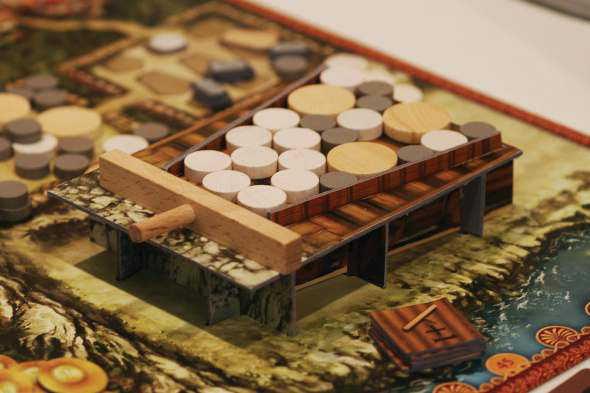
Freeform Slide does not have a specific grid where pieces move. Instead, there is an open surface where pieces can be pushed, collide, and react in a freeform way. Many bear a similarity to the arcade “penny pusher” machines, where a coin or token is dropped onto a surface and a mechanical arm pushes them forward, and the player keeps any coins that get pushed off the edge. An early example of this is Niagara. In this game, the player’s canoes are placed on acrylic disks onto a “river” track with raised sides. As more disks are added, the canoes move closer to the waterfall at the edge of the track and eventually will fall off. More recent examples are Kabuto Sumo and Redcap Ruckus, where disks of various sizes are pushed onto a raised platform. Players are attempting to knock their opponent’s disks off the platform. Another is Via Appia, where players push disks of different sizes into a quarry. Tey then gain resources based on the disks that fall off the edge. A key design feature of these games is to introduce uncertainty into the pushing. You cannot be sure what is going to fall off the edge, and this can lead to a lot of excitement and surprising situations. The figure showing Via Appia illustrates this nicely. Note that the sides of the quarry flare outwards as they near the edge of the platform. This adds a healthy dose of uncertainty to what will fall off, far more than a straight chute would provide (Illustration 3.10). Illustration 3.10 The Quarry in Via Appia. Players insert a disk into the narrow end and get all disks that fall out the wide end. The angled sides make the outcome less predictable. Photo by Daniel Danzer.
The designer needs to take care to create physics that emphasize these features. Having pieces of various sizes, shapes, and weights; having uneven or curved edges; and constraining how players introduce new pieces onto the platform (e.g., with pushing sticks, at certain entry points) will all help to enhance the uncertainty. Physical prototyping will be more important than usual with this style of Slide/Push.
Sample Games
Quantized Abalone (Lalet, Levi, 1987) Black Angel (Dujardin, Georges, Orban, 2019) Masters of Renaissance: Lorenzo il Magnifico – The Card Game (Luciani, Mangone, 2019) Panamax (d’Orey, Sentiero, Soledade, 2014) Ulm (Burkhardt, 2016) Freeform Kabuto Sumo (Miller, 2021) Niagra (Liesching, 2004) Redcap Ruckus (Ude, 2021) Via Appia (Feldkötter, 2013)
定义 玩家滑动一个标记,其前方的其他标记被推动。
讨论
滑动/推动(Slide/Push)可以大致分为两个主要类别:量化和自由形式。量化滑动让棋子移动到特定位置,而自由形式允许棋子在游戏表面上的任何地方移动。经典的抽象游戏《Abalone》是量化滑动机制的一个很好的例子。玻璃球被放置在一个六角网格上,一个回合包括向选定的方向推动一个玻璃球。玻璃球会推动其前方的其他玻璃球。玻璃球总是落入特定的凹槽中,标志着一个具有设定数量空间的划定游戏区域。量化滑动的另一个例子是《文艺复兴大师:华丽的洛伦佐——纸牌游戏》(名字真长!),它有一个4×3的托盘网格,上面放置着不同颜色的玻璃球。每回合,活跃玩家选择一行或一列,并根据颜色获得资源。然后他们拿一个备用玻璃球推向选定的行或列,为下一个玩家改变配置。玩家不仅需要考虑他们想要什么,还需要考虑它将为下一个玩家留下的位置。滑动机制有几个游戏考量。我们首先要看的是使用的推动轴的数量。由于是在六角网格上,《Abalone》有三个滑动运动轴。《文艺复兴大师》在矩形网格上滑动,有两个滑动轴
运动。也有一些游戏具有单一的滑动运动轴,棋子排成一行推动,几乎像一个队列。这类游戏的一个例子是《巴拿马运河》(Panamax),这是关于通过巴拿马运河过境的。在这个游戏中,玩家控制试图通过运河的集装箱船。在狭窄的运河区域,船只不能互相通过。因此,当队列后面的船移动时,它也会移动前面船只。定位你的船只,使其他玩家通过在你的船后面推他们的船来为你移动船只,是一个关键策略。通常,增加轴的数量会增加玩家的选择。这会使决策更加复杂,并增加游戏的份量。这三个例子也说明了滑动/推动可以给玩家互动带来的非常不同的特征。在《Abalone》中,玩家可以向各种方向推动,并且可能会错综复杂地纠缠在一起。目标是将对手的玻璃球推离边缘,因此将玻璃球保持在版图中心很重要,总的来说,战术位置考虑至关重要。在《文艺复兴大师》中,玩家互动是间接的,每次推动网格时,一个玻璃球会掉落并被回收。移除玻璃球是非常短暂的——它将在下一回合重新引入网格。这创造了比《Abalone》更低调的互动,因为被滑动的不是玩家的棋子。该机制为玩家创造了一种受限的方式来影响资源收集。在《乌尔姆》(Ulm)中可以找到类似的方法,玩家将动作板块滑入3×3网格,并采取他们推入的行或列中的所有三个动作,包括他们添加的板块。被推出网格的板块不会激活。最后,《巴拿马运河》中的玩家互动是渐进的,因为它推动另一名玩家的船向前,这对该玩家总是有益的,并通过提供免费移动帮助船只向得分前进。这种互动给《巴拿马运河》带来了一点“胆小鬼博弈”的味道,因为玩家试图让对手的动作也使他们受益。相比之下,在《Abalone》中,滑动从来不是为了让另一名玩家受益,做出这样的举动是一个失误。然而,请注意,这是双人零和游戏性质的功能,而不是该机制的固有特征。影响滑动机制性质的一个关键设计决策是被推离网格的棋子会发生什么。通常,这些棋子会被消除或得分。然而,也可以将它们立即重新引入网格中现在空出的位置(环绕效应)或在未来的回合重新引入。例如在《乌尔姆》中,玩家可以收集这些标记并稍后将它们重新引入网格,或者作为游戏经济中不同子系统的一部分花费它们以获得其他利益。
自由形式滑动没有棋子移动的特定网格。相反,有一个开放的表面,棋子可以在其中被自由形式地推动、碰撞和反应。许多类似于街机“推币机”,硬币或代币被扔到表面上,机械臂推动它们向前,玩家保留任何被推离边缘的硬币。这方面的一个早期例子是《尼加拉瓜》(Niagara)。在这个游戏中,玩家的独木舟被放置在亚克力圆盘上,进入带有凸起侧面的“河流”轨道。随着更多圆盘的添加,独木舟移动到轨道边缘的瀑布附近,最终会掉下来。最近的例子是《兜兜相扑》(Kabuto Sumo)和《Redcap Ruckus》,各种大小的圆盘被推到凸起的平台上。玩家试图将对手的圆盘撞下平台。另一个是《Appia》,玩家将不同大小的圆盘推入采石场。然后他们根据从边缘掉落的圆盘获得资源。这些游戏的一个关键设计特征是在推动中引入不确定性。你不能确定什么会掉下边缘,这会导致很多兴奋和令人惊讶的情况。《Appia》的图片很好地说明了这一点。请注意,采石场的侧面在接近平台边缘时向外张开。这给掉落物增加了很大程度的不确定性,远比直滑槽提供的要多(插图3.10)。
插图 3.10 《Appia》中的采石场。玩家将圆盘插入窄端,并获得所有从宽端掉出的圆盘。成角度的侧面使得结果更不可预测。摄影:Daniel Danzer。
设计师需要注意创造强调这些特征的物理学。拥有各种尺寸、形状和重量的棋子;拥有不平坦或弯曲的边缘;以及限制玩家如何将新棋子引入平台(例如,使用推杆,在特定入口点)都将有助于增强不确定性。这种风格的滑动/推动使得物理原型的制作比平时更重要。
游戏范例
Quantized Abalone (Lalet, Levi, 1987) - 《大鲍鱼/Abalone》 Black Angel (Dujardin, Georges, Orban, 2019) - 《黑天使号》 Masters of Renaissance: Lorenzo il Magnifico – The Card Game (Luciani, Mangone, 2019) - 《文艺复兴大师》 Panamax (d’Orey, Sentiero, Soledade, 2014) - 《巴拿马运河》 Ulm (Burkhardt, 2016) - 《乌尔姆》 Freeform Kabuto Sumo (Miller, 2021) - 《兜兜相扑》 Niagra (Liesching, 2004) - 《尼加拉瓜》 Redcap Ruckus (Ude, 2021) - 《Redcap Ruckus》 Via Appia (Feldkötter, 2013) - 《Appia》