Description
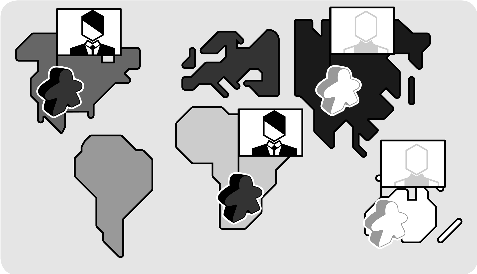
One player has Absolute Control of an area.
Discussion
Absolute Control games, which are frequently referred to as Area Control games, have territories with a binary character: controlled by a single player or uncontrolled. Controlled territories typically only contain one player’s units, and other players are barred from co-existing in that territory. This type of control can be seen in Risk, where attempting to move into enemyoccupied territories triggers a battle. This is as distinct from games like Chess or Onitama, where a piece might project force across other spaces but can never protect the space it occupies itself and is simply captured when another piece enters its space. This is further distinct from games in which multiple factions can share a territory without triggering a confrontation, like Root. This observation leads us to another element of an area more generally, which is that it’s important to know who controls the space, because the space occupied provides benefits, gives access to certain abilities, or produces resources. The reason to occupy the space is not simply tactical and positional. In Axis & Allies, spaces produce industrial production credits that can be used to buy new units. In Small World, territories may have different features like hills or mines, which may trigger specific effects or abilities, including bonus scoring. Many games allow players to control a territory even though they have evacuated the units within it. Typically, these are marked with a “control
token” or something similar to indicate ownership of the area, like Axis & Allies. However, some games, like Diplomacy, do not do this but rely on the players to remember which spaces are controlled. In Diplomacy, this is not much of a hardship because control only matters to special Supply Center spaces, and there are few of those. The last player to control a non-Supply Center space has no impact on the game. Another consideration is how areas change control. The most common is occupation by units. However, some games allow control to transfer without units, such as through diplomacy actions in Pax Britannica and Divine Right. In the latter, neutral countries (composed of many spaces) may be persuaded to join a player’s side, in which case, all the areas pass to the control of that player. Similarly, they can revert to neutral status or control of another player. Diplomacy only allows Supply Centers to change control every second turn, which gives players more time and space to maneuver.
Sample Games
Axis & Allies (Harris, Jr., 1981) Chess (Unknown, ∼1200) Diplomacy (Calhamer, 1959) Divine Right (Rahman and Rahman, 1979) Onitama (Sato, 2014) Pax Britannica (Costikyan, 1985) Risk (Lamorisse and Levin, 1959) Root (Werle, 2018) Small World (Keyaerts, 2009)
描述
一名玩家对一个区域拥有绝对控制权(Absolute Control)。
讨论
绝对控制游戏,常被称为区域控制(Area Control)游戏,具有二元特征的领土:由单个玩家控制或不受控制。受控领土通常只包含一名玩家的单位,其他玩家被禁止在该领土共存。这种类型的控制可以在《风险》(Risk)中看到,试图进入敌人占据的领土会触发战斗。这与像国际象棋或《Onitama》这样的游戏不同,在这些游戏中,棋子可能会向其他空间投射力量,但永远无法保护它自己占据的空间,并且当另一个棋子进入其空间时就会被捕获。这进一步区别于多个派系可以共享一个领土而不会触发对抗的游戏,如《茂林源记》。这一观察将我们引向区域的另一个更普遍的元素,即知道谁控制了空间很重要,因为占据的空间提供利益,允许访问某些能力,或生产资源。占据空间的理由不仅仅是战术和位置上的。在《轴心国与同盟国》(Axis & Allies)中,空间产生工业生产信用,可用于购买新单位。在《小世界》(Small World)中,领土可能具有不同的特征,如山丘或矿山,这可能会触发特定的效果或能力,包括奖励得分。许多游戏允许玩家控制领土,即使他们已经撤离了其中的单位。通常,这些标有“控制
标记”或类似的东西来指示区域的所有权,就像《轴心国与同盟国》。然而,有些游戏,如《外交》(Diplomacy),不这样做,而是依赖玩家记住哪些空间被控制。在《外交》中,这不算太难,因为控制只对特殊的补给中心空间重要,而且数量很少。最后一个控制非补给中心空间的玩家对游戏没有影响。另一个考虑因素是区域如何改变控制权。最常见的是单位占领。然而,有些游戏允许在没有单位的情况下转移控制权,例如通过《不列颠治世》(Pax Britannica)和《君权神授》(Divine Right)中的外交行动。在后者中,中立国家(由许多空间组成)可能被说服加入玩家的一方,在这种情况下,所有区域都归该玩家控制。同样,它们可以恢复到中立状态或由另一名玩家控制。《外交》只允许补给中心每两回合改变一次控制权,这给了玩家更多的时间和空间来机动。
游戏范例
Axis & Allies (Harris, Jr., 1981) - 《轴心国与同盟国》 Chess (Unknown, ∼1200) - 《国际象棋》 Diplomacy (Calhamer, 1959) - 《外交》 Divine Right (Rahman and Rahman, 1979) - 《君权神授》 Onitama (Sato, 2014) - 《Onitama》 Pax Britannica (Costikyan, 1985) - 《不列颠治世》 Risk (Lamorisse and Levin, 1959) - 《风险》 Root (Werle, 2018) - 《茂林源记》 Small World (Keyaerts, 2009) - 《小世界》