Description
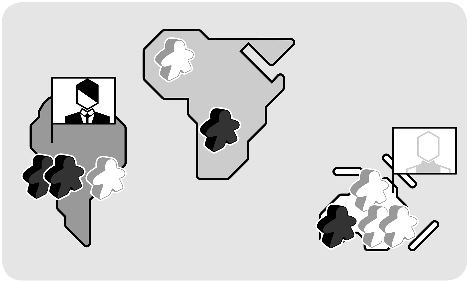
Multiple players may occupy a space and gain benefits based on their proportional presence in the space.
Discussion
An elegant example of European design sensibilities applied to Americanstyle conflict games is the area majority mechanism of El Grande. Each province is worth a different number of Victory Points (VPs) that will be awarded to the player with the most caballeros (soldiers) present in the province. Points are also awarded to the players with the second- and third-most caballeros in the region. Caballeros do not directly interact, and there is no conflict resolution mechanism of any kind. Instead, the game implements a Multiple-Lot simultaneous Auction (AUC-11) themed as a conflict game. The game is not won with tactical brilliance or a lucky streak of die-rolling but through efficiency in winning auctions for VPs. This idea of efficiency is clearer in an even older game from the late nineteenth century, Reversi. In Reversi, both players will, in turn, play 32 doublesided tokens to the board, flipping tokens of their opponent’s color when they lie in an orthogonal or diagonal line between the newly placed token and one or more anchoring tokens. The game is only scored after all tokens are laid down, with the player controlling the majority of the 64 spaces on the board being the victor. One could similarly envision Go as an area majority game, though it is strategically more of an area Enclosure game (RES-12).
In Twilight Struggle, players must not only have a majority of influence in a country in order to obtain control, but they must also have an edge over their opponent equal to the country’s stability number. Stable countries with dependable governments, like Japan, have a stability number of 4, while wartorn, weaker nations who were pawns in the global contest, like Lebanon, have a stability number of 1. Controlling a country grants a few benefits, including doubling the cost of your opponent adding influence to the country through normal operations. However, being on the short end of that influence battle isn’t all bad. As long as you had a presence in the country, you could spread influence to adjacent countries. This is a good example of how different levels of presence and domination of an area can offer different tactical and strategic advantages. The notable distinction of Area Majority games is that troops of opposing factions can co-exist in the same territory. In Inis, not only can opposing clansmen co-exist in the same space, there is even a victory condition which calls for sharing spaces with factions in six different territories. Relatedly, the combat mechanism of Inis allows for players to participate in a round or two of combat and then mutually agree to stop fighting, without withdrawing any troops. Civilization also allows for units from multiple players to co-exist in the same space as long as the total number of tokens does not exceed the food value. If it does, conflict occurs, but there is ample opportunity for peaceful co-occupation. Unlike Twilight Struggle and El Grande, there is no inherent benefit from having more tokens in a space in Civilization, unless combat breaks out. But it can serve as a base from which to expand. While some games allow fluidity to the states of control a territory may exhibit, other games have moments where control must crystallize and resolve in some way. While turn-based approaches are common, in which scoring happens at the end of the round or at the end of some specific rounds, other games tie triggering resolution to the size of the forces present in the territory. In Smash Up, each base has a trigger number. Once the sum of forces played to that base equals or exceeds the trigger number, the base is scored. Similarly, in Retreat to Darkmoor, the legendary hero attacks a line of fleeing villains when the sum of the threat values of the villains breaches the hero’s stability number. In Darkmoor, only those villains surviving the hero’s attack are placed in the haven, whose victory points they will score based on majorities at game-end. For more on this topic, see Chapter 4, “Resolution.” It is worth noting that in a standard Area Majority game, where rewards are granted based on the ownership of a space, ties need to be considered by
the designer. Some games use “friendly” ties, where all players tied for first, for example, receive first-place points. Other use “unfriendly” ties, where players tied for first are awarded second-place points. Other tie-breaking mechanisms (RES-18) are possible, such as priority tokens or simply not allowing players to create a tie.
Sample Games
Civilization (Tresham, 1980) El Grande (Kramer and Ulrich, 1995) Go (Unknown, 2200 bce) Inis (Martinez, 2016) Retreat to Darkmoor (Loomis and Shalev, 2016) Reversi (Mollet and Waterman, 1883) Smash Up (Peterson, 2012) Twilight Struggle (Gupta and Matthews, 2005)
描述
多名玩家可以占据同一空间,并根据他们在该空间中所占的比例获得收益。
讨论
将欧洲设计理念应用于美式冲突游戏的一个优雅范例是《大王》(El Grande)的区域多数机制。每个省份拥有不同数量的胜利点数(VP),这些点数将授予在该省份部署最多骑士(士兵)的玩家。拥有第二多和第三多骑士的玩家也将获得相应点数。骑士不直接互动,也不存在任何形式的冲突解决机制。相反,游戏实施了一个以冲突游戏为主题的多批次同时拍卖(AUC-11)。游戏的胜利不依赖于战术才能或掷骰运气,而是通过高效赢得VP拍卖。这种效率的理念在19世纪后期的一个更古老的游戏《黑白棋》(Reversi)中更为清晰。在《黑白棋》中,双方玩家轮流将32个双面棋子放置到棋盘上,当对手颜色的棋子位于新放置的棋子和一个或多个锚定棋子之间的正交或对角线上时,翻转这些对手颜色的棋子。游戏仅在所有棋子都放置完毕后才计分,控制棋盘上64个格子中多数的玩家获胜。人们也可以将围棋视为一种区域多数游戏,尽管从战略角度来看它更像是一种区域围占游戏(RES-12)。
在《冷战热斗》(Twilight Struggle)中,玩家不仅必须在某个国家拥有多数影响力才能获得控制权,而且还必须拥有等于该国稳定度数值的优势。拥有稳定政府的国家,如日本,稳定度为4,而在全球博弈中沦为棋子的战乱弱国,如黎巴嫩,稳定度为1。控制一个国家会带来一些好处,包括使对手通过常规行动向该国增加影响力的代价加倍。然而,在这场影响力竞争中处于劣势也并非全无益处。只要你在该国保有势力,就可以将影响力扩展到邻国。这是一个很好的例子,说明对一个区域不同程度的存在和控制会带来不同的战术和战略优势。区域多数游戏的显著特点在于,敌对派系的部队可以在同一领土内共处。在《Inis》中,不仅敌对氏族的成员可以在同一空间共处,甚至有一个胜利条件要求与不同派系在六个不同领土中共享空间。与此相关,《Inis》的战斗机制允许玩家参与一两轮战斗后,双方同意停战,而不撤回任何部队。《文明》(Civilization)也允许来自多个玩家的单位在同一空间共存,只要棋子总数不超过食物产量。如果超过,就会发生冲突,但和平共处的机会很充分。与《冷战热斗》和《大王》不同,除非爆发战斗,否则在《文明》中在一个空间拥有更多棋子并无固有优势。但可以作为扩张的据点。虽然有些游戏允许领土的控制状态保持流动性,但其他游戏会在特定时刻要求控制权必须明确并以某种方式结算。虽然回合制是常见的方式,即在回合结束或特定回合结束时进行计分,但其他游戏将结算触发与领土内部队规模关联起来。在《大杀四方》(Smash Up)中,每个基地都有一个触发值。一旦部署到该基地的部队总和达到或超过触发值,该基地就会计分。同样,在《Retreat to Darkmoor》中,当逃跑恶棍的威胁值总和超过英雄的稳定值时,传奇英雄会攻击这排逃跑的恶棍。在《Darkmoor》中,只有在英雄攻击中幸存的恶棍才会被安置在避难所,他们的胜利点数将根据游戏结束时的多数情况计算。关于这一主题的更多信息,请参阅第4章,“解决”。值得注意的是,在标准的区域多数游戏中,奖励基于空间的所有权分配,平局需要考虑
设计师。有些游戏使用“友好”平局,例如所有并列第一的玩家都获得第一名的得分。其他使用“不友好”平局,将并列第一的玩家授予第二名的得分。其他打破平局的机制(RES-18)也是可能的,例如优先级标记或干脆不允许玩家出现平局。
游戏范例
Civilization (Tresham, 1980) - 《文明》 El Grande (Kramer and Ulrich, 1995) - 《大王》 Go (Unknown, 2200 bce) - 《围棋》 Inis (Martinez, 2016) - 《Inis》 Retreat to Darkmoor (Loomis and Shalev, 2016) - 《Retreat to Darkmoor》 Reversi (Mollet and Waterman, 1883) - 《黑白棋》 Smash Up (Peterson, 2012) - 《大杀四方》 Twilight Struggle (Gupta and Matthews, 2005) - 《冷战热斗》