Description
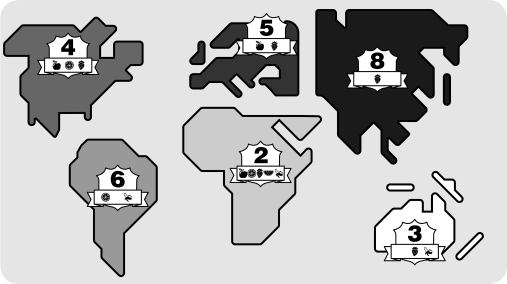
In Area control games, Parameters are assigned to regions that impact why players might wish to control them and how they need to allocate resources to do so.
Discussion
The most common Area Parameters are the rewards gained for controlling areas. Tose could be VPs, which are awarded to the majority owner in El Grande or to a single owner in King of Tokyo. Other common rewards include resources, like in Nexus Ops, and access to special powers, like in Alien Frontiers. As previously discussed, access to adjacent territories can also be considered a special ability. Exploration games like The 7th Continent and dungeon crawlers like Descent: Journeys in the Dark will pile on a variety of parameters onto the tiles that make up their game boards—though admittedly, this is stretching the notion of area control extremely thin, particularly in a co-op context. Memoir ’44 has various bonuses and penalties for attacking and defending in and out of certain types of terrain, as well as rules modifying movement for units moving through terrain. It is a good example of the flexibility of assigning Area Parameters (Illustration 11.3). Carcassonne extends the notion of Area Parameters by assigning parameters to different features on each tile. These parameters include point values and rules for when and how they can be scored. Tough we don’t typically
think of Carcassonne as an area control game or even a bidding game, both of those ideas find expression in its game engine. Placing a pawn takes control and represents a wager on the overall value of that feature when (and if!) it finally scores. Another important Area Parameter is unit limits. These limits, sometimes called stacking limits because they defined how many counters could be stacked on top of one another in hex-andcounter war games, establish a limit to the size of armies. Sometimes these limitations are global, as in Heroes of Land, Air & Sea, which has a five-unit limit on territories. Other times, the stacking limit is expressed as a matter of control limits: in Conquest of the Empire, a general can lead a legion of up to seven units. Some limits are enforced based on terrain and unit type. The most common examples are that naval vessels can’t enter land spaces, and conversely, land units can’t enter sea spaces. Advanced Squad Leader and other war games often assign units a “stacking value,” and each space can hold a maximum stacking total, which sometimes varies by terrain. Mountainous terrain often restricts mechanized unit movement, as in Memoir ’44, where only infantry can move through mountains, but artillery can be emplaced on mountains at setup. Line of sight is another Area Parameter, but one that is more connected to how units interact with one another across multiple areas, rather than being Illustration 11.3 A sample tile from The 7th Continent. The icons indicate actions that are available on the card, their costs, and other special features.
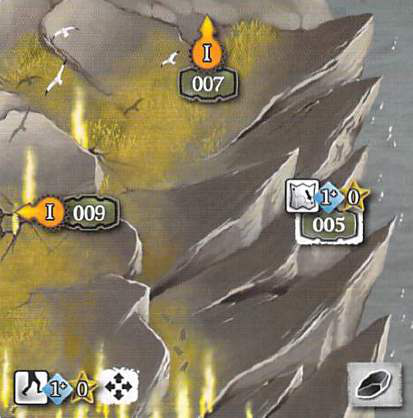
the quality of an area being occupied. We will address it in the section on Force Projection.
Sample Games
The 7th Continent (Roudy and Sautter, 2017) Advanced Squad Leader (Greenwood, 1985) Alien Frontiers (Niemann, 2010) Carcassonne (Wrede, 2000) Conquest of the Empire (Harris, Jr., 1984) Descent: Journeys in the Dark (Wilson, 2005) El Grande (Kramer and Ulrich, 1995) Heroes of Land, Air & Sea (Almes, 2018) King of Tokyo (Garfield, 2011) Memoir ’44 (Borg, 2004) Nexus Ops (Cantino and Kimball, 2005)
描述
在区域控制游戏中,参数(Parameters)被分配给区域,影响玩家为何希望控制它们以及他们需要如何分配资源来做到这一点。
讨论
最常见的区域参数是控制区域获得的奖励。这可能是授予《大王》(El Grande)中多数拥有者或《东京之王》(King of Tokyo)中单一拥有者的胜利点数(VP)。其他常见的奖励包括资源,如在《星海争霸》(Nexus Ops)中,以及获得特殊能力,如在《外星边境》(Alien Frontiers)中。正如前面所讨论的,进入相邻领土也可以被视为一种特殊能力。像《第七大陆》(The 7th Continent)这样的探索游戏和像《深入绝地:黑暗之旅》(Descent: Journeys in the Dark)这样的地牢爬行游戏会在构成其游戏版图的板块上堆积各种参数——尽管必须承认,这极其勉强地扩展了区域控制的概念,特别是在合作背景下。《大战回忆录》(Memoir ’44)对于在某些类型的地形内外进行攻击和防御有各种奖励和惩罚,以及修改穿过地形移动的单位的规则。这是分配区域参数灵活性的一个很好的例子(插图11.3)。《卡卡颂》(Carcassonne)通过将参数分配给每个板块上的不同特征来扩展区域参数的概念。这些参数包括分数值以及何时以及如何计分的规则。虽然我们通常不
认为《卡卡颂》是一个区域控制游戏甚至竞标游戏,但这两种想法都在其游戏引擎中找到了表达。放置一个棋子占据控制权,并代表了对该特征最终计分时(如果有的话!)总价值的赌注。另一个重要的区域参数是单位限制。这些限制有时被称为堆叠限制,因为它们定义了在六角格战棋中可以彼此堆叠多少个算子,从而限制了军队的规模。有时这些限制是全局的,如在《海陆空英雄》(Heroes of Land, Air & Sea)中,领土上有五个单位的限制。其他时候,堆叠限制表示为控制限制问题:在《帝国征服》(Conquest of the Empire)中,将军可以率领多达七个单位的军团。有些限制是根据地形和单位类型强制执行的。最常见的例子是海军舰艇不能进入陆地空间,反之亦然,陆地单位不能进入海洋空间。《高级步兵班长》(Advanced Squad Leader)和其他战争游戏通常为单位分配“堆叠值”,每个空间可以容纳最大堆叠总数,这有时随地形而变化。山区地形通常限制机械化单位移动,如在《大战回忆录》中,只有步兵可以穿过山脉,但火炮在设置时可以被安置在山上。视线是另一个区域参数,但它更多地与单位如何在多个区域之间相互作用有关,而不是
插图 11.3 《第七大陆》的示例板块。图标指示卡上可用的操作、其成本和其他特殊功能。
被占据区域的质量。我们将在力量投射部分讨论它。
游戏范例
The 7th Continent (Roudy and Sautter, 2017) - 《第七大陆》 Advanced Squad Leader (Greenwood, 1985) - 《高级步兵班长》 Alien Frontiers (Niemann, 2010) - 《外星边境》 Carcassonne (Wrede, 2000) - 《卡卡颂》 Conquest of the Empire (Harris, Jr., 1984) - 《帝国征服》 Descent: Journeys in the Dark (Wilson, 2005) - 《深入绝地:黑暗之旅》 El Grande (Kramer and Ulrich, 1995) - 《大王》 Heroes of Land, Air & Sea (Almes, 2018) - 《海陆空英雄》 King of Tokyo (Garfield, 2011) - 《东京之王》 Memoir ’44 (Borg, 2004) - 《大战回忆录》 Nexus Ops (Cantino and Kimball, 2005) - 《星海争霸》