Description
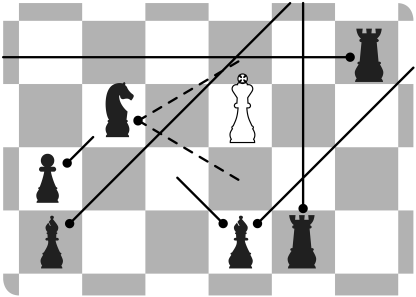
Force Projection is the impact of the movement, attack, and other abilities of units on the decision-making of your opponent.
Discussion
Much of area control revolves around how units can claim and possess areas. However, achieving that control is a matter of how the various abilities and powers of units are arrayed and used in combination. Chess is a good example: in Chess, units occupy their own spaces, but the only relevant parameters tied to that are that pawn movement into the space is blocked, and bishop, rook, and queen units are blocked from passing through those spaces and must end their movements on capture. Where units are positioned in Chess matters much for where they project force. A bishop, knight, and rook may, from three different places on the board, train a withering triple attack on an opposing pawn. Similarly, a powerful queen piece might be harassed and forced off into a corner because all the spaces she could land on are being threatened by other units. Famously, a knight against the edge of the board can be corralled by a bishop in a position exactly three spaces away, orthogonally. In such a position, every space the knight may move to is threatened by the bishop. Force projection as a mechanism is strongly tied to Movement (Chapter 10). Onitama uses Force Projection almost exclusively. In each game, five random movement patterns are in play, and cards rotate in and out of the possession of the players. Skilled players will be able to look ahead several moves
and predict the unfolding of the game board based on where units project force. Many capture-based abstract games exhibit this quality, from Checkers and Chess to Elementos to Hive. Photosynthesis has a unique implementation of this mechanism. Trees don’t project force the way a spearman might. Rather, they project force based on the size of the shadow that they cast. As the sun rotates around the board, a tall tree will shadow others around it, preventing them from generating light points for their owners. Force Projection is not uniquely related to area majority/control games. Enclosure games like Blokus exhibit this pattern, and auction games have a similar feeling in the way that each player’s remaining money is a potential threat in every succeeding auction. The analogy between auctions and area majority games continues to resonate in this context as well. Force projection as we use it here is a spatial mechanism. The number of spaces an army can move, the range of an archer, the area of effect of a wizard’s spell, or a sniper’s line of sight mechanisms are what we’d call Force Projection mechanisms.
Sample Games
Blokus (Tavitian, 2000) Checkers (Unknown) Chess (Unknown, ∼1200) Elementos (Katz, 2015) Hive (Yianni, 2001) Onitama (Sato, 2014) Photosynthesis (Hach, 2017)
描述
力量投射(Force Projection)是单位的移动、攻击和其他能力对对手决策的影响。
讨论
大部分区域控制都围绕单位如何宣称和拥有区域。然而,实现这种控制在于如何排列和结合使用单位的各种能力和力量。国际象棋是一个很好的例子:在国际象棋中,单位占据自己的空间,但与之相关的唯一相关参数是兵移动进入该空间被阻止,主教、车和皇后单位被阻止穿过那些空间,并且必须通过捕获来结束移动。单位在国际象棋中的位置对于它们在哪里投射力量很重要。主教、骑士和车可以从棋盘上的三个不同位置对对手的兵进行毁灭性的三重攻击。同样,强大的皇后棋子可能会被骚扰并被迫退到角落,因为她可能着陆的所有空间都受到其他单位的威胁。众所周知,棋盘边缘的骑士可以被正好三个空间也就是正交方向的主教圈住。在这个位置,骑士可能移动到的每一个空间都受到主教的威胁。作为一种机制,力量投射与移动(第10章)紧密相连。《Onitama》几乎完全使用力量投射。在每场游戏中,有五种随机移动模式在起作用,卡牌在玩家的拥有中轮换进出。熟练的玩家将能够提前看几步
并根据单位投射力量的位置预测游戏版图的展开。许多基于捕获的抽象游戏都表现出这种品质,从跳棋和国际象棋到《Elementos》再到《昆虫棋》(Hive)。《光合作用》(Photosynthesis)有这种机制的独特实现。树木不像长矛兵那样投射力量。相反,它们根据投射阴影的大小投射力量。随着太阳绕着版图旋转,一棵高大的树会给周围的其他树投下阴影,阻止它们为所有者产生光点。力量投射并非唯一与区域多数/控制游戏相关。像《格格不入》(Blokus)这样的围占游戏表现出这种模式,拍卖游戏也有类似的感觉,即每个玩家剩余的金钱在每次后续拍卖中都是潜在的威胁。拍卖和区域多数游戏之间的类比在这种背景下也继续产生共鸣。我们在这里使用的力量投射是一种空间机制。军队可以移动的空间数量、弓箭手的射程、巫师法术的影响区域或狙击手的视线机制都是我们所说的力量投射机制。
游戏范例
Blokus (Tavitian, 2000) - 《格格不入》 Checkers (Unknown) - 《跳棋》 Chess (Unknown, ∼1200) - 《国际象棋》 Elementos (Katz, 2015) - 《Elementos》 Hive (Yianni, 2001) - 《昆虫棋》 Onitama (Sato, 2014) - 《Onitama》 Photosynthesis (Hach, 2017) - 《光合作用》