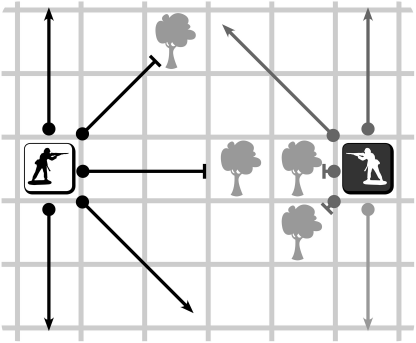
Description
Units may only see certain areas.
Discussion
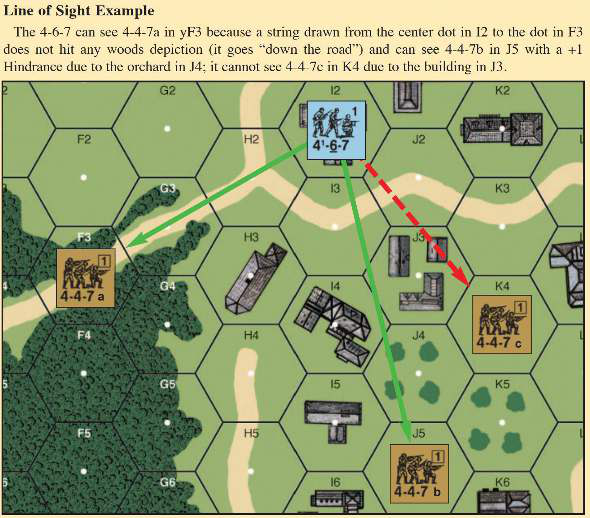
Many tactical games need to determine if a unit can see another, typically for purposes of attacking. This is referred to as Line of Sight (LOS). A variety of mechanisms have been developed to deal with this situation, with different degrees of accuracy and complexity. LOS is a type of Force Projection (ARC- 06) in that it controls which areas of the board a unit may impact. The simplest LOS mechanism is to have a range of a certain number of spaces and to trace the shortest path of spaces (hexes or squares, typically) to the target. If there is any terrain that blocks LOS, the firing unit cannot see the target. PanzerBlitz uses this method. There are almost always multiple ways to trace paths from attacker to target, so typically, the attackers may choose which path they prefer. While this has the benefit of simplicity, it also makes for some unusual situations, particularly on square grids. Its use is typically restricted to hex grids. Games such as Advanced Squad Leader increase realism by having players lay a thread between the attacker and defender hexes. Dots are placed at the center of each hex to assist in this. If the thread touches any obstacles
that block LOS, like buildings or forests, the LOS is blocked. The increased accuracy of this method comes at the cost of fiddliness in terms of moving pieces out of the way and adds the possibility of arguments, as the LOS may just graze certain obstacles and it isn’t totally clear if it is blocked or not (Illustration 11.4a). These systems need to deal with elevation changes as well, to account for hills, gullies, and multilevel buildings. All of these add both complexity and realism. Most games use a “layer cake” approach, with pieces being able to see all spaces on the same elevation as them and can only see lower levels if they are on the edge of their elevation (a “crest” hex). Some games even add rules for blind spots behind obstacles for observers at a height. In Nuns on the Run, players are trying to avoid the nuns patrolling the grounds. Movement is Point-to-Point (MOV-01), and LOS is determined by placing a straight edge between the two points and seeing if it hits any walls. As a help to players, the spaces are numbered, and the rules include a table showing if two spaces (looked up by number) can see each other or not. Nuns Illustration 11.4a A Line of Sight example from Advanced Squad Leader. LOS is traced from hex center to hex center and uses the actual artistic rendition of terrain features to determine what is blocked.
on the Run also has facing. Nuns can only see 180 degrees in front of them. Other games like Advanced Squad Leader do not have facing. Miniatures games often use a “model’s eye” view to LOS. Players lean down to the table and check to see if they can see the opposing models. Laser pointers can be helpful here in making a determination. Yet, as with the thread method, this can often lead to player arguments. There may also need to be a judgment about whether some elements of the model don’t count for LOS. Warhammer Age of Sigmar, for example, specifies that decorative elements added to a model like flowing capes and large crowns are not valid for LOS. This allows players to exercise their creativity when painting and decorating models. Warmachine/Hordes sidesteps this by having players use standard cylinders to represent models when checking for LOS. The tactical battle game Tannhäuser takes a simplified approach to LOS. Spaces on the board are color-coded and grouped into “paths.” Characters on the same path (same colored circles) can see each other. Some spaces between paths have two different colors—to represent that they can be seen from any space in either path (Illustration 11.4b). LOS is a bedeviling aspect of game design. High-level conflict games don’t require these rules at all, but squad-level combat games usually do, Illustration 11.4b Line of Sight in Unmatched is determined by space color. A piece can see pieces in spaces of the same color.
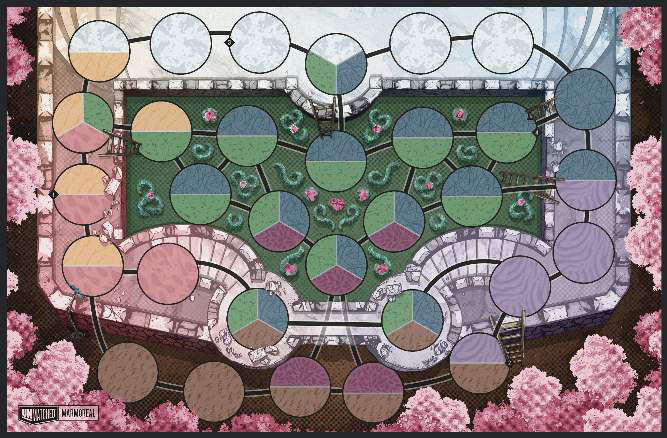
and these games often have some area control aspects to them. LOS usually interferes with force projection, so blocking LOS is a tool in the designer’s toolkit for modifying the way in which certain units shape the battlefield and the options players have for navigating it.
Sample Games
Advanced Squad Leader (Greenwood, 1985) Nuns on the Run (Moyersoen, 2010) PanzerBlitz (Dunnigan, 1970) Tannhäuser (Grosselin and Poli, 2007) Unmatched (Daviau and Jacobson, 2019) Warhammer Age of Sigmar (Uncredited, 2015) Warmachine/Hordes (McVey, Snoddy, and Wilson, 2003)
Set Collection ў ў Humans are pattern-seeking creatures, which perhaps explains why so many games incorporate some version of set collection. There’s a nearly endless variety of types of sets to collect. Some sets are thematic, like Noah’s pairs of animals, or the Tree Little Pigs. Some are abstract, like Poker hands or melds in Gin Rummy, and some sets are arbitrary, like the compass, tablet, and gear science cards in 7 Wonders. Even game concepts like contracts or tickets can be considered types of set. But no matter their variety and under-lying commonality, all sets are built on the idea of synergy: the value or power of the set is greater than the sum of its parts. The result of this characteristic of sets is that as players collect the components of a set, they will naturally diverge in their valuation of the remaining components. Picking up the fifth dumpling in Sushi Go! means much more than the first tempura—but for another player, that tempura completes their set and scores five points, while the first dumpling is worth only a single point. This value difference means that inter-player competition is no longer zerosum. Players can set and achieve goals that are not in diametric opposition to their opponents, and the indirect conflicts that result engender a less aggressive dynamic that can appeal to players who may shy away from direct conflict. Set collection can readily support multiple dimensions, and this is common to all but the simplest of games. Number-based sets can be collected in numerical order or in multiples of a single number. Add in colors or suits for yet another dimension. These orthogonal dimensions create choices and tension, as players consider which types of suits to collect based on their value, distribution of their components, and what their opponents might be trying to collect. The rich math behind the set collection makes it a great tool for designers, but just as important for its popularity is the thematic consonance and DOI: 10.1201/9781003179184-12
intuitiveness of the set collection. In Ticket to Ride, there’s no imaginable reason why, at least from a simulation perspective, a set of four blue train cards can connect Chicago to Omaha, and also Helena to Winnipeg but not Winnipeg to Duluth, or Dallas to El Paso. Surely, the actual inputs of labor, capital, and raw materials are similar, and it’s hard to think why, in practice, the blue tracks are any different from the green ones. And yet, through the set collection, these issues present no challenge to players, their understanding of the game, and their willingness to accept its conceits. Some tracks are green, and some are blue. Game on. That’s the real magic of the set collection. It is an incredibly versatile mechanism for abstracting a whole host of possible game activities. Sometimes, these sets feel richly thematic and representative of the activities being simulated, and other times, the sets are merely a veneer. But our human love for patterns and combinations means we’ll accept quite a bit of abstraction in our set collection. Coupling this activity with clever scoring and collection dynamics, you have one of the fundamental building blocks of board game design. While set collection can be implemented with many different kinds of components, by far the most common components are cards and tiles. For the sake of simplicity, we will refer to set elements generically as cards, unless referring to a specific game that uses some other component.
描述
单位可能只能看到某些区域。
讨论
许多战术游戏需要确定一个单位是否能看到另一个单位,通常是为了攻击。这被称为视线(LOS)。已经开发了各种机制来处理这种情况,具有不同程度的准确性和复杂性。LOS是一种力量投射(ARC-06),因为它控制单位可能影响版图的哪些区域。最简单的LOS机制是拥有一定数量的空间范围,并追踪到目标的最短空间路径(通常是六角格或方格)。如果有任何地形阻挡LOS,射击单位就看不到目标。《PanzerBlitz》使用这种方法。几乎总是有多种方法来追踪从攻击者到目标的路径,因此通常,攻击者可以选择他们喜欢的路径。虽然这有简单的好处,但也制造了一些不寻常的情况,特别是在方格上。它的使用通常限于六角格游戏。诸如《高级步兵班长》(Advanced Squad Leader)之类的游戏通过让玩家在攻击者和防御者六角格之间放置一根线来增加真实感。每个六角格的中心都放置了点以协助此操作。如果线接触到任何障碍物
阻挡LOS的,如建筑物或森林,LOS即被阻挡。这种方法精度的提高是以移动阻挡物方面的繁琐为代价的,并增加了争论的可能性,因为LOS可能只是擦过某些障碍物,而且尚不完全清楚它是否被阻挡(插图11.4a)。这些系统还需要处理海拔变化,以考虑山丘、沟壑和多层建筑。所有这些都增加了复杂性和真实感。大多数游戏使用“多层蛋糕”方法,棋子能够看到与其处于同一海拔的所有空间,并且只有在处于海拔边缘(“波峰”六角格)时才能看到较低的水平。有些游戏甚至为高处的观察者增加了障碍物后面盲点的规则。在《修女狂奔》(Nuns on the Run)中,玩家试图避开巡视场地的修女。移动是点对点的(MOV-01),LOS通过在两点之间放置直尺并查看其是否击中任何墙壁来确定。作为对玩家的帮助,空间已编号,规则包括一个表格,显示两个空间(通过编号查找)是否可以看到对方。修女插图11.4a 《高级步兵班长》中的视线示例。LOS从六角格中心追踪到六角格中心,并使用地形特征的实际艺术渲染来确定阻挡了什么。
《修女狂奔》也有朝向。修女只能看到前方180度。其他游戏如《高级步兵班长》没有朝向。微缩模型游戏通常对LOS使用“模型的眼睛”视角。玩家俯身在桌子上,检查他们是否能看到对方的模型。激光笔在这里有助于做出决定。然而,就像线的方法一样,这经常会导致玩家争论。可能还需要判断模型的某些元素是否不计入LOS。例如,《战锤:西格玛时代》(Warhammer Age of Sigmar)规定,添加到模型上的装饰元素,如流动的斗篷和大皇冠,对LOS无效。这允许玩家在绘画和装饰模型时发挥他们的创造力。《战争机器/部落》(Warmachine/Hordes)通过让玩家在检查LOS时使用标准圆柱体代表模型来回避这一点。战术战斗游戏《Tannhäuser》对LOS采取了简化的方法。版图上的空间采用颜色编码并分组为“路径”。同一路径(相同颜色的圆圈)上的角色可以看到彼此。路径之间的一些空间有两种不同的颜色——表示可以从任一路径的任何空间看到它们(插图11.4b)。LOS是游戏设计中令人困扰的一个方面。高层冲突游戏根本不需要这些规则,但小队级战斗游戏通常需要,
插图 11.4b 《Unmatched》中的视线由空间颜色决定。一个棋子可以看到相同颜色空间中的棋子。
这些游戏通常具有一些区域控制方面。LOS通常会干扰力量投射,因此阻挡LOS是设计师工具箱中的一种工具,用于修改某些单位塑造战场的方式以及玩家导航战场的选项。
游戏范例
Advanced Squad Leader (Greenwood, 1985) - 《高级步兵班长》 Nuns on the Run (Moyersoen, 2010) - 《修女狂奔》 PanzerBlitz (Dunnigan, 1970) - 《PanzerBlitz》 Tannhäuser (Grosselin and Poli, 2007) - 《Tannhäuser》 Unmatched (Daviau and Jacobson, 2019) - 《Unmatched》 Warhammer Age of Sigmar (Uncredited, 2015) - 《战锤:西格玛时代》 Warmachine/Hordes (McVey, Snoddy, and Wilson, 2003) - 《战争机器/部落》
Set Collection(套装收集) 人类是寻找模式的生物,这也许解释了为什么这么多游戏包含某种版本的套装收集。有几乎无穷无尽的套装类型可供收集。有些套装是主题性的,如诺亚成对的动物,或三只小猪。有些是抽象的,如扑克手牌或《金罗美》(Gin Rummy)中的牌组,还有一些套装是任意的,如《七大奇迹》(7 Wonders)中的指南针、石碑和齿轮科学卡。甚至像合同或车票这样的游戏概念也可以被认为是套装类型。但无论它们的多样性和潜在的共性如何,所有套装都建立在协同作用的概念之上:套装的价值或力量大于其部分的总和。这种套装特征的结果是,随着玩家收集套装的组件,他们对剩余组件的估值自然会发生分歧。在《寿司走!》(Sushi Go!)中拿起第五个饺子比第一个天妇罗意义重大得多——但对于另一个玩家来说,那个天妇罗完成了他们的套装并获得五分,而第一个饺子只值一分。这种价值差异意味着玩家之间的竞争不再是零和的。玩家可以设定和实现与对手并不截然对立的目标,由此产生的间接冲突产生了一种不那么具有攻击性的动态,这种动态可以吸引那些可能回避直接冲突的玩家。套装收集可以很容易地支持多个维度,这在除最简单的游戏之外的所有游戏中都很常见。基于数字的套装可以按数字顺序或单个数字的倍数收集。加入颜色或花色以获得另一个维度。这些正交维度创造了选择和紧张感,因为玩家根据其价值、组件分布以及对手可能试图收集的内容来考虑要收集哪种类型的花色。套装收集背后丰富的数学使其成为设计师的绝佳工具,但就其受欢迎程度而言,同样重要的是主题的一致性和 DOI: 10.1201/9781003179184-12
套装收集的直观性。在《车票之旅》(Ticket to Ride)中,至少从模拟的角度来看,没有理由说明为什么一组四张蓝色火车卡可以连接芝加哥到奥马哈,也可以连接海伦娜到温尼伯,但不能连接温尼伯到杜鲁斯,或达拉斯到埃尔帕索。当然,劳动力、资本和原材料的实际投入是相似的,很难想象为什么在实践中蓝色轨道与绿色轨道有任何不同。然而,通过套装收集,这些问题对玩家、他们对游戏的理解以及他们接受其设想的意愿没有挑战。有些轨道是绿色的,有些是蓝色的。游戏开始。这就是套装收集的真正魔力。这是一个令人难以置信的多功能机制,用于抽象大量可能的游戏活动。有时,这些套装感觉主题丰富,代表了正在模拟的活动,而其他时候,套装仅仅是一种饰面。但我们人类对模式和组合的热爱意味着我们会接受套装收集中相当多的抽象。将此活动与巧妙的计分和收集动态相结合,你就拥有了桌面游戏设计的基本构建块之一。虽然套装收集可以用许多不同种类的组件来实现,但到目前为止,最常见的组件是卡牌和板块。为了简单起见,我们将统称套装元素为卡牌,除非提到使用其他组件的特定游戏。