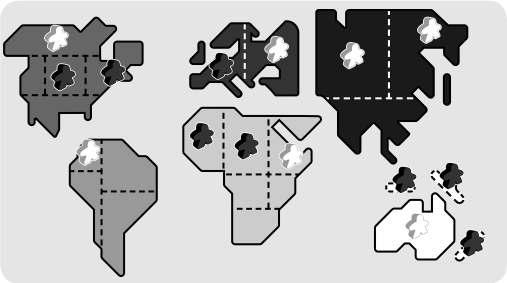
Description
Maps can exhibit hierarchical relationships among their constituent spaces such that a territory might exist in a region and various attributes and parameters may be tied to the control of these areas.
Discussion
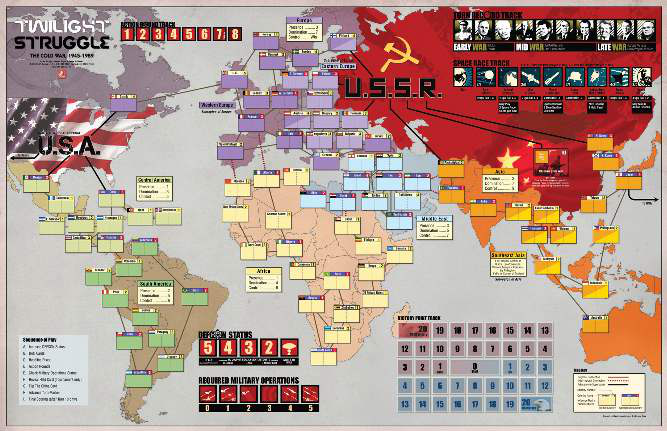
The concept of Regions constituted out of a number of Territories is common in conflict games. One typical mechanism provides an additional reward to players who control a set of Regions that compose a territory. This mechanism, a kind of territorial Set Collection (Chapter 12) can be implemented based on absolute control, like Risk, or based on majority control, as in EightMinute Empire: Legends or Twilight Struggle. Setting regional control offers some natural hooks for designers to hang additional concepts off of. Making movement between Regions more difficult or expensive enhances the defensibility of a region, once it has been taken. Factions can be assigned “homeland” benefits when in their own Regions too, as in Risk Legacy. In essence, regionalizing Territories provides another dimension by which to differentiate Territories, much as the terrain does (Illustration 11.2). Regional effects provide opportunities to bring a setting to life by providing narrative and mechanical events that differentiate the Territories from one another. For Intellectual-Property (IP)-based games like War of the Ring, regional parameters ensure that iconic moments in the original story can be recreated with greater fidelity. Strider can only be revealed as Aragorn and
crowned king if he reaches Minas Tirith or Dol Amroth. Similarly, the Corsairs of Umbar can only attack their historically hated enemies, Gondor, and cannot simply sail to any coastal region. 1960: The Making of the President’s card-driven system helps the Nixon player carry the West and the Kennedy player, the Northeast. The contest is decided mostly in the South and Midwest. Tough deviations are possible, the core identity and patterns of the 1960 election are reinforced by providing different regional strengths to the Kennedy and Nixon players, baked into the makeup of their unique decks.
Sample Games
1960: The Making of the President (Leonhard and Matthews, 2007) Eight-Minute Empire: Legends (Laukat, 2013) Risk (Lamorisse and Levin, 1959) Risk Legacy (Daviau and Dupuis, 2011) Twilight Struggle (Gupta and Matthews, 2005) War of the Ring (Di Meglio, Maggi, and Nepitello, 2004)
Illustration 11.2 The Twilight Struggle board is clearly broken up into regions, as indicated by the backgrounds of the territories. Each territory has a stability rating, and some are designated as Battleground spaces, shown by the dark purple banner.
描述
地图可以在其组成空间之间表现出层级关系,例如领土可能存在于区域(Regions)中,并且各种属性和参数可能与这些区域的控制相关联。
讨论
由多个领土构成的区域概念在冲突游戏中很常见。一种典型的机制为控制构成领土的一组区域的玩家提供额外的奖励。这种机制,一种领土套装收集(第12章),可以基于绝对控制实施,如《风险》(Risk),或基于多数控制实施,如《八分钟帝国:传奇》(Eight-Minute Empire: Legends)或《冷战热斗》(Twilight Struggle)。设置区域控制为设计师提供了一些自然的挂钩,可以挂载额外的概念。使区域之间的移动更加困难或昂贵增强了区域的防御性,一旦它被占领。派系在自己的区域时也可以分配“家园”利益,如在《风险:传承》(Risk Legacy)中。本质上,区域化领土提供了另一个维度来区分领土,就像地形一样(插图11.2)。区域效应通过提供将领土彼此区分开来的叙事和机械事件,为使设置栩栩如生提供了机会。对于基于知识产权(IP)的游戏,如《魔戒圣战》(War of the Ring),区域参数确保可以以更高的保真度再现原始故事中的标志性时刻。大步佬只有在他到达米那斯提力斯或多尔安罗斯时才能被揭示为阿拉贡并
加冕为王。同样,昂巴海盗只能攻击他们历史上痛恨的敌人刚铎,而不能简单地航行到任何沿海地区。《1960:缔造总统》(1960: The Making of the President)的卡牌驱动系统帮助尼克松玩家赢得西部,肯尼迪玩家赢得东北部。比赛主要在南部和中西部决定。尽管可能会出现偏差,但通过为肯尼迪和尼克松玩家提供不同的区域优势,并融入他们独特牌组的构成中,加强了1960年选举的核心身份和模式。
游戏范例
1960: The Making of the President (Leonhard and Matthews, 2007) - 《1960:缔造总统》 Eight-Minute Empire: Legends (Laukat, 2013) - 《八分钟帝国:传奇》 Risk (Lamorisse and Levin, 1959) - 《风险》 Risk Legacy (Daviau and Dupuis, 2011) - 《风险:传承》 Twilight Struggle (Gupta and Matthews, 2005) - 《冷战热斗》 War of the Ring (Di Meglio, Maggi, and Nepitello, 2004) - 《魔戒圣战》
插图 11.2 《冷战热斗》的版图显然被分成了区域,如领土的背景所示。每个领土都有一个稳定等级,有些被指定为战场空间,由深紫色横幅显示。