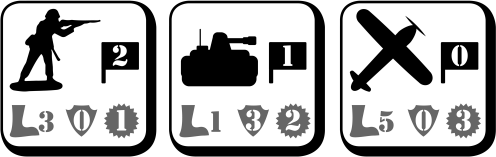
Description
To compete for or establish control requires troops, inhabitants, influence, presence, or some similar metaphor for being in a place. Many games have a variety of unit types, with different abilities, and sometimes, different implications for area control.
Discussion
In some games, only certain units can exercise control over a territory. Axis & Allies requires infantry or armor units to take control of a territory away from an opponent. Fighter and bomber planes may not even land on newly captured territory, which can create some interesting decisions for players who are forced to decide between taking a valuable plane as a casualty of combat in order to capture a territory or having the more expendable infantry unit take the hit but be left with a plane that is unable to conquer the space. In Kemet, the powerful monsters and creatures summoned by the power tiles are not considered units and cannot even remain on the board if their accompanying troops are eliminated (Illustration 11.1). In the context of area majority games, the simplest distinction between unit types is their power. Some units have the strength of one, and others are more powerful. Dominant Species has both a majority contest, based on the total population of a species, and a dominance contest, which is calculated by evaluating the types of food a species can eat and the quantity of that food that is available in the hex being scored. A single unit may lose the population battle but win the dominance battle. A more straightforward application of the idea of varying troop strengths is in Belfort, in which Elves and Dwarves start at a strength of one but can be promoted to count for two points of strength.
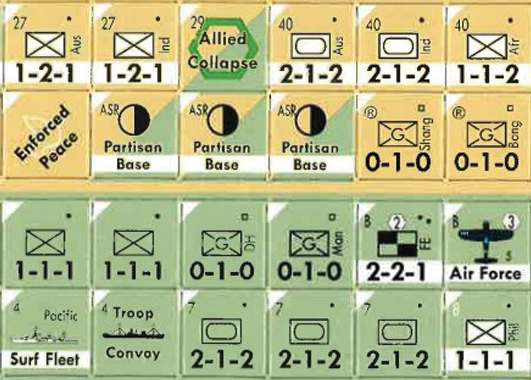
The idea of different unit types is another foundational concept in game design. It is both so old that it’s hard to know where it first began and still a regular feature of modern design. Units can vary in their movement abilities, combat strength, cost, their ability to perform certain tasks or even to be placed in certain spaces, and more. Whether we’re dealing with space operas, like Twilight Imperium and Star Wars: Rebellion or the highly simplified war game-like system Command & Colors, we observe a broad variety of unity types and methods for distinguishing them from one another. In the context of absolute control, some differences in troop types are tied to the uncertainty engine that resolves combat. Whether troops roll a die to hit, or can only be hit by a certain die value, or all the other variations on this core idea (Chapter 4, “Resolution”), the differences between troops are about how they influence random outcomes. This is one of the means by which designers moderate the impacts of output randomness. The types of troops committed and the expected value they generate in terms of hits they can inflict on the opposing side represent a wager, with the value of the territory occupied representing the pot to be won. In an area majority context, there is a narrower range of variation. There are troops that are worth more than one point of strength, troops whose Illustration 11.1 Portion of a counter sheet from Dai Senso! The symbol in the center indicates the type of unit (an X is a type of infantry, while ovals are tanks), which impacts how they move and fight. The three numbers on the bottom of each unit are Attack, Defense, and Movement ratings.
value is hidden, troops who can override rules that restrict additional troops from being added, or troops that provide tie-breaker benefits. Rarely, a unit might actually eliminate existing units from an opposing player, as the T-Rex and Pterodactyl units do in Triassic Terror. In that same game, the Raptor unit also forces opponents to move units to another territory. Cave Troll is built entirely around the mechanism of special powers for units that influence the struggle for majorities in various rooms of a dungeon. Each player fields units that have abilities such as locking down a room in the dungeon to prevent other players from adding units there or swapping units between rooms. In Glenn Drover’s Empires: Galactic Rebellion (which is only the latest iteration of a game once published under the Age of Empires license), a variety of units perform functions either related to or entirely additive to their roles in the majority contest. A Diplomat will let you bring another unit along to a planet to increase your strength there, while a Smuggler will let you get trade goods.
Sample Games
Axis & Allies (Harris, Jr., 1981) Belfort (Cormier and Lim, 2011) Cave Troll (Jolley, 2002) Command & Colors (Borg, 2006) Dai Senso! (Emrich, Prowell, Vasta, 2011) Dominant Species (Jensen, 2010) Glenn Drover’s Empires: Galactic Rebellion (Drover, 2016) Kemet (Bariot and Montiage, 2012) Nexus Ops (Cantino and Kimball, 2005) Star Wars: Rebellion (Konieczka, 2016) Titan (McAllister and Trampier, 1980) Triassic Terror (Hawes, 2013) Twilight Imperium (Petersen, 1997)
描述
为了竞争或建立控制权需要部队、居民、影响力、存在或某些类似的在场隐喻。许多游戏有各种各样的单位类型,具有不同的能力,有时对区域控制有不同的含义。
讨论
在某些游戏中,只有特定的单位可以对领土实施控制。《轴心国与同盟国》(Axis & Allies)要求步兵或装甲单位从对手那里夺取领土控制权。战斗机和轰炸机甚至可能无法降落在新占领的领土上,这可能会给玩家带来一些有趣的决定,他们被迫决定是接受一架有价值的飞机作为战斗伤亡以占领领土,还是让更可消耗的步兵单位承受打击,但留下一架无法征服该空间的飞机。在《凯麦特》(Kemet)中,由力量板块召唤的强大怪物和生物不被视为单位,如果与其同行的部队被消灭,它们甚至无法留在版图上(插图11.1)。在区域多数游戏的背景下,单位类型之间最简单的区别是它们的力量。有些单位的力量为一,而其他单位则更强大。《优势物种》(Dominant Species)既有基于物种总人口的多数竞争,也有优势竞争,这是通过评估一个物种可以吃的食物类型和正在计分的六角格中可用的食物数量来计算的。单个单位可能会输掉人口之战,但赢得优势之战。varying troop strengths想法的一个更直接的应用是在《贝尔福特》(Belfort)中,其中精灵和矮人以一点力量开始,但可以升级为计为两点力量。
不同单位类型的想法是游戏设计中的另一个基本概念。它既古老到难以知道它最初是从哪里开始的,又是现代设计的常规特征。单位在移动能力、战斗力、成本、执行特定任务的能力甚至被放置在特定空间等方面可以有所不同。无论我们是在处理太空歌剧,如《帝国的曙光》(Twilight Imperium)和《星球大战:叛乱》(Star Wars: Rebellion),还是像《指挥与军旗》(Command & Colors)这样高度简化的战争游戏式系统,我们要观察各种各样的单位类型以及将它们彼此区分开来的方法。在绝对控制的背景下,部队类型的一些差异与解决战斗的不确定性引擎有关。无论部队是掷骰子命中,还是只能被特定的骰子值命中,或者是这个核心概念的所有其他变体(第4章,“解决”),部队之间的差异在于它们如何影响随机结果。这是设计师缓和输出随机性影响的手段之一。投入的部队类型以及它们在对对手造成打击方面产生的预期价值代表了一种赌注,被占领土的价值代表了要赢得的彩池。在区域多数背景下,变化范围较窄。有些部队的力量值超过一点,有些部队的
插图 11.1 来自《Dai Senso!》的算子表的一部分。中心的符号表示单位类型(X是一种步兵,而椭圆是坦克),这影响了它们的移动和战斗方式。每个单位底部的三个数字是攻击、防御和移动等级。
价值是隐藏的,有些部队可以覆盖限制增加额外部队的规则,或者有些部队提供平局打破利益。极少数情况下,一个单位实际上可能会消除对手现有的单位,就像《三叠纪恐怖》(Triassic Terror)中的霸王龙和翼龙单位所做的那样。在同一游戏中,猛禽单位还迫使对手将单位移动到另一个领土。《洞穴巨魔》(Cave Troll)完全建立在为单位提供特殊能力的机制之上,这些能力影响地牢各个房间中多数人的斗争。每位玩家派出的单位具有锁定地牢房间以防止其他玩家在那里添加单位或在房间之间交换单位等能力。在格伦·德罗弗(Glenn Drover)的《银河叛乱帝国》(Empires: Galactic Rebellion,这只是曾以《帝国时代》许可出版的游戏的最新迭代)中,各种单位执行的功能要么与之相关,要么完全附加于它们在多数竞争中的角色。外交官会让你带另一个单位去一个星球以增加你在那里的力量,而走私者会让你获得贸易商品。
游戏范例
Axis & Allies (Harris, Jr., 1981) - 《轴心国与同盟国》 Belfort (Cormier and Lim, 2011) - 《贝尔福特》 Cave Troll (Jolley, 2002) - 《洞穴巨魔》 Command & Colors (Borg, 2006) - 《指挥与军旗》 Dai Senso! (Emrich, Prowell, Vasta, 2011) - 《Dai Senso!》 Dominant Species (Jensen, 2010) - 《优势物种》 Glenn Drover’s Empires: Galactic Rebellion (Drover, 2016) - 《银河叛乱帝国》 Kemet (Bariot and Montiage, 2012) - 《凯麦特》 Nexus Ops (Cantino and Kimball, 2005) - 《星海争霸》 Star Wars: Rebellion (Konieczka, 2016) - 《星球大战:叛乱》 Titan (McAllister and Trampier, 1980) - 《泰坦》 Triassic Terror (Hawes, 2013) - 《三叠纪恐怖》 Twilight Imperium (Petersen, 1997) - 《帝国的曙光》