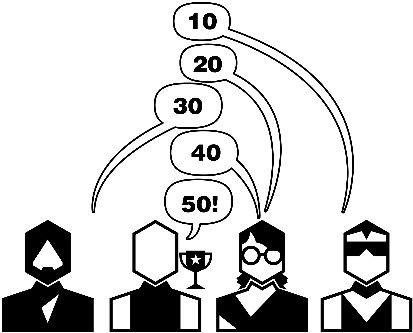
Description
This is a meta-mechanism that can modify other auction techniques. Players may not bid any number that they wish. Tey may only bid based on increments and/or combinations of certain resources.
Discussion
The greatest drawback of auctions as a game design mechanism is their length. The second-biggest defect is that it is difficult for players to make small distinctions in the value of the lots up for bid. Is some collection of goods worth 13? 14? 15? At small increments, it can be very challenging to make a determination. Constrained Bidding offers a cure to both of these defects. Since there are fewer valid bids, and the increment required to raise the bid is higher, auctions come to a close more quickly. Players are rarely faced with the decision to increase their bid by one or two units, and the larger required increments make it easier for players to value the lots up for bid. One of the effects of Constrained Bidding is a reduction in the uncertainty of auction outcomes. It is easier for players to predict which other players might be interested in a lot and how they’ll bid. Some games will have bidding tokens be hidden information to retain some of the tension in the auction (Illustration 8.1).
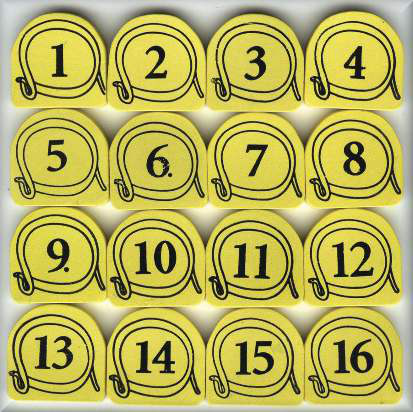
Constrained Bidding is a favorite for designer Reiner Knizia, appearing in Ra, Amun-Re, and High Society. Yet it hasn’t caught on as a generally popular auction mechanism, and designers should be aware of some substantial drawbacks to it. For one, Constrained Bidding, aside from the basic constraint of some minimum bid increment, is an especially artificial device. The need to raise a bid by a specific amount or to bid only the amounts on the bidding tokens you hold does not typically have any thematic justification. It is hard to imagine a real-world auction that would use this kind of mechanism. Constrained Bidding also introduces a challenge in redistributing the used bidding tokens. In most auction games, the money system is either closed or based on some economy that enables you to buy and sell the goods up for auction. But in a fixed token system, all the advantages those fixed increments grant to speed of auction come at the cost of their non-liquidity. Put simply, you can’t make change! Designers need to carefully consider both the balance of initial apportionment of bid tokens and how they come back to their owners after use. One area in which there is still considerable design space is multiuse bidding counters. Will you use a powerful card as currency to bid in an auction? Illustration 8.1 In Ra, players have a subset of these bidding tokens, either three or four depending on player count. Any bid they make must be a single bidding token. Photo by Board Game Geek user kevintlee.
Or will you save its power for use in another aspect of the game? One might see Twilight Struggle (and many other area majority games) as a series of simultaneous auctions, with the multiuse cards representing a kind of fixed bid. Admittedly, in Twilight Struggle, the cards, when used as action points, are more liquid than a true Constrained Bid Auction, but it is in the same family. Indeed, there is an entire category of games that are based on bidding cards with multiple uses, often with players having duplicate decks. Libertalia and Eggs & Empire come to mind immediately. The cards can be seen as a kind of Constrained Bidding token, and players typically have to use each card once before being allowed to pick up the discards. What distinguishes these games from true auctions is twofold. First, the games do not always have an actual lot up for bid. The revealed cards may interact with a pot of gold, for example, but they do not represent contingent offers to purchase some lot as in most auctions. Second, even when a lot or lots do exist, like in Eggs & Empire, winning the auction does not necessarily lead to winning the lot. More generically, the player with the highest bid does not necessarily win the auction. Typically, in these games, in addition to the currency value on the card, there are some additional effects and interactions that can impact the auction’s outcomes dramatically. Nevertheless, these games merit a mention here as they are a means of using the Constrained Bid structure in an engaging and more thematically resonant way.
Sample Games
Amun-Re (Knizia, 2003) Cyclades (Cathala and Maublanc, 2009) Eggs & Empire (Pinchback and Riddle, 2014) High Society (Knizia, 1995) Libertalia (Mori, 2012) Ra (Knizia, 1999) Stockpile (Sobol and Orden, 2015) Twilight Struggle (Gupta and Matthews, 2005)
描述
这是一种可以修改其他拍卖技术的元机制。玩家不能随便叫出任何数字。他们只能基于特定的增量和/或某些资源的组合进行出价。
讨论
拍卖作为一种游戏设计机制的最大缺点是其长度。第二大缺陷是,玩家很难在待拍拍品的价值上做出微小的区分。一些商品集合值13吗?14?15?在小增量下,做出决定可能非常具有挑战性。受限竞价(Constrained Bidding)为这两个缺陷提供了治疗方法。由于有效出价较少,并且提高出价所需的增量较高,因此拍卖会更快结束。玩家很少面临将出价增加一个或两个单位的决定,较大的所需增量使玩家更容易评估待拍拍品的价值。受限竞价的效果之一是减少了拍卖结果的不确定性。玩家更容易预测其他玩家可能对哪个批次感兴趣以及他们将如何出价。有些游戏会让竞标标记成为隐藏信息,以保留拍卖中的一些紧张感(插图8.1)。
受限竞价是设计师莱纳·克尼齐亚(Reiner Knizia)的最爱,出现在《Amun-Re》、《High Society》和《Ra》中。然而,它并没有作为一种普遍流行的拍卖机制流行起来,设计师应该意识到它的一些实质性缺点。首先,除了某种最低加价幅度的基本限制外,受限竞价是一种特别人为的手段。需要将出价提高特定金额或仅出价你持有的竞标标记上的金额通常没有任何主题理由。很难想象现实世界的拍卖会使用这种机制。受限竞价还引入了重新分配使用的竞标标记的挑战。在大多数拍卖游戏中,货币系统要么是封闭的,要么是基于某种允许你买卖待拍商品的经济。但在固定代币系统中,这些固定增量赋予拍卖速度的所有优势都是以其非流动性为代价的。简而言之,你不能找零!设计师需要仔细考虑初始分配竞标标记的平衡以及它们在使用后如何回到所有者手中。多用途竞标计数器仍然有相当大设计空间的一个领域。你会使用一张强大的卡作为货币在拍卖中出价吗?
插图 8.1 在《Ra》中,玩家拥有这些竞标标记的一个子集,三个或四个,具体取决于玩家人数。他们做出的任何出价都必须是单个竞标标记。照片由Board Game Geek用户kevintlee提供。
或者你会保留它的力量用于游戏的另一个方面?人们可能会将《冷战热斗》(Twilight Struggle)(以及许多其他区域多数游戏)视为一系列同时拍卖,多用途卡代表一种固定出价。诚然,在《冷战热斗》中,当卡牌用作行动点时,比真正的受限竞价拍卖更具流动性,但它是同一个家族的。确实,有一整类游戏是基于竞标具有多种用途的卡牌,通常玩家拥有重复的牌组。《莱伯タリア》(Libertalia)和《Eggs & Empire》立即浮现在脑海中。这些卡牌可以被视为一种受限竞价标记,玩家通常必须使用每张卡牌一次,然后才被允许捡起弃牌。区分这些游戏与真正的拍卖有两点。首先,游戏并不总是有一个实际的待拍拍品。例如,揭示的卡牌可能与一罐金子互动,但它们并不像大多数拍卖那样代表购买某些拍品的或有报价。其次,即使存在一个或多个拍品,如在《Eggs & Empire》中,赢得拍卖并不一定导致赢得拍品。更一般地说,出价最高的玩家不一定赢得拍卖。通常,在这些游戏中,除了卡牌上的货币价值外,还有一些额外的效果和互动可以极大地影响拍卖结果。尽管如此,这些游戏值得在这里提及,因为它们是以一种引人入胜且在主题上更共鸣的方式使用受限竞价结构的一种手段。
游戏范例
Amun-Re (Knizia, 2003) - 《阿蒙拉》 Cyclades (Cathala and Maublanc, 2009) - 《基克拉德斯》 Eggs & Empire (Pinchback and Riddle, 2014) - 《Eggs & Empire》 High Society (Knizia, 1995) - 《上流社会》 Libertalia (Mori, 2012) - 《海盗分赃》(Libertalia) Ra (Knizia, 1999) - 《Ra》 Stockpile (Sobol and Orden, 2015) - 《股市大亨》 Twilight Struggle (Gupta and Matthews, 2005) - 《冷战热斗》