Description
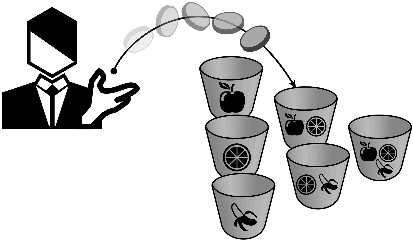
A Dexterity Auction requires the performance of some act of dexterity to submit a valid bid. Typically, this would involve the bid marker itself being placed into some valid bidding area, but other methods for implementing this may be used.
Discussion
Going, Going, GONE! by Dr. Scott Nicholson is the design that most readily comes to mind because of its explicit auction theming. In the game, multiple items are up for bid simultaneously, and players bid in real time by dropping their bid tokens into cups corresponding to each lot. Only tokens that land in the cups count, and the time available for bidding can be fast enough that placing a bid is not assured. While Going, Going, GONE! is squarely a Dexterity Auction, one could perhaps view games like Crokinole and Shuffleboard as being Dexterity Auctions. Consider Crokinole, where players flick their bid markers, attempting to acquire points by occupying board areas. Each side only scores when more of its markers are in a scoring zone than the other side’s markers. The main difference between this and an auction is that in Crokinole, if you land two more markers than your opponent in a scoring zone, you score points for each marker. That would be like bidding on a diamond and winning one diamond for each dollar by which you outbid your opponent.
One can readily imagine a mechanism which awards to the player with the most darts, or stones or markers in some area a singular benefit. This would be a Dexterity Auction where player skill in landing the bid would be more important than player intent to bid some amount. Dexterity Auctions have been implemented in video games that are board game-like in nature, most notably M.U.L.E. and Sumer. In these games, players move on-screen avatars against the clock, representing offers to buy or sell. This allows players to “fake” a bid by moving far ahead and then pulling just behind their opponents as time runs out, to force them into winning an item at a higher price than they might have intended. It’s worth noting that dexterity is one of those mechanisms, like memory, that can be deeply polarizing and potentially inaccessible to those with physical disabilities. It can be especially dissonant when it is one component in a multi-mechanism game. A game that otherwise emphasizes planning and calculation may frustrate players when their plans are ruined by an errant toss.
Sample Games
Crokinole (unknown, before 1876) Going, Going, GONE! (Nicholson, 2013) M.U.L.E. (Berry, 1983) Sumer (Favorov, Gunnarrson, Raab, and Suthers, 2017)
描述
敏捷拍卖(Dexterity Auction)要求执行某种敏捷动作以提交有效出价。通常,这涉及将出价标记本身放入某个有效竞标区域,但也可以使用其他实现此目的的方法。
讨论
斯科特·尼科尔森博士(Dr. Scott Nicholson)的《Going, Going, GONE!》是最容易想到的设计,因为它有明确的拍卖主题。在游戏中,多个物品同时待拍,玩家通过将出价标记放入对应每个批次的杯子中进行实时竞标。只有落入杯子中的标记才算数,可用的竞标时间可能非常快,以至于无法保证放置出价。虽然《Going, Going, GONE!》是地地地道道的敏捷拍卖,但人们也许可以将像《加拿大棋》(Crokinole)和《沙狐球》(Shuffleboard)这样的游戏视为敏捷拍卖。考虑《加拿大棋》,玩家弹射他们的出价标记,试图通过占据版图区域来获得分数。只有当一方在得分区的标记多于另一方时,该方才得分。这与拍卖的主要区别在于,在《加拿大棋》中,如果你在得分区比对手多落入两个标记,你每个标记都得分。这就像竞标一颗钻石,并为你比对手多出的每一美元赢得一颗钻石。
人们可以很容易地想象一种机制,该机制将单一利益授予在某个区域拥有最多飞镖、石头或标记的玩家。这将是一个敏捷拍卖,玩家落地出价的技巧比玩家出价多少的意图更重要。敏捷拍卖已在本质上类似于棋盘游戏的视频游戏中实施,最著名的是《M.U.L.E.》和《Sumer》。在这些游戏中,玩家争分夺秒地移动屏幕上的化身,代表买卖报价。这允许玩家通过移动到很远的前方,然后在时间耗尽时拉到对手身后,“伪造”一个出价,迫使他们以比他们可能预期的更高的价格赢得物品。值得注意的是,敏捷是那些像记忆一样可能极化且对身体残疾者来说可能无法访问的机制之一。当它是多机制游戏中的一个组成部分时,可能会特别不协调。一个本来强调计划和计算的游戏,当玩家的计划被一次错误的投掷毁掉时,可能会让他们感到沮丧。
游戏范例
Crokinole (unknown, before 1876) - 《加拿大棋》 Going, Going, GONE! (Nicholson, 2013) - 《Going, Going, GONE!》 M.U.L.E. (Berry, 1983) - 《M.U.L.E.》 Sumer (Favorov, Gunnarrson, Raab, and Suthers, 2017) - 《Sumer》