Description
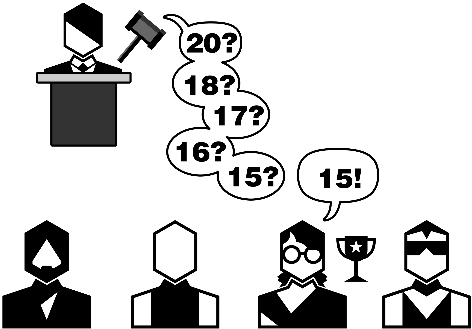
A simultaneous single-bid system in which the lot starts at a very high price and then is gradually decreased by the auctioneer or other controlling mechanism until someone agrees to claim the item at its current price, ending the auction. The first bidder to accept the current price is the winner, such that there are no ties. A Dutch Auction is sometimes also called a one-bid auction because of this feature that the first bid made is also the only bid in the auction.
Discussion
The Dutch Auction has a storied history, having been invented in the seventeenth century in Holland to manage the sale and trade of tulip bulbs that arrived in Holland via the Ottoman Empire. A Dutch Auction maximizes the price at which a good is sold and incentivizes buyers to act quickly since once a bid is made, there is no opportunity to counter the bid; the auction is over! Dutch Auctions only work well when there is a single item up for bid or a single lot. All bidders must receive information of the offer price dropping simultaneously and must be able to respond immediately. Any bidder with an informational time lag is highly disadvantaged in this kind of auction,
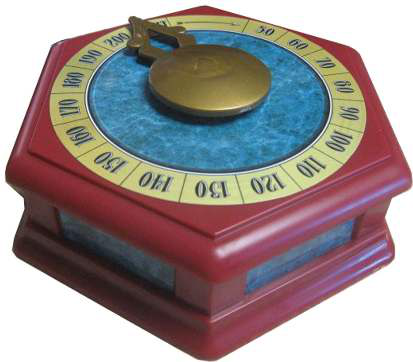
whether that time lag is on hearing the newly announced price or in submitting a bid (Illustration 8.2). One way to execute a Dutch Auction is with an actual clock that counts down prices, as in Merchants of Amsterdam, but the componentry alone makes this an unusual approach. Dutch Auctions spread over multiple turns are very common in board games and are often implemented as a row or river of cards. Each position in the row is tied to a price and players may purchase a card from any position. When a card is purchased, more expensive cards slide down and become cheaper. In many games, the last card is free, and in others, the cheapest card will disappear from the market every turn and a new card will enter at the pricey side. Examples of this market row include Suburbia, Pax Pamir Second Edition, and Trough the Ages. A common variant can be seen in Small World, in which players can purchase the first card in the row for free or pay one coin per card they want to bypass until they reach the card they wish to purchase. The trick here is that a player acquires any coins on a card they purchase, which means it’s not necessary to have a card-clearing mechanism in the market. Eventually, the first option will be worth taking for the coins piled on it. This implementation isn’t strictly a traditional Dutch Auction, since more than one good is up for auction at the same time. It’s also typically mediated Illustration 8.2 The Dutch Auction clock from Merchants of Amsterdam. The dial rotates automatically via a spring mechanism. The first player to slap the center button stops the clock and pays the currently indicated price.
by turn order: you can only make a purchase on your turn. Because of different mechanisms for adjusting the market each turn, every player does not have an equal opportunity to pay any price they wish for a given good. In some cases, like Trough the Ages, calculating at what cost a card will become available to you and manipulating that price by purchasing cards that are cheaper and forcing cards to slide down multiple positions is a key strategy. Despite some of these issues, the market row has become a staple of game design and a favorite method for reasonably fair resource allocation. The logic of this mechanism can sometimes find its way into worker placement games. For example, in Agricola, some buildings will accumulate resources if nobody places a worker there. Eventually, the rewards available are so rich that someone claims them. Trough the lens of the Dutch Auction, we’d say that the price per share kept going down until a buyer was willing to purchase the whole lot. This isn’t quite a Dutch Auction, it’s really an auction with a fixed price (one worker, though it could be a monetary price in a different context) but in which the rewards increase. However, note that unlike traditional auctions, this auction shares a primary feature with Dutch Auctions, which is that the value moves in favor of the buyer. Dutch Auctions use price to effectuate this, rather than the size of return, but they are conceptually quite similar. Dutch Auctions as implemented through market rows are quite a robust and durable solution for game designers. Tey typically don’t take up too much board space, they’re ergonomic, decisive, quick, and make for interesting decisions. In some games, like Morels, or Majesty: For the Realm, they can be a bit tedious when it comes to constantly sliding down cards. Vikings uses an ingenious wheel mechanism to address this situation elegantly by placing the prices on the wheel and rotating it to adjust the prices of the tiles laid around its perimeter. Designers will frequently turn to this river-of-lots mechanism when using some non-monetary currency for resource acquisition. The aforementioned Trough the Ages uses an Action Point currency (ACT-01) for card acquisition. Tough Small World themes the cost as monetary, money is worth an equal number of victory points, so the actual cost to acquire a lot is victory points. This mechanism is also quite amenable to variations involving allowing players to reserve a card in the market for purchase later at a lower price or claiming a card so that its eventual acquisition cost is paid directly to the player.
Sample Games
Agricola (Rosenberg, 2007) Majesty: For the Realm (Andre, 2017) Merchants of Amsterdam (Knizia, 2000) Morels (Povis, 2012) Pax Pamir Second Edition (Wehrle, 2019) Small World (Keyaerts, 2009) Suburbia (Alspach, 2012) Trough the Ages: A Story of Civilization (Chvátil, 2006) Vikings (Kiesling, 2007)
描述
一种同时进行的一次性出价系统,其中拍品以非常高的价格开始,然后由拍卖师或其他控制机制逐渐降低,直到有人同意以当前价格认领该物品,从而结束拍卖。第一个接受当前价格的竞标者是获胜者,以免出现平局。由于第一个叫价也是拍卖中的唯一叫价,因此荷式拍卖有时也称为一次性出价拍卖。
讨论
荷式拍卖有着悠久的历史,它是17世纪在荷兰发明的,用于管理通过奥斯曼帝国抵达荷兰的郁金香球茎的销售和贸易。荷式拍卖最大化了商品的销售价格,并激励买家迅速行动,因为一旦有人出价,就没有反击出价的机会;拍卖结束了!荷式拍卖只有在有一个待拍卖物品或一个批次时才有效。所有竞标者必须同时收到报价下跌的信息,并且必须能够立即做出反应。任何有信息时间滞后的竞标者在这种拍卖中都处于非常不利的地位,
无论是听到新公布价格的时间滞后还是提交报价的时间滞后(插图8.2)。执行荷式拍卖的一种方法是使用实际的时钟来倒数价格,如在《Merchants of Amsterdam》中,但仅组件就使这成为一种不寻常的方法。分布在多个回合中的荷式拍卖在棋盘游戏中非常常见,通常实现为一行或一条卡牌河。行中的每个位置都与价格相关联,玩家可以从任何位置购买卡牌。当这卡牌被购买时,更昂贵的卡牌向下滑动并变得更便宜。在许多游戏中,最后一张牌是免费的,而在其他游戏中,最便宜的牌将在每回合从市场上消失,一张新牌将进入昂贵的一侧。这种市场行的例子包括《Suburbia》、《Pax Pamir Second Edition》和《历史巨轮》(Through the Ages)。在《小世界》(Small World)中可以看到一个常见的变体,玩家可以免费购买行中的第一张牌,或者为他们想要跳过的每张牌支付一枚硬币,直到他们到达他们想要购买的牌。这里的诀窍是,玩家获得他们购买的卡上的任何硬币,这意味着市场上不必有清卡机制。最终,第一个选择将值得为堆积在上面的硬币而采取。这种实现并不严格是传统的荷式拍卖,因为有不止一种商品同时待拍卖。它通常也由
插图 8.2 《Merchants of Amsterdam》中的荷式拍卖钟。表盘通过弹簧机构自动旋转。第一个拍下中心按钮的玩家停止时钟并支付当前指示的价格。
回合顺序调节:你只能在你的回合进行购买。由于每回合调整市场的机制不同,每个玩家并没有平等的机会为给定商品支付他们希望的任何价格。在某些情况下,如《历史巨轮》中,计算卡牌以何种成本变得对你可用,并通过购买更便宜的卡牌并迫使卡牌向下滑动多个位置来操纵该价格是关键策略。尽管有这些问题,但这市场行已成为游戏设计的主要内容,也是合理公平资源分配的最爱方法。这种机制的逻辑有时可以进入工人放置游戏。例如,在《农场主》(Agricola)中,如果没人放置工人,某些建筑物会积累资源。最终,可用的奖励如此丰富,以至于有人认领它们。通过荷式拍卖的镜头,我们会说每股价格一直在下降,直到买家愿意购买整批商品。这不完全是荷式拍卖,它实际上是一个固定价格的拍卖(一个工人,尽管在不同的背景下可能是货币价格),但奖励会增加。然而,请注意,与传统拍卖不同,这种拍卖与荷式拍卖共享一个主要特征,即价值向有利于买家的方向移动。荷式拍卖利用价格来实现这一点,而不是回报的大小,但它们在概念上非常相似。通过市场行实施的荷式拍卖对于游戏设计师来说是一个相当强大和耐用的解决方案。它们通常不会占用太多版图空间,它们符合人体工程学,果断,快速,并做出有趣的决定。在某些游戏中,如《Morels》或《Majesty: For the Realm》,当涉及到不断向下滑动卡牌时,它们可能会有点乏味。《Vikings》使用巧妙的轮子机制优雅地解决了这种情况,通过将价格放在轮子上并旋转它来调整围绕其周边放置的板块的价格。当使用某种非货币进行资源获取时,设计师经常会转向这种批量流机制。前面提到的《历史巨轮》使用行动点货币(ACT-01)获取卡牌。尽管《小世界》将成本定为货币,但金钱值等量的胜利点数,因此获得一批商品的实际成本是胜利点数。此机制也非常适合变体,涉及允许玩家在市场上保留一张卡以便稍后以较低价格购买,或者认领一张卡,使得其最终获取成本直接支付给玩家。
游戏范例
Agricola (Rosenberg, 2007) - 《农场主》 Majesty: For the Realm (Andre, 2017) - 《Majesty: For the Realm》 Merchants of Amsterdam (Knizia, 2000) - 《Merchants of Amsterdam》 Morels (Povis, 2012) - 《Morels》 Pax Pamir Second Edition (Wehrle, 2019) - 《Pax Pamir Second Edition》 Small World (Keyaerts, 2009) - 《小世界》 Suburbia (Alspach, 2012) - 《Suburbia》 Trough the Ages: A Story of Civilization (Chvátil, 2006) - 《历史巨轮》 Vikings (Kiesling, 2007) - 《维京人》(Vikings)