Description
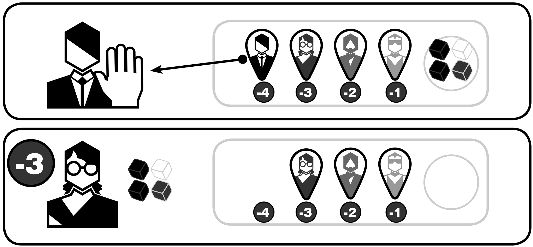
A Dutch Priority Auction, a term of our own invention, is a multiple-lot auction in which prices for the lots are determined based on the number of bids placed on the lots up for bid. The winning bidder is the first player, in bid priority, who chooses to pay the current price for a lot, which is equal to the number of bidding tokens there. Priority may be determined by a variety of factors, including global turn order or turn order for each lot based on the order of bid placement. Players may typically pass on the purchase when they are the priority bidder by removing their bidding token. This has the effect of reducing the price for the lot by one.
Discussion
A Dutch Priority Auction has features of a Dutch, or descending-bid auction, coupled with an ordered, turn-based bidding system to help direct traffic and coordinate the sale of multiple lots simultaneously. In this system, prices will initially move toward the seller (i.e., they’ll rise) as bids are added and then move back toward the buyers as prices descend when bidders decline to buy at a given price. Unlike a traditional Dutch auction, in which any player may accept the going price and end the auction by calling out, a Dutch Priority Auction determines an active player, the priority player, who may choose to accept the going price or pass. In Die Speicherstadt (available in the US as Jórvík, with a Viking theme and some minor balance tweaks), this priority is determined in an initial round of bid-marker placement. Earlier placement provides earlier priority in the auction resolution phase (Illustration 8.5).
The priority player may choose to pass. In most cases, passing means removing a bid marker and thus lowering the asking price by one. Usually, passing in this kind of auction simply means not acting at this time. If the passing player has another bid marker at a lower priority, should the auction continue until that marker comes up, the player will be allowed to purchase the lot at that time. Spyrium adds another element to this core, which is that a player, when passing, receives money equal to the bid markers remaining on the lot. The choice is between a current purchase at a higher price and receiving an equal amount of money but passing on the purchase. In some cases, an early pass can fund a later purchase of the same lot! The effect of this style of auction is to require players to declare the lots they’re interested in, somewhat separately from the price. Players may not have enough bid markers to claim the right to bid on every lot they like and must restrict themselves to only those lots that are most meaningful to them. However, bid markers must do double-duty. Tey can not only be used to stake out lots that a player desires but must also be used to raise prices on other players. There is no other way to raise the price for a lot except to place a Illustration 8.5 The board in Die Speicherstadt. In the position shown, Blue would have the first option to purchase the Counting Office, for four coins. If they choose not to, White would have the next option, at two coins (since is no reason for them to pay for their first meeple). If White declines, Purple may purchase it for one coin.
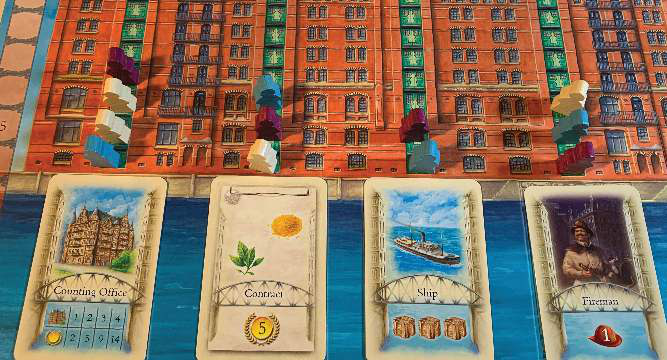
bid marker on it. Bid markers placed late in the first phase may have no other function since they are late in the priority order for auction resolution too.
Sample Games
Die Speicherstadt (Feld, 2010) Jórvík (Feld, 2016) Spyrium (Attia, 2013)
描述
荷式优先权拍卖(Dutch Priority Auction),这是我们要自己发明的一个术语,是一种多批次拍卖,其中批次的价格基于对拍卖批次的出价数量确定。中标者是出价优先级中的第一个选择支付当前批次价格的玩家,该价格等于那里的出价标记数量。优先级可以由各种因素确定,包括全局回合顺序或基于出价放置顺序的每个批次的回合顺序。当玩家是优先竞标者时,通常可以通过移除他们的出价标记来放弃购买。这具有将批次价格降低一个的效果。
讨论
荷式优先权拍卖具有荷式或降价拍卖的特征,再加上有序的、基于回合的竞标系统,以帮助同时引导流量和协调多个批次的销售。在这个系统中,随着出价的增加,价格最初将向卖方移动(即它们会上涨),然后在竞标者拒绝以给定价格购买时,随着价格下降而移回买方。与传统的荷式拍卖不同,在传统的荷式拍卖中,任何玩家都可以接受现价并通过叫喊结束拍卖,荷式优先权拍卖确定一名活跃玩家,即优先玩家,他可以选择接受现价或放弃。在《仓城奇兵》(在美国以《Jórvík》发售,带有维京主题和一些小的平衡调整)中,此优先级是在竞标标记放置的初始回合中确定的。较早的放置在拍卖解决阶段提供较早的优先级(插图8.5)。
优先玩家可以选择放弃。在大多数情况下,放弃意味着移除出价标记,从而将要价降低一个。通常,这种拍卖中的放弃仅仅意味着此时不采取行动。如果放弃的玩家在较低优先级有另一个出价标记,如果拍卖继续直到该标记出现,玩家将被允许在那个时候购买该批次。《Spyrium》在这个核心上增加了另一个元素,即玩家在放弃时,会收到等于批次上剩余出价标记数量的金钱。选择是在以较高价格当前购买和接收等量金钱但放弃购买之间进行的。在某些情况下,早期的放弃可以资助以后购买同一批次!这种拍卖风格的效果是要求玩家声明他们感兴趣的批次,这有些独立于价格。玩家可能没有足够的出价标记来宣称对他们喜欢的每一个批次进行出价的权利,并且必须限制自己只对那些对他们最有意义的批次进行出价。然而,出价标记必须承担双重责任。它们不仅可以用来标记玩家渴望的批次,还必须用来向其他玩家抬高价格。除了放置
插图 8.5 《仓城奇兵》中的版图。在所示位置,蓝色将有第一个选择以四个硬币购买会计室。如果他们选择不买,白色将有下一个选择,两个硬币(因为他们没有理由为他们的第一个米宝付款)。如果白色拒绝,紫色可以以一个硬币购买它。
出价标记外,没有其他方法可以提高批次的价格。在第一阶段后期放置的出价标记可能没有其他功能,因为它们在拍卖解决的优先顺序中也很晚。
游戏范例
仓城奇兵 (Feld, 2010) - 《仓城奇兵》 Jórvík (Feld, 2016) - 《Jórvík》 Spyrium (Attia, 2013) - 《Spyrium》