Description
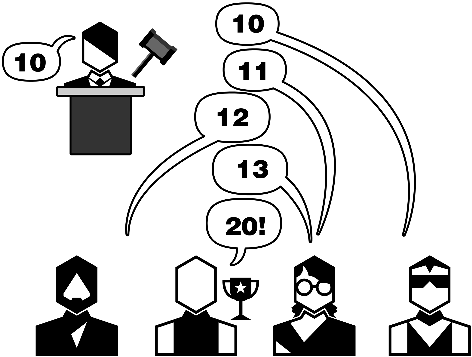
An auctioneer asks for bids of a certain amount and players indicate their willingness to bid at that amount, usually by holding up a hand or paddle, or by calling out. Players are permitted to adjust the increment of the bid, usually by shouting out their actual bid, though this is done infrequently, and usually either to indicate a smaller increment than the auctioneer requests or a much larger one. When a certain amount of time elapses with no increases, or it is clear that no one wishes to raise the current bid, the auctioneer declares that the high bidder is the winner.
Discussion
The English Auction is probably what most people think of when they hear the word “auction.” The auctioneer, at the front of the room, speaking in a too-fast-to-follow cadence while various bidders use paddles to signal their intent to bid in ever-increasing amounts until, at last, the “going, going, gone!” is sounded and the winning bid is declared. The primary differences between an English and an Open Auction are in their governance. An English Auction employs an auctioneer to recognize bidders, to determine which bids are valid, who the current winning bid is, and what is the appropriate bid increment to maximize the settlement price
of the auction, while also bringing the auction to a swift conclusion. The compensation of auctioneers in the real world suggests that these skills are non-trivial and that better auctioneers execute better auctions, which pro-duce higher prices for sellers. For designers, the need for an auctioneer can make English Auctions less appealing, even though the benefits they provide in terms of certainty, fairness, and speed are substantial. Fortunately, designers can turn to a variety of similar auctions that capture those benefits without requiring mediation— including auctions in which the auctioneer may bid. We’ll look at those in the next sections. An overlooked feature of English Auctions is that the price of the auction moves against the preferences of the bidders—that is, it goes up. While that’s what most of us think of when we think of auctions, there are auctions in which the price moves the other way, starting at some high number and then moving down. See Dutch Auction (AUC-08) as an example. English Auctions are dynamic and dramatic, but they share the core of the Open Auction in that they reveal a lot of information to the bidders about one another, and they have a weakly dominant strategy of simply staying in the bidding until your value is reached. There are some other strategies that bidders employ though, whose effects are primarily psychological. Players might make a large jump in bid increment to intimidate other bidders, or they might leave their paddle in the air (aka “lighthouse bidding”) to show they’re in for the long haul. Bidding quickly and crisply is another way to demonstrate an intention to stay in the bidding for a while. These strategies may have the desired effect of driving other players off, but they can also inadvertently raise prices beyond what was necessary to win the auction. Finally, a player may make a bid that is larger than her own value for the lot in order to inflate the final settlement price of the auction. This move can backfire, however, if no other bidder raises the bid further. An important aspect of English Auctions, and auctions with auctioneers more generally, is to whom the closing price is paid. In some auctions, rather than paying the bank, the player who chooses the item up for bid receives payment, unless they are the winner of the item, in which case payment is made to the bank. In practice, the result of this mechanism, which is featured in Modern Art, is that the auctioneer player, the one who put the item up for bid, very rarely purchases it, because effectively, they pay double: the cost of the item and the forgone gains from letting someone else win it and collecting the payment. Tus, effectively, the player who puts the item up for bid plays as the auctioneer, rather than an active bidder, for the duration of that auction.
The dynamic and engaging nature of English Auctions is exciting, but designers will typically have to turn to another mechanism for implementation at the table in games where the auction is not the centerpiece.
Sample Games
Chicago Express (Wu, 2007) Modern Art (Knizia, 1992)
描述
拍卖师通过要求一定金额的出价,玩家表示他们愿意以该金额出价,通常是举手或举牌,或者大声喊出。玩家被允许调整出价增量,通常是通过大声喊出他们的实际出价,尽管这种情况很少见,而且通常要么表示比拍卖师要求的增量更小,要么是更大的增量。当经过一定时间没有增加,或者很明显没有人希望提高当前出价时,拍卖师宣布最高出价者为获胜者。
讨论
英式拍卖可能是大多数人听到“拍卖”这个词时想到的。拍卖师在房间前面,以快得让人跟不上的节奏说话,而各个竞标者使用牌子表示他们愿意以不断增加的金额出价,直到最后响起“第一次,第二次,成交!”,并宣布中标。英式拍卖和公开拍卖之间的主要区别在于它们的治理。英式拍卖雇用拍卖师来识别竞标者,确定哪些出价有效,当前中标是多少,以及适当的出价增量是多少以最大化结算价格
同时也使拍卖迅速结束。现实世界中拍卖师的报酬表明,这些技能是非常重要的,更好的拍卖师执行更好的拍卖,从而为卖方产生更高的价格。对于设计师来说,尽管英式拍卖在确定性、公平性和速度方面提供了巨大的好处,但需要拍卖师可能会使其吸引力降低。幸运的是,设计师可以使用各种类似的拍卖来捕捉这些好处而无需中介——包括拍卖师可以出价的拍卖。我们将在下一节中看看这些。英式拍卖的一个被忽视的特征是拍卖价格违背竞标者的偏好移动——即它会上涨。虽然这是当我们想到拍卖时大多数人想到的,但也有价格反向移动的拍卖,从某个高数字开始然后向下移动。参见荷式拍卖(AUC-08)作为一个例子。英式拍卖充满活力和戏剧性,但它们与公开拍卖有着相同的核心,即它们向竞标者透露了大量关于彼此的信息,并且它们有一个弱优势策略,即简单地留在竞标中直到达到你的价值。不过,竞标者也会采用其他一些策略,其效果主要是心理上的。玩家可能会大幅增加出价增量以恐吓其他竞标者,或者他们可能会将牌子举在空中(又名“灯塔竞标”)以表明他们打算长期坚持。快速而干脆地出价是另一种表明打算在竞标中停留一段时间的方式。这些策略可能会达到赶走其他玩家的预期效果,但也可能无意中将价格提高到超出赢得拍卖所必需的水平。最后,玩家可能会做出大于她自己对拍品估值的出价,以提高拍卖的最终结算价格。然而,如果没有其他竞标者进一步提高出价,这一举动可能会适得其反。英式拍卖以及更普遍的有拍卖师的拍卖的一个重要方面是成交价支付给谁。在某些拍卖中,选择待拍物品的玩家不是向银行付款,而是收到付款,除非他们是物品的赢家,在这种情况下,向银行付款。在实践中,这种机制及其在《现代艺术》(Modern Art)中的特色结果是,拍卖师玩家,即拿出物品进行拍卖的人,很少购买它,因为实际上,他们支付双倍:物品的成本和放弃让别人赢得并收取款项的收益。因此,实际上,拿出物品进行拍卖的玩家在该拍卖期间扮演拍卖师,而不是活跃的竞标者。
英式拍卖的动态和引人入胜的性质令人兴奋,但在拍卖并非核心的游戏中,设计师通常不得不转向另一种机制在桌面上实施。
游戏范例
Chicago Express (Wu, 2007) - 《芝加哥快递》 Modern Art (Knizia, 1992) - 《现代艺术》