Description
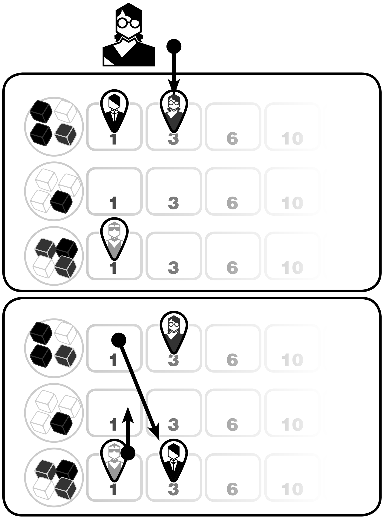
Fixed Placement is a meta-mechanism that modifies a multiple-lot auction by creating rules about which lots players may bid on and representing bids visually on a board or cards. It is often combined with constrained-value bids. A Fixed-Placement auction ends when every player passes and/or no player has the right to bid further. The highest bidder for each lot wins the lot.
Discussion
Multiple-Lot Auctions are fairly common in board games. These auctions introduce a new wrinkle into bidding by forcing players to evaluate several lots at once. Depending on bid timing rules, there may also be strategic elements to sequencing your bids or forcing an auction to close early. Multiple-Lot Auctions present some challenges to tracking. How should the top bid be represented for each lot? What rules should govern bid order?
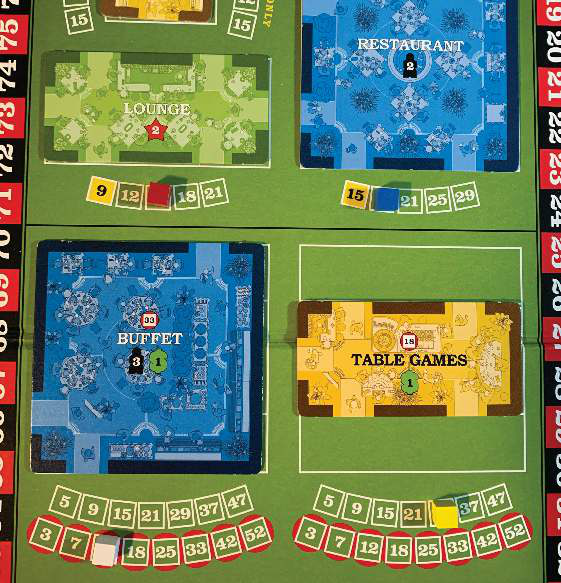
How can the game prevent multiple-lot bidding from devolving into a series of one-lot auctions, in which players ignore all but one lot up for bid at a time? Fixed Placement can help solve all of these problems. Visually, FixedPlacement Auctions provide a track on which players can mark the value of their bid using a player pawn. The right to bid can be governed by turn order. In some games, like Amun-Re, turn order is interrupted whenever a player is outbid. That player becomes the active player, who takes the bid marker representing the bid that was just surpassed and makes another valid bid with it, on another lot. The entire auction ends when each player is the top bidder for some lot. In Cyclades, there are more lots than there are players, but each player has only a single bidding token, so each player will win exactly one auction and some lots will go unpurchased each turn. Critically, in both of these games, a player may not immediately rebid on the lot for which they were just outbid. This rule encourages players to bid close to their actual value for a lot, since if they bid lower, they may not have an opportunity to return to rebid on that lot. In theory, this should speed these auctions, though, in practice, new players may evaluate this dynamic incorrectly, leading to frustration and overlong analysis. Both of these games also feature triangular increases in valid bid increments, which prevents the tit-for-That, raise-by-one bidding that can grind an auction to a near-halt (Illustration 8.4). In Vegas Showdown, bids are submitted strictly in turn order. Bidding too low has multiple consequences: not only will a player be outbid but they will have to wait until the next turn to bid. In the meantime, other players will get to place bids, potentially raising the costs of lots the passed player was interested in purchasing. Vegas Showdown does allow immediately rebidding on the same lot, though the value of the next valid bid increases in a delayed triangular pattern (each interval is repeated three times before increasing). Perhaps the greatest strength of Fixed Placement is that it offers an opportunity to integrate bidding with other game actions. Since there is a visible record of current bids, a design can invite players to take unrelated actions, instead of restricting bidding to its own phase. While Vegas Showdown takes advantage of this feature, there remains a lot of design space here.
Sample Games
Amun-Re (Knizia, 2003) Cyclades (Cathala and Maublanc, 2009) Vegas Showdown (Stern, 2005)
Illustration 8.4 The auction tracks from Vegas Showdown. Each player places a token on the track to indicate their bid on that lot. If a token is overbid, it is returned to the owner to be placed again.
描述
固定位置(Fixed Placement)是一种元机制,通过创建有关玩家可以出价的批次的规则并在版图或卡牌上直观地表示出价来修改多批次拍卖。它通常与受限价值出价相结合。当每位玩家都放弃和/或没有玩家有权进一步出价时,固定位置拍卖结束。每个批次的最高出价者赢得该批次。
讨论
多批次拍卖在棋盘游戏中相当普遍。这些拍卖通过迫使玩家一次评估多个批次,为竞标引入了新的皱褶。根据出价时间规则,排序你的出价或迫使拍卖提前结束也可能有战略因素。多批次拍卖给跟踪带来了一些挑战。每个批次的最高出价应该如何表示?什么规则应该管理出价顺序?
游戏如何防止多批次竞标退化为一系列单批次拍卖,其中玩家忽略除一个待拍批次以外的所有批次?固定位置可以帮助解决所有这些问题。在视觉上,固定位置拍卖提供了一条轨道,玩家可以在其上使用玩家棋子标记其出价的价值。出价的权利可以由回合顺序管理。在某些游戏中,如《Amun-Re》,每当玩家被出价超过时,回合顺序就会中断。该玩家成为活跃玩家,拿着代表刚刚被超过的出价的竞标标记,并用它在另一个批次上进行另一次有效出价。当每个玩家都是某个批次的最高出价者时,整个拍卖结束。在《Cyclades》中,批次比玩家多,但每个玩家只有一个竞标标记,因此每个玩家将恰好赢得一次拍卖,并且每回合有些批次将未被购买。至关重要的是,在这两个游戏中,玩家不可以立即对他们刚刚被出价超过的批次重新出价。这条规则鼓励玩家接近其实际价值出价,因为如果他们出价较低,他们可能没有机会回来对该批次重新出价。理论上,这应该加快这些拍卖的速度,尽管在实践中,新玩家可能会错误地评估这种动态,导致沮丧和过长的分析。这两款游戏都具有有效出价增量的三角形增加,这防止了以牙还牙、加一竞标,这可能会使拍卖几近停滞(插图8.4)。在《Vegas Showdown》中,严格按照回合顺序提交出价。出价太低有多种后果:不仅玩家会被出价超过,而且他们还必须等到下一回合才能出价。与此同时,其他玩家将有机会出价,可能会提高放弃玩家感兴趣购买的批次的成本。《Vegas Showdown》确实允许立即对同一批次重新出价,尽管下一个有效出价的价值以延迟的三角形模式增加(每个间隔重复三次然后增加)。也许固定位置的最大优势在于它提供了将竞标与其他游戏动作结合起来的机会。由于有当前出价的可见记录,设计可以邀请玩家采取无关的行动,而不是将竞标限制在其自己的阶段。虽然《Vegas Showdown》利用了这一功能,但这里仍有很大的设计空间。
游戏范例
Amun-Re (Knizia, 2003) - 《阿蒙拉》 Cyclades (Cathala and Maublanc, 2009) - 《基克拉德斯》 Vegas Showdown (Stern, 2005) - 《Vegas Showdown》
插图 8.4 《Vegas Showdown》的拍卖轨道。每个玩家在轨道上放置一个标记以指示他们对该批次的出价。如果标记被超过,它将返回给所有者以再次放置。