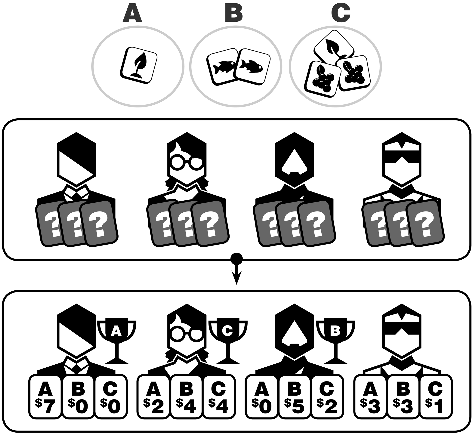
Description
An auction in which players simultaneously bid on Multiple Lots in parallel, instead of bidding for one lot at a time, serially.
Discussion
Multiple-Lot Auctions are very common in tabletop board games because they compress the time it takes to allocate lots among the players. The physical affordances of board games, like tableaus and player-colored tokens, all lend themselves to organizing and displaying information needed to run these types of auctions clearly. Multiple-Lot Auctions ask players to manage two different axes of decision-making at the same time: which lots to bid on and how to divide the money between those lots. In a serial auction, a player’s valuation of a later lot might change dramatically based on winning or losing a previous lot. In an extreme case, like Fresh Fish, once a player has won a fish market stall, they do not bid at all for a second fish market stall. Simultaneous auctions don’t have this kind of rebalancing of player valuations (Illustration 8.3).
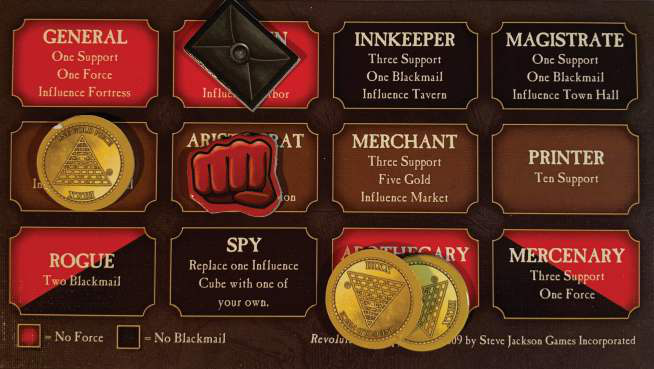
Another interesting characteristic of Multiple-Lot Auctions is that the lots themselves may be of entirely different types. A classic Gamemaster game, originally called Shogun (and later Samurai Swords and Ikusa) features a Multiple-Lot Bid in which players secretly allocate money to a mix of auctions and market purchases. Players can assign money to bid for turn order and for the services of the ninja. The rest of their money can be allocated to build fortifications, hire ronin, and levy additional units. Upon revealing their secret allocations, the auctions for turn order and ninja are resolved, and players can then use the other allocated funds to purchase their fortifications, ronin, and other units. Not only are the benefits of turn order and the ninja quite different from purchasing units or defensive structures but also the auctions themselves operate by somewhat different rules. Any players bidding on turn order will receive priority over non-bidders in choosing their preferred ordering—their bid grants them some benefit, even if they are not the highest bidder. However, the ninja auction is an all-pay auction, but only the highest bidder receives the services of the ninja. If the top bidders are tied, they will pay, but none of them get to use the ninja! Illustration 8.3 The bidding board from Revolution. Each player has one of these boards and allocates different currencies (gold, force, and blackmail) to the different spaces, behind a screen. When all players have allocated their currencies as desired, the screens are revealed, and each space is reviewed to determine the auction winner.
Multiple-Lot Auctions bear a very close resemblance to another game mechanism: Area Majority (ARC-02). Tough area majority games often model military conflicts, as in El Grande, they are mathematically similar to Multiple-Lot Auctions. The troops, or influence cubes, etc. can be abstracted to bidding tokens, and the player with the highest bids wins the lot. Area majority games typically offer rewards to more than only the highest bidder. This is a nested Multiple-Lot Auction. Each different area that players seek to influence houses its own set of lots, worth different amounts of victory points to bidders. Multiple-Lot Auctions are compatible with many other auction mechanisms like Fixed-Placement Auction (AUC-15), Sealed-Bid Auction (AUC04), and Dutch Priority Auction (AUC-16). Teir resolution can be all-pay, winner-pay, cancellation, and others. In some Multiple-Lot Auctions, players are limited in how many lots or how many types of lots they can win too. This mechanism is among the most common and most flexible in the auction family.
Sample Games
El Grande (Kramer and Ulrich, 1995) Fresh Fish (Friese, 2014) Revolution! (duBarry, 2009) Shogun/Samurai Swords/Ikusa (Gray, 1986)
描述
玩家同时并行竞标多个批次(Multiple Lots),而不是一次一个地串行竞标一个批次的拍卖。
讨论
多批次拍卖在桌面棋盘游戏中非常常见,因为它们压缩了在玩家之间分配批次所需的时间。棋盘游戏的物理功能,如画面和玩家颜色的代币,都有助于组织和显示清楚运行此类拍卖所需的信息。多批次拍卖要求玩家同时管理两个不同的决策轴:竞标哪些批次以及如何在这些批次之间分配资金。在系列拍卖中,玩家对后期批次的估值可能会根据赢得或输掉之前的批次而发生巨大变化。在极端情况下,如《Fresh Fish》,一旦玩家赢得了鱼市场摊位,他们根本不会为第二个鱼市场摊位出价。同时拍卖没有这种玩家估值的重新平衡(插图8.3)。
多批次拍卖的另一个有趣特征是,批次本身可能属于完全不同的类型。经典的Gamemaster游戏,最初名为《Shogun》(后来名为《Samurai Swords》和《Ikusa》),具有多批次出价,其中玩家秘密将资金分配给混合拍卖和市场购买。玩家可以分配资金来竞标回合顺序和忍者的服务。他们剩下的钱可以分配给建造防御工事、雇佣浪人和征集额外部队。在揭示他们的秘密分配后,回合顺序和忍者的拍卖得到解决,玩家随后可以使用其他分配的资金购买他们的防御工事、浪人和其他部队。回合顺序和忍者带来的好处不仅与购买单位或防御结构截然不同,而且拍卖本身也按稍有不同的规则运作。任何竞标回合顺序的玩家将在选择他们喜欢的顺序时优先于非竞标者——即使他们不是最高出价者,他们的出价也会给予他们一些好处。然而,忍者拍卖是一场全付拍卖,但只有最高出价者才能获得忍者的服务。如果最高出价者平局,他们将付款,但他们中没有人能使用忍者!
插图 8.3 来自《Revolution》的竞标板。每位玩家都有这样一块板,并在屏幕后面将不同的货币(金币、武力和勒索)分配给不同的空间。当所有玩家都按意愿分配货币时,屏幕揭开,并审查每个空间以确定拍卖获胜者。
多批次拍卖与另一种游戏机制非常相似:区域多数(Area Majority, ARC-02)。尽管区域多数游戏通常模拟军事冲突,如在《El Grande》中,它们在数学上类似于多批次拍卖。部队或影响力立方体等可以抽象为竞标标记,出价最高的玩家赢得批次。区域多数游戏通常向不仅仅是最高出价者提供奖励。这是一个嵌套的多批次拍卖。玩家寻求影响的每个不同区域都有其自己的一组批次,对竞标者来说价值不同数量的胜利点数。多批次拍卖与许多其他拍卖机制兼容,如固定位置拍卖(AUC-15)、密封竞价拍卖(AUC-04)和荷式优先权拍卖(AUC-16)。它们的解决可以是全付、获胜者付、取消等。在某些多批次拍卖中,玩家在可以赢得多少批次或多少类型的批次方面也受到限制。这种机制是拍卖家族中最常见和最灵活的机制之一。
游戏范例
El Grande (Kramer and Ulrich, 1995) - 《大王》 Fresh Fish (Friese, 2014) - 《Fresh Fish》 Revolution! (duBarry, 2009) - 《革命!》 Shogun/Samurai Swords/Ikusa (Gray, 1986) - 《幕府将军/武士刀/战国》