Description
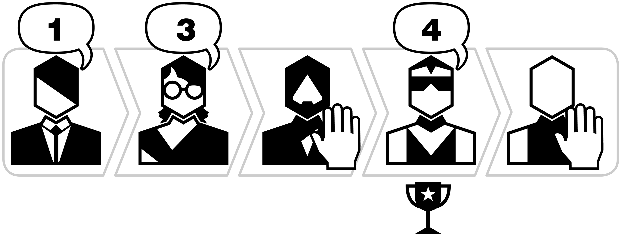
The players each have one opportunity to bid, either passing or raising the prior bidder. The order of bids is determined by one of the Turn Order structures. After the last player has the opportunity to bid, the high bidder wins.
Discussion
The Once-Around Auction structure takes a straightforward approach to shortening auctions by simply collapsing the whole auction into one round. This works very well for speeding the auction, but it does have disparate impacts on players depending on their position in the turn order. The first player is faced with the substantial challenge of making a bid without any other information. Teir bid will set the market and is vulnerable to being outbid by any player, who can bid as little as one dollar more. By contrast, the last player in turn order has perfect information. Tey know exactly how much to bid to win the lot. Often, the player in the next-to-last place is faced with a lot that is relatively inexpensive, but which they do not want. However, they feel like they must police the auction and raise the bid to prevent the last player from getting a windfall and, in doing so, take the risk of having to purchase a lot they did not want at a relatively high price. Whether the strong left-right binding (the term used to describe games that are strongly impacted by turn order and, specifically, the players seated to the right and left of a given player) of this mechanism is positive or negative is largely a matter of perspective, but it is something to design around.
For example, turn order can itself be priced in such a manner that the advantage provided by going last in the auction is accounted for. Alternatively, going first in other aspects of the game may be quite powerful, to help balance the disadvantage of going first in the auction. Another approach is to use constrained bids that require bidders to raise the current winning bid by a more substantial increment, or to provide the first bidder with the right to match the final bid and take the lot. Once-Around Auctions aren’t that common in modern designs, having been superseded by Sealed-Bid Auction (AUC-04) that are agnostic to turn order or by drafting mechanisms that eliminate the role of currency entirely. Generally, they should be used when tight coupling to turn order is desirable and turn order is central to the design.
Sample Games
Medici (Knizia, 1995) Modern Art (Knizia, 1992) New Amsterdam (Allers, 2012) Tin Goose (Clakins, 2016)
描述
玩家每人有一次出价机会,要么放弃,要么提高前一位出价者的出价。出价顺序由回合顺序结构之一决定。最后一名玩家有机会出价后,出价最高者获胜。
讨论
一轮拍卖(Once-Around Auction)结构采用一种直截了当的方法来缩短拍卖时间,只需将整个拍卖压缩到一轮即可。这对于加快拍卖速度非常有效,但根据玩家在回合顺序中的位置,它会对玩家产生不同的影响。第一个玩家面临着在没有任何其他信息的情况下出价的巨大挑战。他们的出价将设定市场,并且很容易被任何玩家出价超过,哪怕只多出一美元。相比之下,回合顺序中的最后一个玩家拥有完美的信息。他们确切地知道出价多少才能赢得批次。通常,倒数第二位的玩家面对的是相对便宜的拍品,但他们并不想要。然而,他们觉得他们必须监管拍卖并提高出价,以防止最后一名玩家获得意外之财,这样做就冒着不得不以相对较高的价格购买他们不想要的拍品的风险。这种机制的弱左右绑定(用于描述受回合顺序强烈影响的游戏的术语,特别是给定玩家左右两边的玩家)是积极的还是消极的,在很大程度上取决于视角,但这是设计中需要考虑的问题。
例如,回合顺序本身可以定价,以便考虑到在拍卖中最后行动所提供的优势。或者,在游戏的其他方面首先行动可能非常强大,以帮助平衡在拍卖中首先行动的劣势。另一种方法是使用受限竞价,要求竞标者以更大幅度的增量提高当前中标,或者向第一位竞标者提供匹配最终出价并获得拍品的权利。一轮拍卖在现代设计中并不常见,已被对回合顺序不可知的密封竞价拍卖(AUC-04)或完全消除了货币作用的轮抽机制所取代。通常,当希望与回合顺序紧密耦合并且回合顺序是设计的核心时,应使用它们。
游戏范例
Medici (Knizia, 1995) - 《美第奇》 Modern Art (Knizia, 1992) - 《现代艺术》 New Amsterdam (Allers, 2012) - 《New Amsterdam》 Tin Goose (Clakins, 2016) - 《Tin Goose》