Description
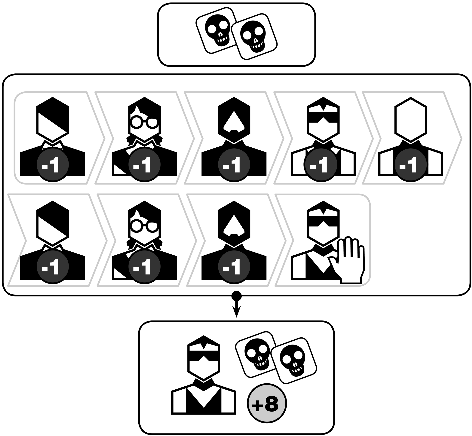
Players bid to avoid taking the lot up for bid because it has some negative effects. Common effects include a negative victory point value, or a requirement to discard something of value such as a resource or special ability. Typically, in a Reverse Auction all players, except the claimant of the lot, pay their bids. Sometimes, the lot claimant will receive those payments.
Discussion
No Tanks! is a classic example of Reverse Auctions. The structure of the auction is Turn Order Until Pass, with a constrained bid of one victory point per bid. Each lot is worth some number of points, but the winner of the game is the player with the fewest points. Bidding tokens cancel out one of these “bad” points, so they’re helpful toward winning the game. When a player passes, they take both the card and all the bidding tokens placed on the card. The key mechanism in the game is that each sequence of consecutive cards is worth bad points equal to the lowest card in the sequence. Tus, a “9” card is worth 9 bad points to all players, except for the player who already has the “10.” For that player, the “9” is actually worth a good point, because the “10”
card will no longer count against them, and instead they’ll get only 9 bad points. This twist, which leads to players having sharply different values for a given lot, creates a fascinating auction dynamic. In the world of classic card games, Hearts stands out as the ReverseAuction variant of the familiar trick-taking genre. In Hearts, players play with straightforward trick-taking rules but seek to avoid winning any hearts in the tricks they collect. Hearts are worth bad points … unless a player collects all of them (and the Queen of Spades) to “shoot the moon.” In that case, all the other players collect the bad points for that hand. While trick taking is its own mechanism, and indeed a genre of games unto itself, it has a close relationship with auctions, which is a topic we’ll explore in greater depth in Trick-Taking Games (CAR-01) in Chapter 13. Suffice it to say that trick taking is almost like a Once-Around Bidding Auction with multiple currencies. In most games, the tricks are inherently valuable, but in Hearts, they are only meaningful based on whether they contain hearts or the queen of spades. In High Society, players bid for valuable possessions and title cards via traditional auctions but have Reverse Auctions for Misfortune cards. The claimant of the Misfortune card recovers any money cards they previously bid to avoid taking the lot, but all other players must discard the money cards they bid. In this implementation, the lot up for bid defines the auction procedure. By contrast, Eggs & Empire, a simultaneous-bid multi-lot auction game, provides auctions that have both positive and negative lots mixed into the same auction. The player bidding the lowest will be forced to accept the negatively valued lot. One can think of this auction as a Reverse Auction in which bidders who avoid the negative lot receive an extra reward, or as a traditional all-pay auction in which the lowest bidder receives a penalty. Another similar hybrid auction can be seen in the Game of Trones board game. Players make simultaneous sealed bids of Power tokens to defeat the Wildlings. If the sum of the Power bid by the players is equal to or greater than the Wildlings’ strength, the Wildlings are defeated, and the highest bidder receives the benefit of reclaiming a discarded leader back into their hand. If, however, the sum of Power bid is less than the strength of the Wildlings, all players must remove two points worth of military units from the board. The lowest bidder must remove four points worth of units. As these examples demonstrate, a Reverse Auction is usually implemented within some more complex auction environment. In part, this may be because Reverse Auctions are inherently negative in experience. The “winner” receives a negative effect, and the “losers” all pay money. Everyone’s a loser! Because of this negative experience, designers use Reverse Auctions as a seasoning, a way
to flavor a game, rather than as its central mechanism. No Tanks! remains the seminal example of a Reverse Auction as the central mechanism of play.
Sample Games
Eggs & Empire (Pinchback and Riddle, 2014) A Game of Trones (Petersen and Wilson, 2003) Hearts (Unknown, 1850) High Society (Knizia, 1995) No Tanks! (Gimmler, 2004)
描述
玩家竞标是为了避免拿走待拍的批次,因为它有一些负面影响。常见的影响包括负胜利点数值,或要求丢弃有价值的东西,如资源或特殊能力。通常,在反向拍卖(Reverse Auction)中,除批次认领者外,所有玩家都支付他们的出价。有时,批次认领者将收到这些付款。
讨论
《No Tanks!》是反向拍卖的一个经典例子。拍卖的结构是直到放弃的回合顺序,每次出价一点胜利点数。每个批次都值一定数量的点数,但这游戏的赢家是点数最少的玩家。竞标标记抵消了其中的一个“坏”点,所以它们有助于赢得游戏。当玩家放弃时,他们拿走卡牌和放置在卡牌上的所有竞标标记。游戏的关键机制是每组连续的卡牌都值得等于序列中最低卡牌的坏点数。因此,一张“9”卡对所有玩家来说值9个坏点,除了已经拥有“10”的玩家。对于该玩家来说,“9”实际上值一个好点,因为“10”
卡将不再计入他们的分数,取而代之的是他们只得到9个坏点。这种转折导致玩家对给定批次的估值截然不同,创造了迷人的拍卖动态。在经典纸牌游戏的世界里,《红心大战》(Hearts)作为熟悉的吃墩类型的反向拍卖变体脱颖而出。在《红心大战》中,玩家使用简单的吃墩规则进行游戏,但在他们收集的墩中试图避免赢得任何红心。红心值坏点……除非玩家收集了所有红心(和黑桃Q)以“射月”。在这种情况下,所有其他玩家收集那手牌的坏点。虽然吃墩是其自己的机制,甚至本身就是一类游戏,但它与拍卖有着密切的关系,这是一个我们将在第13章的吃墩游戏(CAR-01)中更深入探讨的主题。只要说吃墩几乎就像是一种具有多种货币的一轮竞标拍卖就够了。在大多数游戏中,墩原本是有价值的,但在《红心大战》中,它们只有根据是否包含红心或黑桃Q才有意义。在《上流社会》(High Society)中,玩家通过传统拍卖竞标贵重物品和头衔卡,但对不幸卡进行反向拍卖。不幸卡的认领者收回他们之前为了避免拿走该批次而出价的任何金钱卡,但所有其他玩家必须丢弃他们出价的金钱卡。在这个实现中,待拍的批次定义了拍卖程序。相比之下,《Eggs & Empire》,一款同时出价多批次拍卖游戏,提供的拍卖在同一拍卖中混合了正面和负面批次。出价最低的玩家将被迫接受负值批次。人们可以将这次拍卖视为反向拍卖,其中避免负面批次的竞标者获得了额外奖励,或者是传统的全付拍卖,其中出价最低的竞标者受到惩罚。另一个类似的混合拍卖可以在《权力的游戏》版图游戏中看到。玩家对击败野人进行同时密封竞投权力标记。如果玩家出价的权力总和等于或大于野人的力量,野人就被击败,最高出价者获得将弃掉的领袖拿回手中的好处。然而,如果出价的权力总和小于野人的力量,所有玩家必须从版图上移除价值两点的军事单位。最低出价者必须移除价值四点的单位。正如这些例子所表明的那样,反向拍卖通常在一些更复杂的拍卖环境中实施。部分原因可能是因为反向拍卖本质上是负面的体验。“赢家”收到负面效果,而“输家”都付钱。每个人都是输家!由于这种负面体验,设计师使用反向拍卖作为一种调味品,一种
给游戏调味的方法,而不是作为其核心机制。《No Tanks!》仍然是反向拍卖作为游戏核心机制的开创性例子。
游戏范例
Eggs & Empire (Pinchback and Riddle, 2014) - 《Eggs & Empire》 A Game of Trones (Petersen and Wilson, 2003) - 《权力的游戏》 Hearts (Unknown, 1850) - 《红心大战》 High Society (Knizia, 1995) - 《上流社会》 No Tanks! (Gimmler, 2004) - 《No Thanks!》