Description
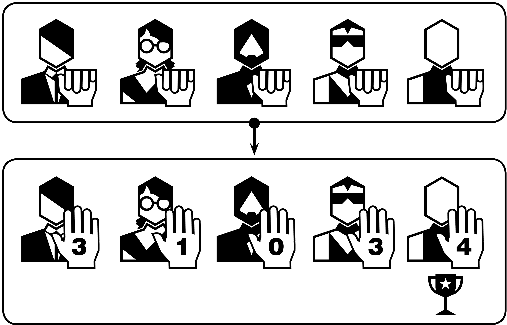
Players secretly make a bid. All bids are revealed simultaneously, and the high bidder wins.
Discussion
Sealed-Bid Auctions, also called Blind-Bid Auctions, compress all the excitement of an auction into one tense bidding decision, followed by a big reveal. Designers favor them for these features and for their speed. In games in which an auction is one subsystem in a larger game, or in which there are many sequential auctions, a single sealed-bid system is perfect for moving the game along. A good example of this is the Game of Trones board game, in which players run a gauntlet of three auctions in a row every few rounds. The consecutive auctions allocate special abilities among the players and thus must be quick and decisive, as the rest of the game involves intricate and time-consuming planning, negotiations, and troop movements. Sealed-Bid Auctions sacrifice some of the informational value of other iterative bid systems. Players who assess correctly that they will not be the winners of an auction will often bid nothing, or perhaps a token amount, to deny other players knowledge of their true valuation. This may be a feature or a bug, depending on the intent of the designer and the needs of the design, but is worth keeping in mind when employing this mechanism.
Sealed-bid systems typically require some type of tiebreaker, since nothing stops players from bidding the same amount. Various tie-breaking methods exist. In the aforementioned A Game of Trones, one of the abilities that players bid on is tie-breaking—an ability one of the player factions starts the game with. Other common tiebreakers include turn order or reverse order of the current score (a kind of catch-up mechanism). Some games feature rebidding by the tied players, like Spartacus: A Game of Blood and Treachery and Container. Fist of Dragonstones breaks ties through a rebid with a special currency that is only used for that purpose. This approach is decisive, but it lengthens the bidding process that sealed bidding is meant to curtail. An ergonomic consideration for sealed bidding is the componentry used for currency. The easiest way to do sealed bidding is by placing currency in a closed fist. Designers should carefully consider the size and material for the currency to ensure that bids fit comfortably in most hands, that tokens are easy to stack and pick up, and that they are at least somewhat resistant to the palm-sweat these auctions engender. Other approaches to sealed bids include using a dial to set a value, as in Dune, setting a die to a value, as in Tiny Epic Kingdoms, or placing bids behind a screen, as in Modern Art. Sealed-Bid Auctions are often used for combat resolution. In both Dune and Tiny Epic Kingdoms, players bid military strength, which might be further modified by other effects, to determine the victor of a military encounter. Scythe offers a similar auction, but players bid a resource to power their mechs rather than bidding actual troops. Sealed bidding, more than any other type of bidding, may require losers to pay their bids (sometimes referred to as an “all-pay” auction). This has stronger thematic consonance when the bids represent a battle, rather than the purchase of goods. The lost bids make sense when they represent battle losses, but they make less sense when the bids are surrendered but no goods are acquired in return. All-pay auctions are used in game theory to model, among other things, elections and political contests, which perhaps makes them more fitting for use in the Game of Trones board game. There is a lot of design space available in all-pay auctions, though players often express strongly negative reactions to these auctions, so proceed with care. Note that variants like loser-pays-half, as in For Sale (which is a turn-order auction, not a blind bid), can help remove some of the stings, while incentivizing higher bids, ironically. Sealed bids are also used in unlimited bidding, which is an unusual mechanism that allows players to bid any amount they wish. For example, in QE, players can write in a bid of any amount, so long as it fits on their bidding placard. Players do not have a store of money of any kind, since they represent sovereign nations
that can print any amount of money. Magic Money takes a similar approach, with players in the roles of wizards, who can conjure however much money they desire. In both games, the player who spends the most money, in total, over the course of the game, is eliminated, regardless of how many points they may have earned from winning the lots up for auction throughout the game. The best-known unlimited bidding games use modified sealed bids. In both QE and Magic Money, the opening bid is revealed to all players, but only the auctioneer sees the remaining bids. In Magic Money, that player reveals the winning amount to everyone, but in QE, the auctioneer only reveals the winning bidder, but not the value of their bid. The mix of hidden information and elimination of the player who spent the most money leads unlimited bidding games to feel less like an auction and more like a bluffing game. Auctions generally call for tightly evaluating values and costs, but unlimited auctions reward players who correctly assess when they have won enough lots that they can break off and not pursue an ever-rising spiral of bid prices. Unlimited bidding games appear to be mechanically fragile, and they operate as a social experiment as much as they do as a competitive game. While it is easy to be enamored of their central conceit of unlimited bidding, it may be that the more durable and useful innovation is in dispensing with the final revelation of all the bids. Auctions are excellent at price discovery, but uneven distribution of bidding information is an interesting way to limit that price discovery so that future auctions retain more tension and mystery.
Sample Games
Container (Delonge and Ewert, 2007) Dune (Eberle, Kittredge, and Olatka, 1979) Fiji (Friese, 2006) Fist of Dragonstones (Faidutti and Schacht, 2002) For Sale (Dorra, 1997) A Game of Trones (Petersen and Wilson, 2003) Magic Money (Hiwiller, 2020) Modern Art (Knizia, 1992) QE (Birnbaum, 2019) Scythe (Stegmaier, 2016) Spartacus: A Game of Blood and Treachery (Dill, Kovaleski, and Sweigart, 2012) Tiny Epic Kingdoms (Almes, 2014)
描述
玩家秘密出价。所有出价同时揭晓,最高出价者获胜。
讨论
密封竞价拍卖(Sealed-Bid Auctions),也称为盲拍,将拍卖的所有兴奋压缩到一个紧张的竞标决定中,然后是一个大揭秘。设计师因这些特点和速度而青睐它们。在拍卖是较大游戏中的一个子系统或有许多连续拍卖的游戏中,单一的密封竞价系统非常适合推动游戏进行。这方面的一个很好的例子是《权力的游戏》版图游戏,玩家每几轮就要连续进行三场拍卖。连续的拍卖在玩家之间分配特殊能力,因此必须迅速而果断,因为游戏的其余部分涉及错综复杂且耗时的计划、谈判和部队移动。密封竞价拍卖牺牲了其他迭代竞标系统的一些信息价值。正确评估自己不会成为拍卖赢家的玩家通常会出价零,或者只是象征性的金额,以否认其他玩家了解他们的真实估值。这可能是一个功能或一个错误,取决于设计师的意图和设计的需求,但在采用这种机制时值得牢记。
密封竞价系统通常需要某种类型的平局决胜局,因为没有什能阻止玩家出价相同的金额。存在各种打破平局的方法。在前面提到的《权力的游戏》中,玩家竞标的能力之一是打破平局——这是其中一个玩家派系开始游戏时拥有的能力。其他常见的平局决胜局包括回合顺序或当前分数的倒序(一种追赶机制)。有些游戏以平局玩家重新出价为特色,如《斯巴达克斯:血与沙》(Spartacus: A Game of Blood and Treachery)和《货柜大亨/集装箱》(Container)。《龙石之拳》(Fist of Dragonstones)通过使用仅用于该目的的特殊货币重新出价来打破平局。这种方法是决定性的,但它延长了密封竞价旨在缩减的竞标过程。密封竞价的一个人体工程学考虑因素是用于货币的组件。进行密封竞价的最简单方法是将货币放在紧握的拳头中。设计师应仔细考虑货币的大小和材料,以确保出价能舒适地放在大多数手中,代币易于堆叠和捡起,并且它们至少对这些拍卖产生的手汗有一定的抵抗力。密封出价的其他方法包括使用转盘设定值,如在《沙丘》(Dune)中,将骰子设定为某个值,如在《小小史诗王国》(Tiny Epic Kingdoms)中,或将出价放在屏幕后面,如在《现代艺术》中。密封竞价拍卖通常用于战斗解决。在《沙丘》和《小小史诗王国》中,玩家竞标军事力量,这可能会被其他效果进一步修改,以确定军事遭遇的胜利者。《镰刀战争》(Scythe)提供了类似的拍卖,但玩家竞标资源以驱动他们的机甲,而不是竞标实际的部队。与其他类型的竞标相比,密封竞价可能要求输家支付他们的出价(有时称为“全付”拍卖)。当出价代表战斗而不是购买商品时,这具有更强的主题一致性。当它们代表战斗损失时,失去的出价是有道理的,但当出价被交出但没有获得任何商品回报时,这就不太合理了。游戏理论中使用全付拍卖来模拟选举和政治竞赛等,这也许使它们更适合用于《权力的游戏》版图游戏。全付拍卖有很多可用的设计空间,尽管玩家经常对这些拍卖表示强烈的负面反应,所以要小心进行。请注意,像《For Sale》(这是一个回合顺序拍卖,而不是盲拍)中的输家付一半这样的变种,可以帮助消除一些刺痛,同时讽刺地激励更高的出价。密封出价也用于无限竞标,这是一种不寻常的机制,允许玩家出价他们希望的任何金额。例如,在《QE》中,玩家可以写下任何金额的出价,只要它适合他们的竞标牌。玩家没有任何形式的资金储备,因为他们代表主权国家
可以印任何数额的钱。《Magic Money》采取类似的方法,玩家扮演巫师的角色,他们可以变出他们想要的金钱。在这两款游戏中,在游戏过程中总共花费最多钱的玩家将被淘汰,无论他们通过赢得游戏中的拍卖拍品获得了多少分数。最著名的无限竞标游戏使用修改后的密封出价。在《QE》和《Magic Money》中,开标向所有玩家揭晓,但只有拍卖师看到其余的出价。在《Magic Money》中,该玩家向所有人揭晓获胜金额,但在《QE》中,拍卖师只揭晓获胜的竞标者,而不揭晓其出价的价值。隐藏信息与花费最多钱的玩家被淘汰的混合导致无限竞标游戏感觉不太像拍卖,而更像是一个虚张声势的游戏。拍卖通常要求严格评估价值和成本,但无限拍卖奖励那些正确评估何时赢得了足够多的批次,可以停下来不再追求不断上涨的出价螺旋的玩家。无限竞标游戏在机制上似乎很脆弱,它们既是竞技游戏,也是社会实验。虽然很容易迷恋无限竞标的核心构想,但更持久和有用的创新可能在于免除最终揭示所有出价。拍卖擅长价格发现,但竞标信息的不均匀分布是限制价格发现的一种有趣方式,以便未来的拍卖保留更多的紧张感和神秘感。
游戏范例
Container (Delonge and Ewert, 2007) - 《货柜大亨/集装箱》 Dune (Eberle, Kittredge, and Olatka, 1979) - 《沙丘》 Fiji (Friese, 2006) - 《斐济》 Fist of Dragonstones (Faidutti and Schacht, 2002) - 《龙石之拳》 For Sale (Dorra, 1997) - 《For Sale》 A Game of Trones (Petersen and Wilson, 2003) - 《权力的游戏》 Magic Money (Hiwiller, 2020) - 《Magic Money》 Modern Art (Knizia, 1992) - 《现代艺术》 QE (Birnbaum, 2019) - 《QE》 Scythe (Stegmaier, 2016) - 《镰刀战争》 Spartacus: A Game of Blood and Treachery (Dill, Kovaleski, and Sweigart, 2012) - 《斯巴达克斯:血与沙》 Tiny Epic Kingdoms (Almes, 2014) - 《小小史诗王国》