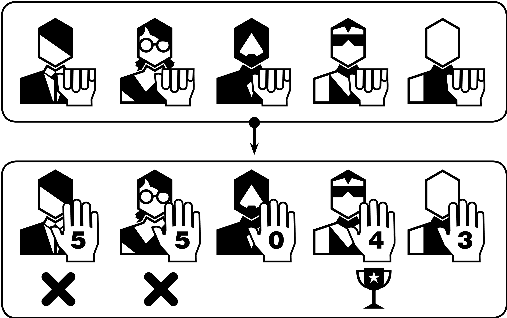
Description
Players secretly make a bid. All bids are revealed simultaneously and the high bidder wins unless there are ties for the high bidder. Tied bids cancel each other out and are treated as the lowest bids.
Discussion
The purpose of ties canceling out is in some sense a response to the challenge of running auctions without an auctioneer. A skilled auctioneer can help sort out two tied bidders and create some separation between them. Cancellation acts as a kind of heavy-handed auctioneer who refuses to acknowledge tied bids. Mechanically, this type of auction works best when coupled with constrained bids that increase the chances of ties. When players are working from a defined and limited set of bid markers, they may have a much better idea about what their opponents could bid. The bidding game begins to resemble a bluffing or betting game more than a regular auction, as players know that bidding big can’t guarantee their victory. If players are good at tracking which markers players have already used to bid, they can deduce which low bids might actually win the auction and which high bids are more susceptible to cancellation. This interaction does echo real-world dynamics in which the two strongest competitors can impede each other sufficiently to allow a weaker competitor to emerge from the fray with the prize.
This counter-intuitive mechanism hasn’t proven especially popular over the years. The non-thematic notion that a seller would ignore a higher bid simply because more than one bidder made it flies in the face of economic rationalism. As such, this is a mechanism that can feel “gamey,” or anti-thematic. Another drawback to this mechanism is that bidders can find it quite punishing while also feeling random. When players reveal their bids and discover they both valued the lot really highly but neither gets it, and that can be very frustrating. However, this same feature can lead to fun and dramatic moments and increases the element of Yomi (UNC-01) for the players. As such, it works best in lighter games with more chaos. Players looking for a highly strategic experience will not be attracted to this mechanism.
Sample Games
Hol’s Der Geier (Raj) (Randolph, 1988) Sky Runner (Glimne, Karlsson and Sevelin, 1999)
描述
玩家秘密出价。所有出价同时揭晓,除非最高出价者出现平局,否则最高出价者获胜。平局出价相互抵消,并被视为最低出价。
讨论
平局相互抵消的目的在某种意义上是对没有拍卖师进行拍卖的挑战的回应。熟练的拍卖师可以帮助解决两个平局的竞标者并在他们之间创造一些分离。取消就像是一种拒绝承认平局出价的强硬拍卖师。在机械上,这种类型的拍卖在与增加平局机会的受限竞价相结合时效果最佳。当玩家使用一组定义和有限的出价标记时,他们可能对自己对手可能出价的内容有更好的了解。竞标游戏开始更像是一个虚张声势或博彩游戏,而不是常规拍卖,因为玩家知道大额出价并不能保证他们的胜利。如果玩家善于追踪玩家已经用来出价的标记,他们可以推断出哪些低出价实际上可能赢得拍卖,哪些高出价更容易被取消。这种互动确实呼应了现实世界的动态,即两个最强大的竞争对手可以充分相互阻碍,从而允许较弱的竞争对手从争斗中脱颖而出并获得奖品。
这一反直觉的机制多年来并未被证明特别受欢迎。卖方仅仅因为不止一个竞标者出价就忽略较高出价的非主题概念与经济理性背道而驰。因此,这是一个让人感觉“游戏化”或反主题的机制。这种机制的另一个缺点是,竞标者会觉得它相当惩罚人,同时也感觉随机。当玩家揭晓他们的出价并发现他们都非常看重该批次但都没有得到它时,这可能会非常令人沮丧。然而,这一同样的特征可以导致有趣和戏剧性的时刻,并为玩家增加Yomi(UNC-01)元素。因此,它最适合更混乱的轻度游戏。寻找高度战略体验的玩家不会被这种机制所吸引。
游戏范例
Hol’s Der Geier (Raj) (Randolph, 1988) - 《Hol’s Der Geier (Raj)》 Sky Runner (Glimne, Karlsson and Sevelin, 1999) - 《Sky Runner》