Description
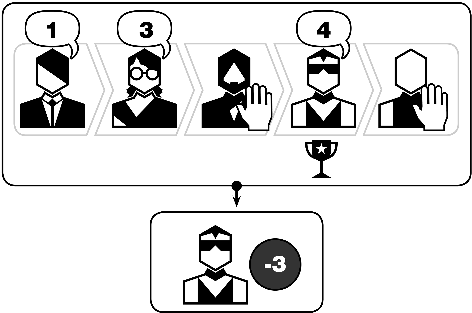
This mechanism modifies other auctions, such as Turn Order Until Pass or Sealed Bid. The amount paid by the Highest Bidder is equal to the secondhighest bid.
Discussion
In game theory, Second-Bid auctions, also called Second-Price auctions or Vickrey Auctions, are well-studied in relation to the question of how will the choice of auction type impact the price of a good? If I have a car that I want to sell, for example, which auction type will fetch me the best price? One way to ensure the highest possible price for the seller is to use an auction mechanism that encourages bidders to make mistakes in their bidding strategies. A Dutch Auction (AUC-08) is a great example. The added pressure of the clock and the possibility of someone else making a bid that can’t be countered leads to somewhat higher settlement prices than a traditional English Auction. In many cases, there is a desire to create a fast and fair auction, in which the best strategy for all bidders is to simply bid the highest price they are willing to pay. In a traditional auction, the correct strategy is to bid 1 over the previous bid because maybe nobody will outbid you and you’ll win the auction at a lower price than the amount you were willing to pay. This makes for slow going at times.
A second-highest auction is the solution to the question of how to make auctions fast and fair for buyers and sellers. In essence, your bid in a SecondPrice auction is not an offer to pay that amount but to pay anything up to that amount. Your bid of 999, such that anyone who wants to buy the item must pay $1,000 or more. The dominant strategy in a Second-Price auction is to bid your true value for the lot. If all other players value the lot at a lower price, you’ll pay their valuation, not your higher price. If other players value the lot higher than you, you won’t win, but they’ll never pay less than your true value. Vickrey Auctions are extremely rare in board games. The only example we were able to turn up was Reiner Knizia’s Das letzte Paradies (The Last Paradise), a largely forgotten title. In part, this is because Vickrey Auctions aren’t that different from other auction types when it comes to board games. In any non-blind auction method, a Vickrey settlement method will yield a final price that is roughly the same as the non-Vickrey, or perhaps one-bid increment smaller. That’s a lot of rules overhead for such a small change in price. In blind bidding systems, the Vickrey does impact actual prices more substantially, but in many cases, the game design capitalizes on that inefficiency in the auction. Put another way, the returns to bidding skill are higher in Non-Vickrey Auctions, whereas Vickrey Auctions provide a clear dominant strategy to the bidders. In a sense, the efficiency of Vickrey Auctions may make them less interesting for gameplay. Perhaps another important reason Vickrey Auctions aren’t used is that their game-theoretical impact isn’t patently obvious to players. If you explain the way the auction works, most players don’t intuitively understand that their best bet is to bid their true value. A game that uses Vickrey to try and make auctions more fair and less chaotic may find that players are simply confused by it. Where Vickrey Auctions really shine is in a situation that doesn’t come up in board games very often, which is in allocating a large lot of identical goods. Want to sell 100 tons of cinnamon? A Vickrey Auction is a great way to find the settlement price at which all 100 tons will sell. Once that price is found, even bidders who offered more for some portion of the lot are charged the market-clearing price, not their higher bid. In essence, the buyer is trading away the highest possible returns for speed and the certainty of selling out their whole inventory. An echo of this idea can be found in Harbour, where a player must sell their entire lot of goods when they choose the sell action, but this sale is to the bank. One might imagine that this transaction is the end result of a Vickrey Auction that happened off-screen, so to speak. Vickrey Auctions, though important for the study and for understanding
auction strategies, have relatively few practical applications in board games, at least so far. As board games have moved into digital arenas, Vickrey Auctions may find new applications, especially in asynchronous game modes. When games are player asynchronously, multiple-round bidding structures can slow the game down enormously. In the case of Trough the Ages: A New Story of Civilization, players can bid military strength to claim colonies. Colony auctions occur during the Events phase of each player’s turn, should a colony be drawn from the Events deck. The Events phase is the first part of a player’s turn, and until the auction is fully resolved, the player is frozen and cannot proceed to the main phase of their turn. Instead, a Turn Order Until Pass Auction (AUC-03) to determine the high bidder. The colony is then awarded, the winner spends the necessary military strength, and the active player can then complete their turn. When adapting Trough the Ages for digital play, the designer offered a modification to this system to prevent games from stalling for hours or even days at each auction. Players simply enter one bid, which represents the maximum that they are willing to bid. Once all bids are in, the highest bidder wins and pays one more than the amount bid by the second-highest bidder. In practice, the difference between this auction and the turn-order auction is mainly that, in case of ties, the winner is the player closest to the active player in turn order, and the winner pays the amount of the tied bid, rather than one more. In a turn-order bidding system, ties are not possible. As we’ve noted above, these types of auctions are uncommon in analog games. One reason may be that it is hard to conceal the highest price the top bidder was willing to bid. In a Vickrey Auction, the winner pays the amount bid by the second-highest bidder. The amount that the winner bid is not typically revealed. This information can be quite consequential, especially in a game like Trough the Ages, where players may have hidden resources that they can optionally apply. Revealing a bid that is high enough to require using hidden resources effectively reveals that a player has those resources. In a digital format, the game’s internal logic can determine and declare the winner without revealing the total bid amount. It may not be possible to achieve that same outcome in an unmoderated analog format.
Sample Games
Das letzte Paradies (Knizia, 1993) Harbour (Almes, 2015) Trough the Ages: A New Story of Civilization (Digital) (Chvátil, 2006)
描述
这种机制修改了其他拍卖,例如直到放弃的回合顺序或密封竞价。最高出价者支付的金额等于第二高出价。
讨论
在博弈论中,次价拍卖(Second-Bid auctions),也称为第二价格拍卖或维克里拍卖(Vickrey Auctions),在拍卖类型的选择将如何影响商品价格的问题上得到了很好的研究。例如,如果我想卖一辆车,哪种拍卖类型会给我带来最好的价格?确保卖方获得最高可能价格的一种方法是使用一种鼓励竞标者在竞标策略中犯错的拍卖机制。荷式拍卖(AUC-08)就是一个很好的例子。时钟的额外压力以及其他人做出无法反击的出价的可能性导致结算价格比传统的英式拍卖略高。在许多情况下,人们希望创建一个快速、公平的拍卖,其中所有竞标者的最佳策略只是出价他们愿意支付的最高价格。在传统拍卖中,正确的策略是比之前的出价高1美元,直到达到你的保留点。你不会比之前的出价高出超过1美元,因为也许没有人会出价超过你,你会以低于你愿意支付的金额赢得拍卖。这有时会导致进展缓慢。
第二高价拍卖是解决如何使拍卖对买卖双方都快速公平的问题的方案。本质上,你在第二价格拍卖中的出价不是提出支付该金额,而是支付最高达该金额的任何费用。你出价1000美元实际上是出价999美元,这样任何想买该物品的人都必须支付1000美元或更多。在第二价格拍卖中,占主导地位的策略是出价你对该批次的真实价值。如果所有其他玩家对该批次的估值较低,你将支付他们的估值,而不是你的更高价格。如果其他玩家对该批次的估值高于你,你不会赢,但他们支付的费用绝不会低于你的真实价值。维克里拍卖在棋盘游戏中极其罕见。我们能够找到的唯一例子是莱纳·克尼齐亚(Reiner Knizia)的《Das letzte Paradies》(最后的乐园),这主要是一个被遗忘的头衔。部分原因是维克里拍卖在棋盘游戏方面与其他拍卖类型没有太大区别。在任何非盲拍方法中,维克里结算方法产生的最终价格将与非维克里大致相同,或者可能小一个出价增量。对于价格如此小的变化来说,这是大量的规则开销。在盲拍系统中,维克里确实更大大地影响实际价格,但在许多情况下,游戏设计利用了拍卖中的这种低效率。换句话说,非维克里拍卖中的竞标技巧回报更高,而维克里拍卖为竞标者提供了明显的优势策略。从某种意义上说,维克里拍卖的效率可能会让它们在游戏玩法上变得不那么有趣。也许维克里拍卖不被使用的另一个重要原因是它们的博弈论影响对玩家来说并不显而易见。如果你解释拍卖的工作原理,大多数玩家凭直觉并不理解他们最好的选择是出价他们的真实价值。使用维克里试图使拍卖更公平、更少混乱的游戏可能会发现玩家只是对此感到困惑。维克里拍卖真正大放异彩的地方是在棋盘游戏中并不经常出现的情况,即分配大量相同的商品。想卖100吨肉桂?维克里拍卖是寻找所有100吨将出售的结算价格的好方法。一旦找到该价格,即使是对该批次某些部分出价更高的竞标者也要收取市场出清价格,而不是他们的更高出价。本质上,买方正在为了速度和售罄整个库存的确定性而放弃最高可能的回报。《Harbour》中可以找到这种想法的回响,玩家选择出售行动时必须出售他们的整批商品,但这笔交易是卖给银行的。人们可以想象这笔交易可以说是在屏幕外发生的维克里拍卖的最终结果。维克里拍卖,虽然对于研究和理解
拍卖策略很重要,但在棋盘游戏中实际应用相对较少,至少到目前为止是这样。随着棋盘游戏进入数字领域,维克里拍卖可能会找到新的应用,特别是在异步游戏模式中。当游戏是异步玩家时,多轮竞标结构会极大地减慢游戏速度。在《历史巨轮》(Through the Ages: A New Story of Civilization)的情况下,玩家可以竞标军事力量以获得殖民地。如果从事件牌堆中抽出殖民地,殖民地拍卖会在每个玩家回合的事件阶段发生。事件阶段是玩家回合的第一部分,在拍卖完全解决之前,玩家被冻结,无法进行到他们回合的主要阶段。取而代之的是,进行直到放弃的回合顺序拍卖(AUC-03)以确定最高出价者。然后授予殖民地,获胜者花费必要的军事力量,活跃玩家随后可以完成他们的回合。在改编《历史巨轮》进行数字游戏时,设计师对该系统进行了一些修改,以防止游戏在每次拍卖时停滞数小时甚至数天。玩家只需输入一个出价,代表他们愿意出价的最大值。一旦所有出价都进入,最高出价者获胜并支付比第二高出价者出价高一的金额。在实践中,这种拍卖与回合顺序拍卖的区别主要在于,在平局的情况下,获胜者是回合顺序中离活跃玩家最近的玩家,获胜者支付平局出价的金额,而不是多付一。在回合顺序竞标系统中,平局是不可能的。正如我们在上面指出的,这些类型的拍卖在模拟游戏中并不常见。一个原因可能是很难隐瞒最高出价者愿意出价的最高价格。在维克里拍卖中,获胜者支付第二高出价者出价的金额。获胜者出价的金额通常不会被透露。这些信息可能非常重要,特别是在像《历史巨轮》这样的游戏中,玩家可能拥有可以有选择地运用的隐藏资源。透露足以要求使用隐藏资源的出价实际上表明玩家拥有这些资源。在数字格式中,游戏的内部逻辑可以在不透露总出价金额的情况下确定并宣布获胜者。在不受监管的模拟格式中可能无法实现相同的结果。
游戏范例
Das letzte Paradies (Knizia, 1993) - 《Das letzte Paradies》 Harbour (Almes, 2015) - 《Harbour》 Trough the Ages: A New Story of Civilization (Digital) (Chvátil, 2006) - 《历史巨轮》(数字版)