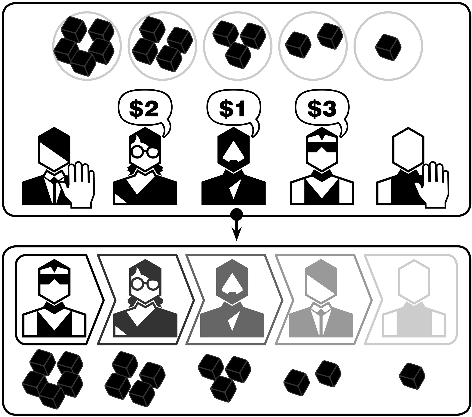
Description
Selection Order Bid is a form of multiple-lot auction in which players are not directly bidding on the lots themselves but the order in which they’ll draft the lots. As the bid increases, players may pass and accept a later place in the order. In some cases, players must pay their entire current bid (an all-pay mechanism), and in others, they may recover some of their bid.
Discussion
There are many systems for auctioning off multiple lots, but Selection Order Bid may be the most elegant. In For Sale, players bid to draft first from a collection of property cards. The cards range in value substantially, and a given flop of cards can either cluster closely, with the lowest being separated from the highest by only a few dollars, or be spaced quite widely apart. Players bid in turn order for the right to draft first. A player may choose to pass and collect the lowest-value card remaining. When passing, they pay half their previous bid. The last player to remain in the auction receives the most valuable card but must also pay his or her full bid.
Another way to think of the pay-half-when-pass variant is that it’s actually a simultaneous bid on two lots: a full-price bid on the most valuable card and a half-price bid on the least valuable card. Considered in this fashion, Selection Order Bid is a type of constrained bidding system or even a sort of ante. If you want to bid 5 for the lowest-value card, which you could have had for free, had you chosen to pass. This is somewhat analogous to a penny auction, where players must pay a fee for each bid they make, even if it is not the winning bid. The halved value of the bid that is forfeit whether or not the player wins the auction can be seen as the bid fee, rather than a bid itself. In certain games, this type of auction also forces players to estimate the value of lots to other players. For example, if players are collecting different symbols or colors, the lots will have different values for different players. If a certain lot is only good for one player, that player can take a chance and bid low assuming that the lot will be remaining when the player’s selection opportunity comes.
Sample Games
Age of Steam (Wallace, 2002) Eggs & Empire (Pinchback and Riddle, 2014) For Sale (Dorra, 1997)
描述
选择顺序竞价(Selection Order Bid)是一种多批次拍卖形式,其中玩家不直接竞标批次本身,而是竞标他们轮抽批次的顺序。随着出价的增加,玩家可以放弃并接受顺序中较后的位置。在某些情况下,玩家必须支付他们的全部当前出价(全付机制),而在其他情况下,他们可能会收回部分出价。
讨论
有许多拍卖多批次的系统,但选择顺序竞价可能是最优雅的。在《For Sale》中,玩家竞标从一组房产卡中首先轮抽的权利。这些卡的价值相差很大,给定的一组卡既可以紧密聚集,最低价与最高价仅相差几美元,也可以相距甚远。玩家按回合顺序竞标首先轮抽的权利。玩家可以选择放弃并收集剩余的最低价值卡。当放弃时,他们支付之前出价的一半。最后留在拍卖中的玩家获得最有价值的卡,但也必须支付他或她的全额出价。
思考放弃时付半价变体的另一种方式是,它实际上是对两个批次的同时出价:对最有价值卡的全价出价和对最不具价值卡的半价出价。以这种方式考虑,选择顺序竞价是一种受限竞价系统,甚至是一种赌注。如果你想在拍卖开始时对高价值卡出价10美元,你基本上同意为最低价值卡支付5美元,如果你选择放弃,你可以免费获得这张卡。这有点类似于一分钱拍卖,玩家必须为他们做出的每次出价支付费用,即使这不是获胜出价。无论玩家是否赢得拍卖,那一半被没收的出价价值都可以被视为出价费,而不是出价本身。在某些游戏中,这种类型的拍卖还迫使玩家估计批次对他人的价值。例如,如果玩家收集不同的符号或颜色,批次对不同玩家将具有不同的价值。如果某个批次仅对一名玩家有利,该玩家可以冒险并低价出价,假设当该玩家的选择机会到来时,该批次仍将保留。
游戏范例
Age of Steam (Wallace, 2002) - 《蒸气时代》 Eggs & Empire (Pinchback and Riddle, 2014) - 《Eggs & Empire》 For Sale (Dorra, 1997) - 《For Sale》