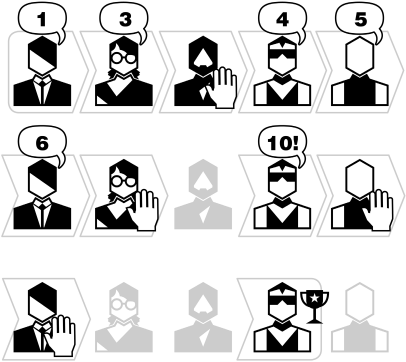
Description
Starting with one player and going in turn order, players may raise the current bid or pass. When all players but one have passed, the player remaining in the auction is the winner. Normally, players that pass may not re-enter the auction. However, allowing re-entry is a variation that is not uncommon.
Discussion
The benefits of this Turn Order Until Pass mechanism are in its simplicity and how it aligns with players’ expectations. Players are rarely confused by how to run this kind of auction, so it doesn’t require an auctioneer. Popular games, like Power Grid and Trough the Ages: A New Story of Civilization, feature this type of auction, and in a board game-adjacent space, auctions in fantasy sports are typically of this kind, perhaps adding to the popularity and familiarity of the mechanism. From a game theory perspective, the dominant strategy for bidders is the same as in an Open Auction, namely to stay in the bidding until their value for the item for bid is reached. This can help prevent any player from receiving an unearned windfall simply because of the mechanics of the bidding.
Turn Order Until Pass provides a structure to govern the uncertainties that normally exist in Open and English Auctions. A player may only bid on his or her turn and must exceed or, in some cases, at least match the previous high bid. This ordered and clear structure makes it an excellent choice for board games. Turn Order Until Pass does have some drawbacks. For one, it’s not as dynamic as Open Auctions, as the ordered process of bidding removes some of the energy from the auction process. The imposition of a turn order on bidding also creates a bit of inequity. If the current bid is 11. If 11, there’s nothing I can do. If nobody else bids, that player will win the auction at 1 at a time can be painful. However, incrementing by $1 at a time is theoretically the dominant strategy to avoid overpaying, so it’s tough to put the blame on the players for doing so. It’s the designer’s responsibility to incentivize behavior that leads to a better experience! Turn Order Until Pass remains one of the easiest types of auctions to implement, run, and participate in. The mechanism exists in many different games as a relatively quick way to allocate resources or benefits. However, games that place a central focus on the auction mechanism usually introduce some additional twists. In recent years, Drafting (CAR-06) has overtaken simple bidding as the preferred method for quick allocation of resources— not least because auctions require more precise valuation by players, which can be challenging, especially for new players. This issue is not unique to
this specific kind of auction and has been discussed at greater length in the introduction to this section. Re-entry after passing is a variant that allows players to pass but re-enter the bidding when their turn comes around again. Passing is risky, in the sense that if all but one player passes, the auction will close. However, re-entering after passing does create some interesting drama but at a high cost in terms of playtime. When players pass, an auction speeds along since it has fewer participants. When re-entry is allowed, the number of participants in the auction never decreases. Perhaps the main advantage of allowing re-entry is preventing accidental windfalls by allowing a previously passed player to raise the bid on a lot that should sell for more but whose value is languishing for whatever reason.
Sample Games
Power Grid (Friese, 2004) Raccoon Tycoon (Drover, 2018) Trough the Ages: A Story of Civilization (Chvátil, 2006)
描述
从一名玩家开始并按回合顺序进行,玩家可以提高当前出价或放弃。当除一名玩家外所有其他玩家都放弃时,留在拍卖中的玩家获胜。通常,放弃的玩家可能无法重新进入拍卖。然而,允许重新进入是一种并不罕见的变体。
讨论
这种直到放弃的回合顺序(Turn Order Until Pass)机制的好处在于它的简单性以及它如何符合玩家的期望。玩家很少会对如何进行这种拍卖感到困惑,因此它不需要拍卖师。流行的游戏,如《电力公司》(Power Grid)和《历史巨轮》(Through the Ages: A New Story of Civilization),都采用这种类型的拍卖,在棋盘游戏相邻领域,梦幻体育中的拍卖通常也是这种类型,这可能增加了该机制的流行度和熟悉度。从博弈论的角度来看,竞标者的优势策略与公开拍卖相同,即留在竞标中,直到达到他们对竞标物品的估值。这有助于防止任何玩家仅仅因为竞标机制而获得不劳而获的意外之财。
直到放弃的回合顺序提供了一种结构来管理通常存在于公开和英式拍卖中的不确定性。玩家只能在他或她的回合出价,并且必须超过或者在某些情况下至少匹配之前的最高出价。这种有序清晰的结构使其成为棋盘游戏的绝佳选择。直到放弃的回合顺序确实有一些缺点。首先,它不像公开拍卖那样充满活力,因为有序的竞标过程消除了拍卖过程中的一些能量。在竞标中强加回合顺序也会造成一点不公平。如果目前的出价是10美元,而且轮不到我,我就不能出价11美元。如果11美元是我愿意支付的最高金额,但活跃玩家继续出价11美元,我无能为力。如果没有其他人出价,该玩家将以11美元赢得拍卖,即使有不止一个竞标者愿意支付该金额。在英式拍卖中,熟练的拍卖师会识别出何时有不止一个竞标者陷入相同的出价,并会劝诱其中一方提高出价。如果做不到这一点,拍卖师将承认谁先出价——这也可能不是完全公平,但至少为所有竞标者提供了出价他们希望的任何数字的理论机会。相比之下,在直到放弃的回合顺序拍卖中,一些玩家根本没有机会出价某些价值。当没有拍卖师时引入的另一个问题是,如果玩家不合理地增加他们的出价,拍卖可能会拖延。在玩家持有大量资金的游戏中,玩家一次增加1美元的出价可能会很痛苦。然而,一次增加1美元理论上是避免多付钱的优势策略,所以很难指责玩家这样做。设计师有责任激励导致更好体验的行为!直到放弃的回合顺序仍然是最容易实施、运行和参与的拍卖类型之一。该机制存在于许多不同的游戏中,作为分配资源或利益的一种相对快速的方式。然而,将中心重点放在拍卖机制上的游戏通常会引入一些额外的转折。近年来,轮抽(Drafting, CAR-06)已取代简单竞标成为快速分配资源的首选方法——尤其是因为拍卖需要玩家进行更精确的估值,这可能具有挑战性,特别是对于新玩家。这个问题并不是
这种特定类型的拍卖独有的,并且在本节的介绍中已经进行了更详细的讨论。放弃后重新进入是一个变体,允许玩家放弃但在轮到他们时重新进入竞频。放弃是有风险的,即如果除一名玩家外所有其他玩家都放弃,拍卖将关闭。然而,放弃后重新进入确实创造了一些有趣的戏剧性,但在游戏时间方面付出了高昂的代价。当玩家放弃时,拍卖加速进行,因为参与者较少。当允许重新进入时,参与拍卖的人数从未减少。允许重新进入的主要优势也许是防止意外之财,允许之前放弃的玩家提高对此应卖得更多但其价值因某种原因而萎靡不振的批次的出价。
游戏范例
Power Grid (Friese, 2004) - 《电力公司》 Raccoon Tycoon (Drover, 2018) - 《Raccoon Tycoon》 Trough the Ages: A Story of Civilization (Chvátil, 2006) - 《历史巨轮》