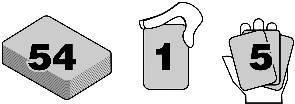
and Deck Exhaustion
Description
Games frequently limit the number of cards that may be held in a given container, whether that is a hand, a deck, or something else. Similarly, various game effects trigger when a deck, draw pile, or hand becomes exhausted.
Discussion
Hand Limits are a critical part of the superstructure of a game. Cards represent options, and the more cards are held in hand, the more choices a player must consider. In modern games, where cards are not simply members of a set, but instead provide actions or other benefits, more cards mean more power. In many games, there is no possibility of card advantage because card plays and Card Draws are symmetrical and metered. In Diamonds, as in most trick-taking games, all the cards that will be in play are dealt at the beginning, and players each play one card per turn. In Mystery Rummy: Jack the Ripper, as in most Rummy-style games, players draw a card into their hands at the start of their turns and discard one card to end their turns. Similarly, cooperative card games tend to tightly limit card economies because of how closely coupled those economies are with game difficulty. Forbidden Island, for example, if played without a hand limit of artifact cards, is a substantially easier game. Whenever a game involves collecting sets of cards, it will be easier for players to collect sets when they can draw and keep larger numbers of cards. Cooperative games can tweak these settings to change the challenge level presented to the players. This one-in-one-out static card economy is overturned by many modern designs, and players routinely have more agency over their draws and
discards. In Memoir ‘44, scenario-specific rules set the draws, discards, and hand limits for each faction, which allows the designer to model military concepts like surprise, supply lines, and operational capacity. Individual cards, like “Recon,” allow players to draw additional cards, at the cost of taking a less powerful action on the map. In Evolution: The Beginning, players always receive the same number of cards each turn, but they may play as many or as few cards as they wish and carry over all their cards from turn to turn. Intentionally or not, this evokes the idea of punctuated equilibrium, in which long periods of limited speciation are punctuated by moments of great activity, evolutionarily speaking. Ticket to Ride similarly doesn’t encumber players with a hand limit but imposes a draw limit of two (one if you draw a face-up wild train from the display). Players may lay down melds of any size though, so long as a matching route in size and color is available on the board. Tus, player hand-size fluctuates throughout the game, and skilled players will consider the potential moves their opponents can make based on the number of cards in their hands. Bohnanza requires players to draw, and either plant or trade, a fixed number of cards from the deck each turn. These cards can then be supplemented by any number of cards in hand. Some games treat Card Draw as similar to any other resource. In Deus, players choose to either play a card or discard some number of cards. Players may discard any number of cards, but one discarded card, and its suit, determines which discard ability is triggered. The discard abilities include gaining money, resources, buildings, or additional card draws. In Race for the Galaxy, players must explicitly choose whether to convert goods, represented by cards, into victory points or additional card draws. At the other end of the spectrum, from this more permissive approach to card economies is Trough the Ages, which sorely restricts card movement from the market row into the hand. Players must spend precious actions to acquire cards from the market row and may never exceed their hand limit—unlike many other games that allow players to temporarily exceed hand limits and then discard down at the end of the phase or turn. In fact, Trough the Ages: A Story of Civilization has no player-triggered discard mechanism at all, and taking a card into hand comes with an enormous opportunity cost. The hand limit is itself determined by a civilization’s government type, and more advanced governments increase the player’s hand size and thus, fairly directly, the power and possibilities of that player’s civilization.
Sample Games
Power Grid (Friese, 2004) Bohnanza (Rosenberg, 1997) Deus (Dujardin, 2014) Diamonds (Fitzgerald, 2014) Evolution: The Beginning (Crapuchetts, 2016) Forbidden Island (Leacock, 2010) Memoir ‘44 (Borg, 2004) Mystery Rummy: Jack the Ripper (Fitzgerald, 1998) Race for the Galaxy (Lehmann, 2007) Trough the Ages: A Story of Civilization (Chvátil, 2006) Ticket to Ride (Moon, 2004)
以及牌组耗尽
描述
游戏经常限制可以在给定容器中持有的卡牌数量,无论是手牌、牌组还是其他。类似地,当牌组、抽牌堆或手牌耗尽时,各种游戏效果会触发。
讨论
手牌限制是游戏上层结构的关键部分。卡牌代表选项,手中持有的卡牌越多,玩家必须考虑的选择就越多。在现代游戏中,卡牌不仅仅是一个集合的成员,而是提供行动或其他好处,更多的卡牌意味着更多的力量。在许多游戏中,没有卡牌优势的可能性,因为卡牌打出和抽牌是对称的和有节制的。在《钻石》(Diamonds)中,如同大多数吃墩游戏一样,所有将要使用的卡牌在开始时发出,玩家每回合打出一张卡牌。在《神秘拉米纸牌:开膛手杰克》(Mystery Rummy: Jack the Ripper)中,如同大多数拉米风格的游戏一样,玩家在回合开始时抽一张卡牌到手中,并弃掉一张卡牌结束他们的回合。同样,合作卡牌游戏倾向于严格限制卡牌经济,因为这些经济与游戏难度紧密耦合。例如,《禁忌之岛》(Forbidden Island),如果在没有神器卡手牌限制的情况下进行,是一个容易得多的游戏。每当游戏涉及收集卡牌集合时,当玩家可以抽取和保留更多数量的卡牌时,收集集合会更容易。合作游戏可以调整这些设置以改变呈现给玩家的挑战级别。这种一进一出的静态卡牌经济被许多现代设计推翻,玩家通常对他们的抽牌和
弃牌有更多的自主权。在《回忆录’44》(Memoir ‘44)中,特定场景规则为每个派系设置抽牌、弃牌和手牌限制,这允许设计师模拟军事概念,如惊喜、补给线和作战能力。个别卡牌,如”侦察”(Recon),允许玩家抽取额外的卡牌,代价是在地图上采取不那么强大的行动。在《进化:起源》(Evolution: The Beginning)中,玩家总是在每回合获得相同数量的卡牌,但他们可以打出任意数量的卡牌,并将所有卡牌从一回合带到下一回合。无论是有意还是无意,这唤起了间断平衡的想法,在这种想法中,从进化的角度来说,有限物种形成的长时期被巨大活动的时刻打断。《车票之旅》(Ticket to Ride)同样不会用手牌限制来妨碍玩家,但强加了两张的抽牌限制(如果你从展示中抽取一张面朝上的野生火车,则为一张)。然而,只要板上有大小和颜色匹配的路线,玩家就可以放下任何大小的组合。因此,玩家手牌大小在整个游戏中波动,熟练的玩家会根据对手手中的卡牌数量考虑他们可能采取的潜在行动。《种豆》(Bohnanza)要求玩家在每回合从牌组中抽取、种植或交易固定数量的卡牌。然后这些卡牌可以由手中任意数量的卡牌补充。一些游戏将抽牌视为类似于任何其他资源。在《Deus》中,玩家选择打出一张卡牌或弃掉一些数量的卡牌。玩家可以弃掉任意数量的卡牌,但一张弃掉的卡牌及其花色决定了触发哪个弃牌能力。弃牌能力包括获得金钱、资源、建筑或额外的抽牌。在《银河竞逐》(Race for the Galaxy)中,玩家必须明确选择是将由卡牌表示的商品转换为胜利点数还是额外的抽牌。在光谱的另一端,从这种对卡牌经济更宽容的方法来看,《历史巨轮》(Trough the Ages)严重限制了从市场排到手中的卡牌移动。玩家必须花费宝贵的行动从市场排获取卡牌,并且永远不能超过他们的手牌限制——与许多其他允许玩家暂时超过手牌限制然后在阶段或回合结束时弃牌的游戏不同。实际上,《历史巨轮:文明的故事》(Trough the Ages: A Story of Civilization)根本没有玩家触发的弃牌机制,将卡牌拿到手中会带来巨大的机会成本。手牌限制本身由文明的政府类型决定,更先进的政府增加玩家的手牌大小,从而相当直接地增加该玩家文明的力量和可能性。
游戏范例
Power Grid (Friese, 2004) - 《电力公司》 Bohnanza (Rosenberg, 1997) - 《种豆》 Deus (Dujardin, 2014) - 《Deus》 Diamonds (Fitzgerald, 2014) - 《钻石》 Evolution: The Beginning (Crapuchetts, 2016) - 《进化:起源》 Forbidden Island (Leacock, 2010) - 《禁忌之岛》 Memoir ‘44 (Borg, 2004) - 《回忆录’44》 Mystery Rummy: Jack the Ripper (Fitzgerald, 1998) - 《神秘拉米纸牌:开膛手杰克》 Race for the Galaxy (Lehmann, 2007) - 《银河竞逐》 Trough the Ages: A Story of Civilization (Chvátil, 2006) - 《历史巨轮:文明的故事》 Ticket to Ride (Moon, 2004) - 《车票之旅》