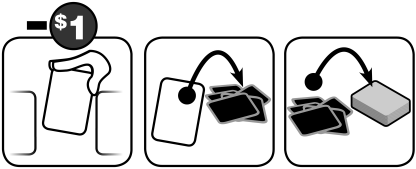
Description
Players play cards out of individual decks, seeking to acquire new cards and to play through their decks iteratively, improving them over time through card acquisition.
Discussion
Deck Building isn’t a single mechanism, and throughout this book, we discuss mechanisms that are also present in Deck-Building games. Nevertheless, a core structure has emerged in deck-building games that we’ll consider here. Tough Deck Building is a relatively new mechanism and genre, having appeared first in 2008’s Dominion, follow-ups have often mimicked Dominion’s basic structures. The basic idea is that cards can provide actions, currency for use only in the current turn, or victory points. In base Dominion, nearly all the cards provide only one of each of these uses, but many deck builders that followed combined these and offered players a choice for how to use each card. Some games have also expanded beyond these boundaries, like the bases that persist in players’ tableaus until they are destroyed in Star Realms. In many deck builders, players will dispose of their whole hand of cards each turn. Commonly, players have a limit on the number of cards they can play as actions, but no limit on the cards that can be played as money, though not all cards will have a money value. While Dominion limits the number of buy actions that players can take, most follow-ups limit players to what they can afford. Some cards allow players to draw, and then play, even more cards. At the conclusion of their turn, players will draw back to the full hand, usually five cards. While Dominion provided for a static, open market for cards,
later deck builders like Ascension: Deckbuilding Game and Star Realms offer players a market row that is replenished from a randomized deck. Acquisition methods are a good place to evoke a theme, while also addressing the inherent variability of laying out cards for purchase at random. Valley of the Kings has a pyramidal market that allows players to buy only the three cards at the base, after which higher-level cards will drop down into lower levels as the pyramid crumbles. This mechanism gives players foresight, and a bit of control, over which cards will be available to their opponents. In Eminent Domain, basic cards are acquired at no cost from a central display, but powerful tech cards are acquired by being able to play the requisite number of technology icons. Tough there are no dependencies and prerequisites as in an actual Tech Tree (ACT-16), the effect of making players show a greater number of technology icons for the more powerful cards offers a similar scaling effect. The synergies of certain combinations of cards create more viable and powerful branches through this tiered collection of technologies. For readers interested in fully exploring Deck-Building mechanisms, Dominion’s expansions are an instructive journey. Intrigue introduces negative player interactions like forced discards. Alchemy introduces a second currency type, and cards which can only be purchased with that currency. Seaside introduces the ability to carry over cards from turn to turn. Prosperity adds treasures, a new kind of resource that can be spent to trigger abilities without using up actions. Dark Ages focuses on interactions with the discard pile, while Adventures adds persistent cards that can be played in a future hand. Cornucopia rewards players for collecting varieties of cards, while Guilds introduces persistent money and reasons to spend it. Dominion represents one approach to Deck Building, which is part of a larger category called pool building, which includes pools built from items other than cards. This can be entirely isomorphic to Deck Building, as in Puzzle Strike, in which cards are replaced with custom Poker chips that are drawn from a bag. The Poker chip component is easier to shuffle as often as deck builders require and is more durable when subjected to frequent shuffling. Orléans, on the other hand, has players drawing workers out of a bag, who can then be assigned to a variety of actions on a player’s board. Andy Parks, the designer of the deck builder Core Worlds, describes the distinction between these games as being between drafting verbs, that is, actions, as in most deck builders, and drafting nouns, as in Orléans. In a deck builder like Dominion, most cards represent an action that players can take simply by playing the card, which is what Parks means by drafting verbs. In Orléans, players pull workers out of a bag and assign them to different
actions. However, actions require some specific combination of worker types in order to trigger—a kind of Set Collection (Chapter 12)—rather than each worker type having a specific type of action associated with it. Parks refers to this as drafting nouns. His own Assault of the Giants game features drafting adjectives—modifiers that provide bonuses and additional abilities, but that must attach to existing cards and characters—out of the pool, presenting yet another possible way to construct a pool builder. Pools work well as resolution mechanisms, where they’re called chit-pull systems. There are also games that don’t have true pool-building mechanisms but come very close. In Machi Koro, players purchase numbered cards whose abilities are triggered based on die rolls. Players can buy cards, representing the pool, and they can buy cards that trigger on the same numbers, to increase the payouts of specific numbers. However, players have a limited impact on the over-all probability of numbers being rolled. Tey can choose to roll one die or two dice, but that’s all. In a deck builder, players can assure themselves of a zero probability of not drawing certain cards, simply by not acquiring them. Machi Koro doesn’t provide quite that level of control to players. Going farther out on this mechanical limb, we can consider the placement of settlements in Catan as a pool-building-adjacent mechanism. Even the selection of runners in Can’t Stop shares something of this flavor. In Roll for the Galaxy, players acquire worker dice that have different faces and different values as goods. Players may shape their overall pool both based on which dice they acquire and which dice they place back into their pool each turn. As deck builders and collectible card games show, there is an enormous amount of design space outlined by cards and some tokens. In addition to the games discussed above, cooperative deck builders like Shadowrun: Crossfire, Gloomhaven, and Pathfinder Adventure Card Game continue to blur the line between card, board, and role-playing games. There are also variants like no-shuffle deck builders like Aeon’s End and build-the-enemy’s deck games like Tiny Epic Defender.
Sample Games
Aeon’s End (Riley, 2016) Ascension: Deckbuilding Game (Fiorillo and Gary, 2010) Assault of the Giants (Parks, 2017) Can’t Stop (Sackson, 1980) Catan (Teuber, 1995) Core Worlds (Parks, 2011)
Dominion (Vaccarino, 2008) Dominion and Expansions (Vaccarino, 2008) Eminent Domain (Jaffee, 2011) Gloomhaven (Childres, 2017) Intrigue (Dorra, 1994) Machi Koro (Suganuma, 2012) Orléans (Stockhausen, 2014) Pathfinder Adventure Card Game (Selinker, Brown, O’Connor, Peterson, and Weidling, 2013) Puzzle Strike (Sirlin, 2010) Roll for the Galaxy (Huang and Lehmann, 2014) Shadowrun: Crossfire (Elliot, Heinsoo, Lin, Marques, McCarthy, Schneider, and Watkins, 2014) Star Realms (Dougherty and Kastle, 2014) Valley of the Kings (Cleaver, 2014)
描述
玩家从各自的牌库中出牌,寻求获得新卡牌并反复打穿他们的牌库,通过卡牌获取随着时间的推移改进牌库。
讨论
牌库构筑(Deck Building)不是单一的机制,在本书中,我们讨论了在牌库构筑游戏中也存在的机制。尽管如此,在牌库构筑游戏中通过出现了一个核心结构,我们将在这里进行考虑。虽然牌库构筑是一个相对较新的机制和类型,最早出现在2008年的《皇舆争霸》(Dominion)中,但后续作品往往模仿《皇舆争霸》的基本结构。基本思想是卡牌可以提供行动、仅在当前回合使用的货币或胜利点数。在基础版《皇舆争霸》中,几乎所有卡牌只提供这些用途中的一种,但随后的许多牌库构筑游戏结合了这些用途,并为玩家提供了如何使用每张卡牌的选择。有些游戏也扩展到了这些界限之外,比如《星域奇航》(Star Realms)中一直留在玩家画面中直到被摧毁的基地。在许多牌库构筑游戏中,玩家每回合都会丢弃整手牌。通常,玩家可以作为行动打出的卡牌数量有限制,但作为金钱打出的卡牌没有限制,尽管并非所有卡牌都有金钱价值。虽然《皇舆争霸》限制了玩家可以采取的购买行动数量,但大多数后续作品仅限制玩家能支付得起的。有些卡牌允许玩家抽牌,然后打出更多卡牌。在回合结束时,玩家将抽回满手牌,通常是五张。虽然《皇舆争霸》提供了一个静态的开放卡牌市场,
但后来的牌库构筑游戏,如《暗杀神》(Ascension: Deckbuilding Game)和《星域奇航》,为玩家提供了一个从随机牌库补充的市场行。获取方法是唤起主题的好地方,同时也解决了随机布置购买卡牌的固有可变性。《国王谷》(Valley of the Kings)有一个金字塔市场,允许玩家只购买基底的三张牌,之后更高级别的牌会随着金字塔的崩溃而下降到更低级别。这种机制让玩家有先见之明,并对对手可用的卡牌有一点控制权。在《皇宇争霸》(Eminent Domain)中,基本卡牌可以从中央展示区免费获得,但强大的科技卡牌是通过能够打出必要数量的科技图标来获得的。虽然没有像实际科技树(ACT-16)那样的依赖关系和先决条件,但让玩家为更强大的卡牌展示更多数量的科技图标的效果提供了类似的缩放效果。某些卡牌组合的协同作用通过这种分层技术的收集创造了更可行和强大的分支。对于有兴趣充分探索牌库构筑机制的读者来说,《皇舆争霸》的扩展包是一次有益的旅程。《暗潮汹涌》(Intrigue)引入了像强制弃牌这样的负面玩家互动。《炼金术士》(Alchemy)引入了第二种货币类型,以及只能用该货币购买的卡牌。《海国图志》(Seaside)引入了将卡牌从一回合带到下一回合的能力。《繁荣》(Prosperity)增加了财宝,这是一种新的资源,可以花费来触发能力而不消耗行动。《黑暗时代》(Dark Ages)专注于与弃牌堆的互动,而《冒险》(Adventures)增加了可以在未来手牌中打出的持久卡牌。《丰裕之角》(Cornucopia)奖励玩家收集各种卡牌,而《行会》(Guilds)引入了持久的金钱和消费它的理由。《皇舆争霸》代表了牌库构筑的一种方法,这是称为池构筑(pool building)的更广泛类别的一部分,其中包括由非卡牌项目构建的池。这可以与牌库构筑完全同构,如在《Puzzle Strike》中,卡牌被替换为从袋子中抽出的定制扑克筹码。扑克筹码组件更容易像牌库构筑游戏要求的那样经常洗牌,并且在经常洗牌时更耐用。另一方面,《奥尔良》(Orléans)让玩家从袋子里抽出工人,然后可以将通过分配到玩家版图上的各种行动中。牌库构筑游戏《核心世界》(Core Worlds)的设计师Andy Parks描述了这些游戏之间的区别在于轮抽动词(即行动),这在大多数牌库构筑游戏中是这样的,以及轮抽名词,如在《奥尔良》中。在像《皇舆争霸》这样的牌库构筑游戏中,大多数卡牌代表玩家可以通过打出卡牌来采取的行动,这就是Parks所说的轮抽动词。在《奥尔良》中,玩家从袋子里抽出工人并分配到不同的
行动中。然而,行动需要特定的工人类型组合才能触发——一种集合收集(Set Collection,第12章)——而不是每种工人类型都有特定类型的行动与其相关联。Parks称之为轮抽名词。他自己的《Assault of the Giants》游戏具有轮抽形容词的特点——提供奖金和额外能力的修饰符,但必须附加到现有的卡牌和角色上——从池中,呈现了构建池构筑游戏的另一种可能方式。池作为解决机制运作良好,在那里它们被称为抽签系统。也有一些游戏没有真正的池构筑机制,但非常接近。在《Machi Koro》中,玩家购买编号卡,其能力基于掷骰子触发。玩家可以购买代表池的卡牌,他们可以购买在相同数字上触发的卡牌,以此增加特定数字的支付。然而,玩家对数字被掷出的总体概率影响有限。他们可以选择掷一个骰子或两个骰子,仅此而已。在牌库构筑游戏中,玩家可以通过不获取某些卡牌来确保自己不抽到这些卡牌的概率为零。《Machi Koro》并没有为玩家提供那种程度的控制。在这个机械分支上走得更远,我们可以将《卡坦岛》(Catan)中的定居点放置视为一种池构筑相邻机制。甚至《Can’t Stop》中赛跑者的选择也有这种味道。在《银河竞逐》(Roll for the Galaxy)中,玩家获得具有不同面和不同价值作为商品的工人骰子。玩家可以根据他们获得的骰子以及每回合放回池中的骰子来塑造他们的整体池。正如牌库构筑游戏和集换式卡牌游戏所展示的那样,卡牌和一些代币勾勒出了巨大的设计空间。除了上面讨论的游戏外,像《Shadowrun: Crossfire》、《Gloomhaven》和《Pathfinder Adventure Card Game》这样的合作牌库构筑游戏继续模糊卡牌、棋盘和角色扮演游戏之间的界限。还有像《Aeon’s End》这样的不洗牌牌库构筑游戏和像《Tiny Epic Defender》这样的构建敌人牌库游戏的变体。
游戏范例
Aeon’s End (Riley, 2016) - 《末日决战》 Ascension: Deckbuilding Game (Fiorillo and Gary, 2010) - 《暗杀神》 Assault of the Giants (Parks, 2017) - 《Assault of the Giants》 Can’t Stop (Sackson, 1980) - 《欲罢不能》 Catan (Teuber, 1995) - 《卡坦岛》 Core Worlds (Parks, 2011) - 《核心世界》
Dominion (Vaccarino, 2008) - 《皇舆争霸》 Dominion and Expansions (Vaccarino, 2008) - 《皇舆争霸及其扩展》 Eminent Domain (Jaffee, 2011) - 《皇宇争霸》 Gloomhaven (Childres, 2017) - 《幽港迷城》 Intrigue (Dorra, 1994) - 《暗潮汹涌》(注意:Dominion也有一个名为Intrigue的扩展,此处Dorra的游戏可能是另一个名为Intrigue的游戏,但在Dominion上下文中通常指扩展。不过根据年份1994和Dorra,这应该是指Stefan Dorra的《Intrigue》游戏,中文译名《阴谋》或《篡位》。文中提到Intrigue是指Dominion的扩展(文中说Dominion’s expansions… Intrigue introduces…),但Sample Games列表里列的是Dorra, 1994。这是一个书中的混淆点。但在翻译Sample Games时应保留原意,即Dorra的Intrigue。) Machi Koro (Suganuma, 2012) - 《骰子街》 Orléans (Stockhausen, 2014) - 《奥尔良》 Pathfinder Adventure Card Game (Selinker, Brown, O’Connor, Peterson, and Weidling, 2013) - 《路径探险者卡牌游戏》 Puzzle Strike (Sirlin, 2010) - 《Puzzle Strike》 Roll for the Galaxy (Huang and Lehmann, 2014) - 《银河竞逐》 Shadowrun: Crossfire (Elliot, Heinsoo, Lin, Marques, McCarthy, Schneider, and Watkins, 2014) - 《暗影狂奔:交叉火力》 Star Realms (Dougherty and Kastle, 2014) - 《星域奇航》 Valley of the Kings (Cleaver, 2014) - 《国王谷》