Description
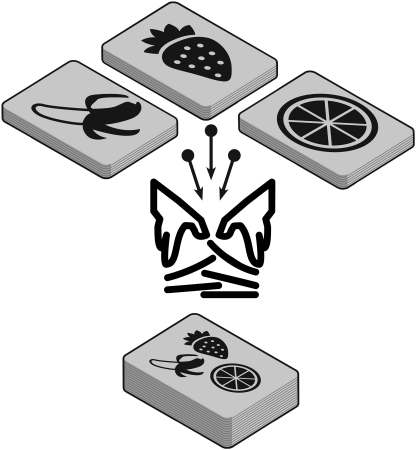
Prior to a multiplayer game session, players select the cards that will make up the decks they use during the multiplayer session. The game provides rules governing how decks may be constructed that typically covers the number of cards in the deck, required cards, restricted cards, and limits on copies of the same card. This mechanism is isomorphic to force-building or list-building in miniatures games and can more generally refer to any game that requires players to assemble private pools of game elements that they will use during play.
Discussion
Deck construction is a retronym, a term that is only required because of the emergence of a later mechanism that creates ambiguity about what we may be referring to. In deck-building players build decks and play them as an integrated part of the core play experience (see CAR-05). Deck construction, on the other hand, refers to games where players typically prepare a deck in advance.
The most familiar implementation of deck construction is common in trading card games (TCG), from competitive dueling games like Magic: The Gathering to cooperative ones like Arkham Horror: The Card Game. Players sit down with a pool of cards and build a deck to suit their play style and objectives, within the rules set forth by the game. Perhaps the most important rule of all in deck construction is defining the pool of cards available to players. In competitive TCGs, there might be many sanctioned play formats, each with its own rules about available cards. Official tournaments might be limited to cards from a specific cycle or set of expansions, and within that pool, there may be cards that are banned entirely or limited to fewer copies than the normal limit. In collectible games, another key limit is which cards players own and thus have access to. Even in non-collectible formats, such as the Living Card Game® format introduced by Fantasy Flight Games, players may not have as many copies of a card as they wish and may need to acquire multiple sets to construct a deck to their exact specifications. Other types of limits include limiting players to selecting cards of a particular faction and to selecting cards with a total cost that falls under some budgeted amount. These limits are frequently found in miniatures and skirmish games. Both present useful opportunities for designers. Faction identities emerge from the abilities assigned to their cards, and players might prefer factions that support their desired play style. Buying a deck or army within some point limit ensures that players have roughly balanced sides, even as they select units from large and varied pools. Rules about deck construction are critical to ensuring playability, balance, and limitation on exploits. In games where deck exhaustion is a loss condition, the maximum number of cards in the deck determines how appealing and successful a “milling” strategy, which forces opponents to discard from their decks, might be. A required minimum number of cards in the deck, coupled with limits on copies of cards, sets the variability range for a deck. Without those rules, a deck might contain one particular combo of a couple of cards over and over again, ensuring the combo is present in every hand. This might be quite efficient, but it undermines the conceit of the genre, in which players seed effective combinations into a deck that is large enough to output variable draws. While deck construction is usually a mechanism intended to give players a lot of agency, choice, and self-expression within a game system, it can also be a barrier to entry. Building a deck in advance of a game takes time, and
building an effective deck takes experience. Many games offer preconstructed starter decks that let players jump into the game and only later engage in the deck-construction elements. In cooperative and solo games, decks will typically have to be rebuilt to optimize deck contents for each scenario, making the meta-game activity of deck construction a key aspect of engagement with the game. An alternative to pregame deck construction is a draft format. CAR-06 goes into detail about draft options. Rather than having rules about deck size, numbers of copies of a single card allowed, and other restrictions, drafting naturally constrains players by only allowing them to select from the pool of available cards, a pool which is shared by all players. At the other end of the spectrum of agency and engagement lies Smash Up. Smash Up invites players to select two different faction decks and shuffle them together to produce one integrated deck. These faction decks are all preconstructed and so players are not selecting individual cards at all. This is the most extreme version of the limitations of deck contents, and it completely removes the barriers of deck construction, though at a high cost to the player agency in the design of the deck. Deck construction is part of a larger design pattern in which players choose the kinds of power-ups, abilities, and characteristics they want to play with. One axis of differentiation is whether the choices happen in the meta-game, as in a TCG, or in a pregame selection format. While Smash Up does technically have rules for drafting the available factions, players often simply just decide to play with some pair of factions without formally engaging in that process. In Seasons, on the other hand, players use a pick-and-pass drafting format (CAR-06) that is very much the first stage of the game itself, precisely because players are responding to each other’s choices as they move through the selection process. Notable marginal examples straddle a broad range. In Baseball Highlights 2045, players begin with preconstructed decks and draft new cards in between rounds. This is a kind of midpoint between deck construction, deck building, and preconstructed decks. In the solo scenario-based game Israeli Air Force Leader, players choose a squadron of pilots for each mission. One might even see Galaxy Trucker as an example of deck construction, albeit as loosely construed as possible. These examples demonstrate the wealth of possibilities available to designers in designing a meta-game selection experience for players.
Sample Games
Arkham Horror: The Card Game (French and Newman, 2016) Baseball Highlights 2045 (Fitzgerald, 2015) Galaxy Trucker (Chvátil, 2007) Israeli Air Force Leader (Verssen and Verssen, 2017) Magic: The Gathering (Garfield, 1993) Seasons (Bonnessée, 2012) Smash Up (Peterson, 2012)
描述
在多人游戏会话之前,玩家选择将在多人游戏会话期间使用的组成其牌库的卡牌。游戏提供了管理如何构建牌库的规则,通常包括牌库中的卡牌数量、必选卡牌、受限卡牌以及同一张卡牌的副本数量限制。这种机制与微缩模型游戏中的部队构建或列表构建同构,并且可以更普遍地指任何要求玩家组装其将在游戏期间使用的游戏元素私人池的游戏。
讨论
套牌构筑(Deck Construction)是一个返璞词(retronym),这是一个仅因后来出现的机制产生歧义而需要的术语。在牌库构筑(deck-building)中,玩家构建牌库并将其作为核心游戏体验的综合部分进行游戏(见CAR-05)。另一方面,套牌构筑是指玩家通常提前准备牌库的游戏。
套牌构筑最熟悉的实现常见于集换式卡牌游戏(TCG)中,从《万智牌》(Magic: The Gathering)等竞争性决斗游戏到《诡镇奇谈:卡牌版》(Arkham Horror: The Card Game)等合作游戏。玩家坐下来拿着一池卡牌,在游戏规定的规则内构建适合其游戏风格和目标的牌库。也许套牌构筑中最重要的规则是定义玩家可用的卡牌池。在竞争性TCG中,可能有许多认可的游戏格式,每种格式都有关于可用卡牌的自己的规则。官方锦标赛可能仅限于来自特定循环或扩展集的卡牌,在该池中,可能有卡牌被完全禁止或被限制为比正常限制更少的副本。在可收集游戏中,另一个关键限制是玩家拥有并因此有权访问哪些卡牌。即使在非可收集格式中,例如Fantasy Flight Games推出的成长式卡牌游戏(Living Card Game®)格式,玩家也可能没有他们希望的那么多的卡牌副本,并且可能需要获取多套来构建符合其确切规格的牌库。其他类型的限制包括限制玩家选择特定派系的卡牌以及选择总成本低于某个预算金额的卡牌。这些限制常见于微缩模型和遭遇战游戏中。两者都为设计师提供了有用的机会。派系特性从分配给其卡牌的能力中显现出来,玩家可能更喜欢支持其所需游戏风格的派系。在某个点数限制内购买一副牌或军队确保了玩家拥有大致平衡的一方,即使他们从庞大而多样的池中选择单位。关于套牌构筑的规则对于确保可玩性、平衡性和限制漏洞至关重要。在牌库耗尽是失败条件的游戏中,牌库中的最大卡牌数量决定了强迫对手从牌库中弃牌的“磨牌”策略的吸引力和成功程度。牌库中所需的最小卡牌数量,加上对卡牌副本的限制,设定了牌库的可变性范围。如果没有这些规则,一副牌可能一遍又一遍地包含几张卡牌的一个特定组合,确该组合在每一手牌中都存在。这可能非常有效,但它破坏了该类型的构思,即玩家将有效的组合播种到一个足够大以输出可变抽牌的牌库中。虽然套牌构筑通常是一种旨在给玩家在游戏系统中提供大量代理权、选择权和自我表达的机制,但它也可能是进入的障碍。在游戏之前构建一副牌需要时间,而且
构建一副有效的牌需要经验。许多游戏提供预构建的起始牌组,让玩家跳入游戏,并在之后才参与套牌构筑元素。在合作和单人游戏中,牌库通常必须重建以优化每个剧本的牌库内容,这使得套牌构筑的元游戏活动成为参与游戏的关键方面。赛前套牌构筑的一种替代方案是轮抽格式。CAR-06详细介绍了轮抽选项。轮抽不是有关于牌库大小、允许的单张卡牌副本数量和其他限制的规则,而是通过只允许玩家从可用卡牌池中进行选择来自然地限制玩家,这是一个所有玩家共享的池。在代理权和参与度谱系的另一端是《Smash Up》。《Smash Up》通过邀请玩家选择两个不同的派系牌库并将它们洗在一起产生一个综合牌库。这些派系牌库都是预构建的,所以玩家根本不是在选择个别卡牌。这是对牌库内容限制的最极端版本,它完全消除了套牌构筑的障碍,尽管这是以牌库设计中的玩家代理权为代价的。套牌构筑是更大的设计模式的一部分,其中玩家选择他们想要使用的能量提升、能力和特征。区分的一个轴是选择是发生在元游戏中,如在TCG中,还是在赛前选择格式中。虽然《Smash Up》在技术上确实有轮抽可用派系的规则,但玩家通常只是决定使用某对派系进行游戏,而没有正式参与该过程。另一方面,在《季节》(Seasons)中,玩家使用选择并传递的轮抽格式(CAR-06),这在很大程度上是游戏本身的第一阶段,因为玩家在通过选择过程时正在回应彼此的选择。值得注意的边缘例子跨越了广泛的范围。在《Baseball Highlights 2045》中,玩家从预构建的牌库开始,并在回合之间轮抽新卡牌。这是套牌构筑、牌库构筑和预构建牌库之间的一种中点。在基于单人剧本的游戏《以色列空军指挥官》(Israeli Air Force Leader)中,玩家为每次任务选择一个飞行员中队。人们甚至可以将《银河卡车司机》(Galaxy Trucker)视为套牌构筑的一个例子,尽管解释得尽可能宽松。这些例子展示了设计师在为玩家设计元游戏选择体验方面可用的丰富可能性。
游戏范例
Arkham Horror: The Card Game (French and Newman, 2016) - 《诡镇奇谈:卡牌版》 Baseball Highlights 2045 (Fitzgerald, 2015) - 《Baseball Highlights 2045》 Galaxy Trucker (Chvátil, 2007) - 《银河卡车司机》 Israeli Air Force Leader (Verssen and Verssen, 2017) - 《以色列空军指挥官》 Magic: The Gathering (Garfield, 1993) - 《万智牌》 Seasons (Bonnessée, 2012) - 《季节》 Smash Up (Peterson, 2012) - 《Smash Up》