Description
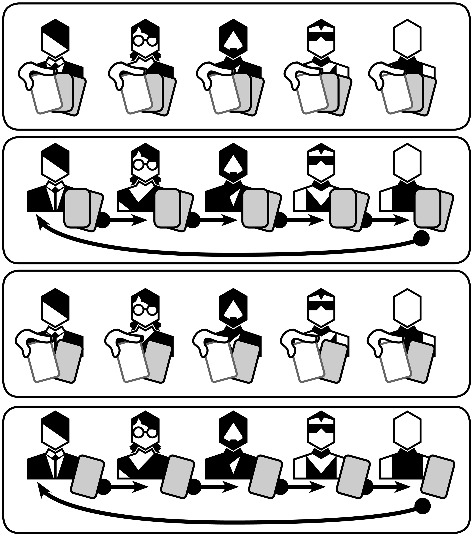
Drafting is a means of distributing cards or other game elements to players through an ordered selection process.
Discussion
Many games can be described as a process of acquiring, manipulating, and spending resources. One of the main distinctions between modern and classic card games is the move away from random deals and draws and towards more agential means of acquiring cards. Auctions are one popular method (Chapter 8), but they can be cumbersome, mathy, and intimidating to many players. Drafting represents a quicker alternative. One way to think of a draft is that instead of precisely valuing each lot and bidding accordingly in an auction, players can instead ask What do I want most right now? Do I have to take it now, or will it be here for me next turn too?
Drafting cards is closely related to Action, Drafting (ACT-02), and Worker Placement (Chapter 9). The core concept is the same in all of these: players select, in turn order, something for their exclusive use. What makes card Drafting different is the variety of design options afforded by the physicality of the card. The draft variant most similar to worker placement is the Rochester draft, as exemplified in The Networks. All available cards are laid on the table, and players each take one card on their turns. Play continues until all the cards have been taken or all players pass their turn. Like a worker placement game, Rochester drafts make all options visible and available at the same time. This can be overwhelming for players and can lead to analysis paralysis, just like in a worker placement game. By physically removing cards from the display, Rochester drafts simplify visually as the draft continues. Consequently, each card is also exclusive to the player who selects it, though designers can include multiple copies of a card if they wish for an action to be available to multiple players. In addition, for games in which cards are taken in hand and played in a later phase, Rochester drafts test the players’ ability to recall what cards their opponents took. In a worker placement game, the players’ pawns encode that information visually, and everyone can see where each pawn was played. Another simple draft mechanism is pick-and-pass. In Lords of Waterdeep, a game effect calls for the active player to draw a hand of cards equal to the number of players at the table, select one to keep, and pass the rest. Each player does this in turn, until the last player is left with the last card. Some games call for drawing one more card than the number of players, so the last player also has a choice. This mechanism is tightly coupled to turn order. Lords of Waterdeep leverages this coupling to provide the greatest return to the player who triggered the effect, but designers should take care not to overly advantage players based on turn order when using this mechanism. To mitigate turn-order imbalances, designers can implement a snake draft, in which the order of Drafting in round 1 is inverted in round 2, so that the last player in the first round becomes the first player in the last round. Snake Drafting mitigates but does not resolve turn-order imbalance. Assuming a level drop-off in the values of cards, the value of the first choice in round 1 and the last choice in round 2 is greater than the value of the last choice in round 1 and the first choice in round 2. In cases where values don’t drop off in a level fashion, the problem remains: some positions are superior to others. Games where the difference in value is negligible, or in which different selections have different values for each player, may be the best place to implement
snake drafts. Most games will use a snake draft as part of some larger system, or in setup, as in Catan’s placement of initial settlements. One game to cleverly address this issue is Kingdomino, in which players draft dominoes with two terrain squares on them and add them to their kingdom. Some squares feature crowns, which make all connected squares of the same terrain worth one point per crown in the combined region. The tiles are numbered, with the lowest-numbered tiles being the least valuable. To draft the tiles, they are laid out in numbered order in a vertical display. The player who chooses the most valuable tiles, the bottom tile in the display, will claim that tile, but will go last in the following turn. Conversely, the player selecting the least-valuable top tile will go first in the next round. While the tiles have some absolute value, they will differ in relative value to each player based on the exact terrains featured on them and what is in each player’s tableau already. In some cases, a player will gladly take a weaker tile, and its better place in turn order, because of how well the tile fits in his or her own board. Another approach to balancing the turn-order issue of Drafting is to have parallel pick-and-pass drafts happening simultaneously. This method, featured in 7 Wonders, Sushi Go!, and Among the Stars, is executed by dealing each player a hand with a number of cards equal to or greater than the number of players playing. Each player picks a card from his or her hand to keep, then passes the hand to the left, and receives a hand from the player to the right. Play continues until all cards are selected. This kind of draft accelerates gameplay because all players are choosing at the same time. However, unlike a Rochester draft, where all choices are visible at all times and where players have nearly equal access to every card, in a parallel draft, each player will only see some fraction of the cards—as few as half in a 7-player game of 7 Wonders—and will simply not ever have the option of taking those cards. Another consideration is if one player is particularly slow, he or she can create a bottleneck, which often leads to confusion about which player is up to which round of Drafting. As mentioned earlier, Drafting, in nearly all its formats, presents two questions. The first is what does the player value most. Many players will stop their analysis here and select the card they like best. But, more skilled players will ask whether they need to take that card right away or when turn order wheels back around to them, that card will still be there. This technique, called “wheeling,” adds tension and skill to Drafting. Wheeling is particularly important to booster drafts of Magic: The Gathering and other Collectible Card Games (CCG). What’s unique about
these styles of the draft is that the pool of cards in the draft is unknown to any player, since they come out of sealed booster packs. Moreover, in many CCGs, card synergies are tightly coupled such that once you begin drafting toward some strategy or deck type, other cards drop to little or even negative value. The extremes in valuation for cards between players make wheeling much more likely to succeed, since the card that one player values the most may have little use to the other players. When that disparity is large enough, it might make sense to take a card that’s useless to you, simply to deny it to other players, a move called hate-drafting. Wheeling and hate-drafting are not mechanisms, but they are behaviors that emerge from the Drafting mechanism and the underlying card distributions and overall game system. Tey are part of what makes the Drafting mechanism so engaging, and designers should evaluate their prototypes with these behaviors in mind. A few other variants on the parallel Drafting structure include whether cards are played immediately after Drafting, as in Best Treehouse Ever, or in turn order during a play phase, for example, in Medieval Academy. Sometimes, not all cards drafted are played, as in Fairy Tale, where only three of the five cards drafted each round are played and the other two are discarded. Another variant is to allow players to mix their hand with the hand of cards being passed. In this kind of setup, players may take as many cards as they wish from the new hand, as long as they pass the correct number of cards to the next player. Having players play a card immediately after drafting can also help keep the draft on schedule and avoids bottlenecking and confusion by forcing all players to play at roughly the same cadence. Drafting games can sometimes be played at 2 players, as in Seasons, but they tend to be a little flat. Tides of Madness is a drafting game limited to 2 players only, and among its innovations is that players can be forced to collect cards with madness symbols on them and can even lose the game if they collect too many. 7 Wonders Duel is a 2-player drafting game with quite a few mechanical twists to ratchet up the tension. Players can only draft cards on the bottom-most revealed level of a structure, but by taking a card, they can reveal face-down cards higher in the structure that become available for drafting. Cards can be used for multiple purposes, including selling off for money, which incentivizes hate-drafting. In addition, there are three possible win conditions, including two in-game sudden-death wins. One win condition is tied to a tug-of-war contest that requires both players to take enough military cards to prevent being overrun by the other player. Another instant-win
condition is subject to a set-collection contest in which players must draft wisely to at least prevent their opponents from assembling the winning set. These during-game concerns, and the possibility of forcing certain lines of play because of them, add richness to the Drafting choices.
Sample Games
7 Wonders (Bauza, 2010) 7 Wonders Duel (Bauza and Cathala, 2015) Among the Stars (Bagiartakis, 2012) Best Treehouse Ever (Almes, 2015) Catan (Teuber, 1995) Fairy Tale (Nakamura, 2004) Kingdomino (Cathala, 2016) Lords of Waterdeep (Lee and Tompson, 2012) Magic: The Gathering (Garfield, 1993) Medieval Academy (Poncin, 2014) The Networks (Hova, 2016) Seasons (Bonnessée, 2012) Sushi Go! (Walker-Harding, 2013) Tides of Madness (Čurla, 2016)
描述
轮抽(Drafting)是一种通过有序的选择过程向玩家分发卡牌或其他游戏元素的方法。
讨论
许多游戏可以被描述获取、操纵和花费资源的过程。现代和经典纸牌游戏的主要区别之一是远离随机发牌和抽牌,转向更具代理性的卡牌获取方式。拍卖是一种流行的方法(第8章),但对于许多玩家来说,它们可能笨重、数学化且令人生畏。轮抽代表了一种更快的替代方案。思考轮抽的一种方式是,与其在拍卖中精确评估每个批次并相应出价,玩家反而可以问我现在最想要什么?我现在必须拿走它,还是下一回合它还会在这里等着我?
轮抽卡牌与行动轮抽(Action, Drafting,ACT-02)和工人放置(第9章)密切相关。所有这些的核心概念都是一样的:玩家按回合顺序选择某些东西供其专用。卡牌轮抽的不同之处在于卡牌的物理特性提供的各种设计选项。最类似于工人放置的轮抽变体是罗彻斯特轮抽(Rochester draft),如《The Networks》所示。所有可用的卡牌都摆在桌子上,玩家轮流拿取一张卡牌。游戏继续进行,直到所有卡牌都被拿走或所有玩家放弃回合。就像工人放置游戏一样,罗彻斯特轮抽使所有选项同时可见和可用。这可能会让玩家不知所措,并导致分析瘫痪,就像在工人放置游戏中一样。通过从展示中物理移除卡牌,罗彻斯特轮抽在继续进行时在视觉上简化了。因此,每张卡牌也是选择它的玩家专用的,尽管设计师可以包括一张卡牌的多个副本,如果他们希望一个行动可供多个玩家使用。此外,对于将卡牌拿在手中并在稍后阶段打出的游戏,罗彻斯特轮抽测试玩家回忆对手拿了什么牌的能力。在工人放置游戏中,玩家的棋子在视觉上编码了该信息,每个人都可以看到每个棋子在哪里打出。另一种简单的轮抽机制是选择并传递(pick-and-pass)。在《深水城领主》(Lords of Waterdeep)中,一种游戏效果要求活跃玩家抽取一手等于桌上玩家数量的卡牌,选择一张保留,然后传递其余的。每个玩家轮流这样做,直到最后一名玩家剩下最后一张牌。有些游戏要求抽取的卡牌比玩家数量多一张,所以最后一名玩家也有选择权。这种机制与回合顺序紧密耦合。《深水城领主》利用这种耦合为触发效果的玩家提供最大的回报,但设计师在使用该机制时应注意不要基于回合顺序过度偏袒玩家。为了减轻回合顺序的不平衡,设计师可以实施蛇形轮抽(snake draft),其中第一轮的轮抽顺序在第二轮倒转,因此第一轮的最后一名玩家成为第二轮的第一名玩家。蛇形轮抽减轻了但并未解决回合顺序的不平衡。假设卡牌价值的水平下降,第一轮第一选择和第二轮最后选择的价值大于第一轮最后选择和第二轮第一选择的价值。在价值并未按水平方式下降的情况下,问题仍然存在:某些位置优于其他位置。价值差异可以忽略不计的游戏,或者不同选择对每个玩家具有不同价值的游戏,可能是实施
蛇形轮抽的最佳场所。大多数游戏将使用蛇形轮抽作为某些更大系统的一部分,或者在设置中,如《卡坦岛》(Catan)初始定居点的放置。巧妙解决这个问题的一款游戏是《多米诺王国》(Kingdomino),玩家轮抽上面有两个地形方块的多米诺骨牌并将它们添加到他们的王国中。有些方块具有皇冠,这使得在组合区域中所有相同地形的连接方块每个皇冠值一分。板块是编号的,编号最低的板块价值最低。为了轮抽板块,它们按编号顺序垂直陈列。选择最有价值板块(展示中底部的板块)的玩家将认领该板块,但在下一回合中将最后行动。相反,选择价值最低的顶部板块的玩家将在下一轮首先行动。虽然板块具有一些绝对价值,但基于其上的确切地形以及每个玩家画面中已有的内容,它们对每个玩家的相对价值会有所不同。在某些情况下,玩家会很高兴拿这一块较弱的板块及其更好的回合顺序位置,因为该板块非常适合他或她自己的版图。平衡轮抽回合顺序问题的另一种方法是同时进行并行的选择并传递轮抽。这种方法在《七大奇迹》(7 Wonders)、《寿司走起!》(Sushi Go!)和《星际奇兵》(Among the Stars)中具有特色,其执行方式是向每位玩家分发一手数量等于或大于玩家人数的卡牌。每位玩家从他或她的手中挑选一张卡牌保留,然后将手牌向左传递,并从右边的玩家那里接收一手牌。游戏继续进行,直到选择完所有卡牌。这种轮抽加速了游戏过程,因为所有玩家都在同一时间进行选择。然而,不像罗彻斯特轮抽,在罗彻斯特轮抽中所有选择始终可见,并且玩家几乎平等地访问每张卡牌,在并行轮抽中,每个玩家只能看到一小部分卡牌——在7人《七大奇迹》游戏中少至一半——并且根本没有选择那些卡牌的选项。另一个考虑因素是,如果一名玩家特别慢,他或她可能会造成瓶颈,这通常会导致关于哪个玩家到了哪一轮轮抽的困惑。如前所述,几乎所有格式的轮抽都提出了两个问题。第一个是玩家最看重什么。许多玩家会在此停止分析并选择他们最喜欢的卡牌。但是,更熟练的玩家会问他们是否需要立即拿走那张卡牌,或者当回合顺序转回到他们时,那张卡牌是否还会还在那里。这种称为“wheeling”(轮转)的技术增加了轮抽的紧张感和技巧。Wheeling对《万智牌》和其他集换式卡牌游戏(CCG)的补充包轮抽尤为重要。独特之处在于
这些风格的轮抽在于轮抽中的卡牌池对任何玩家来说都是未知的,因为它们来自密封的补充包。此外,在许多CCG中,卡牌协同作用紧密耦合,以至于一旦你开始针对某种策略或牌组类型进行轮抽,其他卡牌的价值就会下降到很小甚至是负值。玩家之间卡牌估值的极端差异使得wheeling更有可能成功,因为一个玩家最看重的卡牌对其他玩家可能没什么用处。当这种差异足够大时,拿走一张对你没用的卡牌可能是有意义的,仅仅是为了拒绝其他玩家,这一举动称为“hate-drafting”(恶意轮抽)。Wheeling和hate-drafting不是机制,而是从轮抽机制和底层卡牌分布以及整体游戏系统中涌现的行为。它们是让轮抽机制如此引人入胜的一部分,设计师在评估他们的原型时应考虑到这些行为。并行轮抽结构的其他一些变体包括卡牌是否在轮抽后立即打出,如在《Best Treehouse Ever》中,还是在游戏阶段按回合顺序打出,例如在《Medieval Academy》中。有时,并非所有轮抽的卡牌都被打出,如在《Fairy Tale》中,每轮轮抽的五张卡牌中只有三张被打出,另外两张被弃掉。另一种变体是允许玩家将他们的手牌与正在传递的手牌混合。在这种设置中,玩家可以从新手牌中拿走任意数量的卡牌,只要他们向下一位玩家传递正确数量的卡牌即可。让玩家在轮抽后立即打出一张卡牌也有助于保持轮抽按计划进行,并通过迫使所有玩家以大致相同的节奏进行游戏来避免瓶颈和困惑。轮抽游戏有时可以由2名玩家进行,如在《季节》中,但它们往往有点平淡。《Tides of Madness》是一款仅限2名玩家的轮抽游戏,其创新之处在于玩家可能被迫收集带有疯狂符号的卡牌,如果收集太多甚至可能输掉游戏。《七大奇迹:对决》(7 Wonders Duel)是一款2人轮抽游戏,具有许多机械转折以加剧紧张感。玩家只能轮抽结构中最底部揭示级别的卡牌,但通过拿走一张卡,他们可以揭示结构中更高级别的面朝下卡牌,这些卡牌变得可供轮抽。卡牌可用于多种目的,包括出售换钱,这激励了恶意轮抽。此外,还有三种可能的获胜条件,包括两种游戏内的突然死亡胜利。一种获胜条件与拔河比赛有关,要求两名玩家都拿走足够的军事卡牌以防止被另一名玩家压倒。另一种即时胜利
条件受制于集合收集竞赛,其中玩家必须明智地轮抽,以至少防止对手组装获胜集合。这些游戏过程中的关注点,以及因它们而迫使某些游戏路线的可能性,增加了轮抽选择的丰富性。
游戏范例
7 Wonders (Bauza, 2010) - 《七大奇迹》 7 Wonders Duel (Bauza and Cathala, 2015) - 《七大奇迹:对决》 Among the Stars (Bagiartakis, 2012) - 《星际奇兵》 Best Treehouse Ever (Almes, 2015) - 《Best Treehouse Ever》 Catan (Teuber, 1995) - 《卡坦岛》 Fairy Tale (Nakamura, 2004) - 《Fairy Tale》 Kingdomino (Cathala, 2016) - 《多米诺王国》 Lords of Waterdeep (Lee and Tompson, 2012) - 《深水城领主》 Magic: The Gathering (Garfield, 1993) - 《万智牌》 Medieval Academy (Poncin, 2014) - 《Medieval Academy》 The Networks (Hova, 2016) - 《The Networks》 Seasons (Bonnessée, 2012) - 《季节》 Sushi Go! (Walker-Harding, 2013) - 《寿司走起!》 Tides of Madness (Čurla, 2016) - 《Tides of Madness》