Description
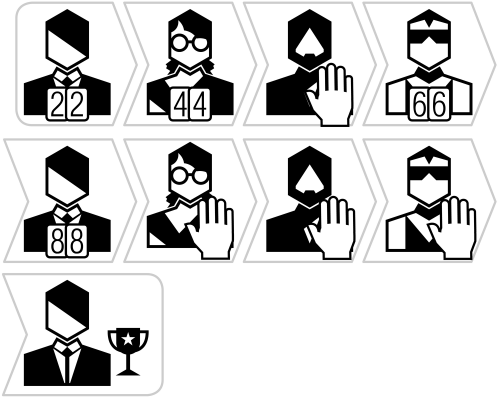
Players play one card or a set of related cards. Subsequently, players must play cards of an equal or higher value of the same set already played. The last player to successfully play wins the right to start a new round of Climbing.
Discussion
Ladder-Climbing games, or simply Climbing games, are closely related to trick-taking games. The two began to differentiate geographically, with Western games in Europe developing around winning tricks and trump suits, and Eastern games in China, Korea, and Japan developing around shedding hands and playing sets. The simplest Climbing games, like President (also known as Scum, Bum, Landlord, and Capitalism among many others), have players playing single cards, doubles, triples, or quads. Subsequent plays must follow the set but be of an equal or higher rank, for example, following three 8s with three 10s. More complex sets, as in Haggis, include runs or sequences of consecutive cards or runs of paired cards. Bombs, unbeatable combinations that can be played no matter what set preceded them, are another wrinkle in this genre.
Shedding all your cards, also called “going out,” is generally a goal in Climbing games, and in many classic shedding games, it is the win condition. In some games, like The Great Dalmuti, play continues until all but one player has gone out, and players are ranked in order of going out. Going out isn’t necessarily the win condition. Some games, like Tichu, reward the player who goes out first with points for doing so, while also granting points for the specific contents of tricks won. Climbing games offer many of the same kinds of variations as trick-taking games. Bidding, partnerships, and wild cards are all common. Another popular variation is the pyramidal deck, as in The Great Dalmuti, which is a deck of ranked cards with a number of cards in each rank equal to the value of the rank. Tus, there are eight 8s, nine 9s, etc. Taking this idea even further, Custom Heroes introduces plastic cards that are placed in sleeves. Adding more cards to a sleeve can change the card’s value or introduce special abilities to the card.
Sample Games
Custom Heroes (Clair, 2017) The Great Dalmuti (Garfield, 1995) Haggis (Ross, 2010) President (Unknown) Tichu (Hostettler, 1991)
描述
玩家打出一张卡牌或一组相关卡牌。随后,玩家必须打出与已打出的同一组牌价值相等或更高的卡牌。最后一名成功出牌的玩家赢得开始新一轮爬梯的权利。
讨论
爬梯游戏(Ladder-Climbing games),或简称爬梯游戏(Climbing games),与吃墩游戏密切相关。这两者开始在地理上区分开来,欧洲的西方游戏围绕赢得墩数和将牌花色发展,而中国、韩国和日本的东方游戏则围绕出完手牌和打出套牌发展。最简单的爬梯游戏,如《President》(如果不熟悉也可以称为Scum、Bum、斗地主(Landlord)和Capitalism等),玩家打出单张、对子、三张或四张。随后的出牌必须跟随套牌,但等级必须相等或更高,例如,用三张10跟随三张8。更复杂的套牌,如在《Haggis》中,包括顺子或连续卡牌序列或配对卡牌序列。炸弹,无论之前是什么套牌都可以打出的无敌组合,是这一类型的另一个波折。
出完所有卡牌,也称为“going out”(出局/完牌),通常是爬梯游戏的目标,在许多经典的出牌游戏中,这是胜利条件。在某些游戏中,如《The Great Dalmuti》,游戏继续进行,直到除一名玩家外的所有玩家都出局,玩家按出局顺序排名。出局并不一定是胜利条件。有些游戏,如《Tichu》,奖励首先出局的玩家积分,同时也为赢得的墩的具体内容给予积分。爬梯游戏提供许多与吃墩游戏相同的变化。叫价、合作和百搭牌都很常见。另一个流行的变体是金字塔形牌库,如在《The Great Dalmuti》中,这是一个排名卡牌的牌库,每个等级的卡牌数量等于该等级的价值。因此,有八个8,九个9等。将这个想法以此类推,《Custom Heroes》引入了放置在卡套中的塑料卡牌。向卡套中添加更多卡牌可以改变卡牌的价值或为卡牌引入特殊能力。
游戏范例
Custom Heroes (Clair, 2017) - 《Custom Heroes》 The Great Dalmuti (Garfield, 1995) - 《The Great Dalmuti》 Haggis (Ross, 2010) - 《Haggis》 President (Unknown) - 《大富豪/斗地主》(President通常对应大富豪,Landlord对应斗地主) Tichu (Hostettler, 1991) - 《梯级戏/地主》