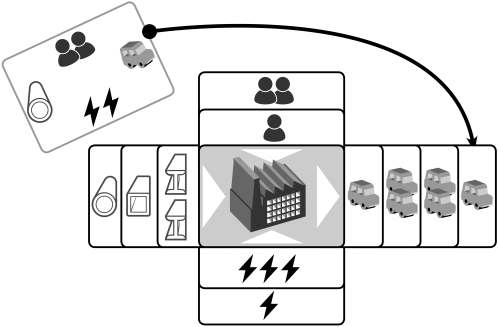
Description
A set of cards in a specific relationship to one another that allows them to be played to a table or scored is a meld. When laying these cards down, the way the cards splay, or overlap one another, may sometimes reveal or conceal certain abilities or attributes.
Discussion
Melds are a kind of Set Collection (Chapter 12) that are very common in card games. Classic card games typically allow melds of identical cards, sometimes called a set, or melds containing cards in a fixed series, for example, ascending by one, usually called a run. Rummikub is one example of a game that includes both types of melds. Go Fish is a very simple example of a single meld—the group of four. Commonly, players must assemble a meld in their hands and only then play the melds out onto the table. In Rummy and its many variants, melds played out on the table can be added to by other players, sometimes called “laying off”—but only if they have already played a meld themselves. In Rummikub, players may disassemble and reassemble any melds on the table, as they seek to lay off more tiles from their hands into these new arrangements. Melding is not limited to cards. The very popular Mahjong uses tiles and takes advantage of their tactile nature in a variety of ways, such as being used to form a wall at the start of each round which defines the play area.
An important design consideration for melds is that each element (card or tile) should belong to more than one possible grouping. For example, in Rummy, legal melds include groups of the same values as well as sequential values. Melds with overlapping elements give more nuanced and textured gameplay. Conversely, each element being a part of only one possible meld simplifies the game and decisions and is typically used in children’s games such as the aforementioned Go Fish. Melding often involves Splaying, which is discussed thoroughly in ACT20 Layering.
Sample Games
…and then, we held hands (Chircop and Massa, 2015) Circle the Wagons (Aramini, Devine, and Kluka, 2017) Go Fish (Unknown) Honshu (Malmioja, 2016) Innovation (Chudyk, 2010) Lotus (Goddard and Goddard, 2016) Mahjong (Unknown, ∼1850) Rummy (Unknown, ∼1850) Rummikub (Hertzano, 1977)
描述
一组彼此之间具有特定关系的卡牌,允许它们被打出到桌面上或得分,这称为组合(meld)。当放下这些卡牌时,卡牌展开或重叠的方式有时可能会揭示或隐藏某些能力或属性。
讨论
组合(Melds)是一种集合收集(Set Collection,第12章),在纸牌游戏中非常常见。经典纸牌游戏通常允许相同卡牌的组合,有时称为套牌(set),或包含固定系列卡牌的组合,例如递增一,通常称为顺子(run)。《拉密》(Rummikub)是包含这两种类型组合的游戏的一个例子。《钓鱼》(Go Fish)是单一组合的一个非常简单的例子——四张一组。通常,玩家必须在手中组装一个组合,然后才将组合打出到桌面上。在《拉米》(Rummy)及其许多变体中,打出到桌面上的组合可以由其他玩家添加,有时称为“贴牌/接龙”(laying off)——但前提是他们自己已经打出了一个组合。在《拉密》中,玩家可以拆卸和重新组装桌面上的任何组合,因为他们试图将更多的牌从手中贴到这些新排列中。组合不仅限于卡牌。非常流行的《麻将》(Mahjong)使用牌块,并以各种方式利用其触觉特性,例如在每一轮开始时用于形成定义游戏区域的墙。
组合的一个重要设计考虑因素是每个元素(卡牌或牌块)应属于多个可能的分组。例如,在《拉米》中,合法组合包括相同数值的组以及连续数值。具有重叠元素的组合提供了更细致和更有质感的游戏玩法。相反,每个元素只是一个可能组合的一部分简化了游戏和决策,通常用于儿童游戏,如前述的《钓鱼》。组合通常涉及展开(Splaying),这在ACT20分层(Layering)中进行了彻底讨论。
游戏范例
…and then, we held hands (Chircop and Massa, 2015) - 《执子之手》 Circle the Wagons (Aramini, Devine, and Kluka, 2017) - 《圈地大冒险》 Go Fish (Unknown) - 《钓鱼》 Honshu (Malmioja, 2016) - 《本州》 Innovation (Chudyk, 2010) - 《创新/旷世发明》 Lotus (Goddard and Goddard, 2016) - 《莲花》 Mahjong (Unknown, ∼1850) - 《麻将》 Rummy (Unknown, ∼1850) - 《拉米》 Rummikub (Hertzano, 1977) - 《拉密/以色列麻将》