?
Definition
Multiple actions are shown on a card, but only one can be used.
Discussion
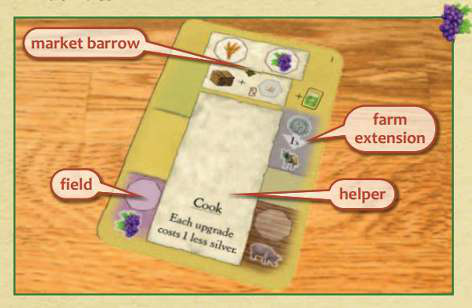
In this mechanism, the cards are typically broken up into clearly defined areas, each of which presents the player with a different option. Note: We use “cards” throughout this entry, as that is the most common implementation. Tiles may also be used, although this mechanism can also be used on tiles or other components. However, it does require a certain amount of real estate to make the choices clear, so cards tend to be the component of choice. This mechanism presents the players with two or more choices, and they can select only one to perform. For example, in La Granja, each card has four different abilities that can be used, each of which is arranged on the edge of a card. The clever player mat allows for cards to be tucked under any of its four edges, so only the operative section of the card is showing. Once
the card is placed it cannot be moved—the player forgoes the other options (Illustration 13.1a). Sometimes, the cards can only be used one time, as in La Granja. In others, however, they are recycled so that players may select different options each time. In Gloomhaven, for example, each action card has two abilities, and the player can choose which to execute each time the card returns to their hand. A positive feature of this mechanism is that it presents the players with clear and focused options. It also naturally leads to difficult decisions, particularly when only one option may be chosen the entire game. This feeds into players’ feelings of decision anxiety, which may or may not be a design goal. A key consideration for the designer is which abilities to combine on the same card. One option is simply to randomly assign them to cards. However, this may result cards where one choice is generally superior to the others, which can reduce the decision space. A better approach is to match the power levels of the different options. This will maximize the difficulty in the player deciding which option to use. A final consideration is whether to thematically tie the elements together for each card. In Gloomhaven, the two halves of the cards are frequently thematically connected. A subset of this mechanism is Action/Event (ACT-04). In this system, players can choose from a set number of action points or an event. Since one element of the card is a number, balancing is simplified. See that mechanism for more details about specific implementation considerations. Illustration 13.1a The cards in La Granja are placed under the player mat at different edges, only showing the chosen section of the card.
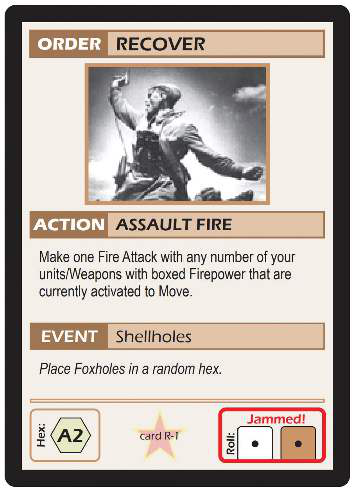
An alternative approach to Multi-Use cards is to allow the cards themselves to be used as physical objects, typically as a discard. For example, in Race for the Galaxy, cards must be discarded to pay to play other cards. In The Ares Project, cards can be played either face up, typically creating a structure that can create units, or face down on those structures where they represent the resources required for the units to be built. The Multi-Use cards in Combat Commander have six functions in the game; however, only two are options for the players. At the top of the card is an Order that players can issue on their turn. Next, there is an Action, which can be used either on their own or on their opponent’s turn. Below the Action is an Event. Randomly, the players may be required to flip the top card of their deck and perform the Event. Finally, at the bottom left is a Random Hex, which can be used for some events and other game functions, and at the bottom right a series of die rolls, which are used to resolve actions. Additionally, the die rolls may be in a special “trigger” box which can generate events, sniper attacks, or jam guns (Illustration 13.1b). Illustration 13.1b The cards in Combat Commander serve many purposes. Players use Orders and Actions to command their units. The other features are various types of randomizers.
All of this allows a compact way to present a wide range of information. It also gives savvy players the ability to track which die rolls have been used, for example, to modulate their play accordingly.
Sample Games
Andean Abyss (Ruhnke, 2012) The Ares Project (Engelstein and Engelstein, 2011) Ceylon (Zinsli and Zinsli, 2018) Combat Commander: Europe (Jensen, 2006) Gloomhaven (Childress, 2017) Glory to Rome (Chudyk, 2005) La Granja (Keller and Odendahl, 2014) We the People (Herman, 1993)
?
定义
一张卡牌上显示多个行动,但只能使用其中一个。
讨论
在这个机制中,卡牌通常被分成明确定义的区域,每个区域为玩家呈现不同的选项。注:我们在整个条目中使用“卡牌”,因为那是其实最常见的实现方式。也可以使用板块,尽管此机制也可以用于板块或其他组件。然而,它确实需要一定量的空间来明确选择,因此卡牌倾向于成为首选组件。此机制为玩家呈两个或更多选择,他们只能选择一个执行。例如,在《La Granja》中,每张卡牌有四种不同的能力可以使用,每种能力都安排在卡牌的边缘。巧妙的玩家垫允许将卡牌塞入其四个边缘中的任何一个下方,因此只显示卡牌的操作部分。一旦
卡牌被放置,它就不能移动——玩家放弃了其他选项(插图13.1a)。有时,卡牌只能使用一次,就像在《La Granja》中一样。然而,在其他情况下,它们被回收,以便玩家每次都可以选择不同的选项。例如在《幽港迷城》(Gloomhaven)中,每张行动卡都有两种能力,玩家可以选择每次卡牌回到手中时执行哪一种。这种机制的一个积极特征是它为玩家提供了清晰和专注的选项。它自然也导致困难的决定,特别是当整个游戏中只能选择一个选项时。这助长了玩家的决策焦虑感,这可能是也可能不是设计目标。设计师的一个关键考虑因素是将哪些能力结合在同一张卡牌上。一种选择是简单地随机分配给卡牌。然而,这可能会导致某些卡牌的一个选择通常优于其他选择,从而减少决策空间。更好的方法是匹配不同选项的强度水平。这将最大化玩家决定使用哪个选项的难度。最后的考虑因素是否在每张卡牌上将元素在主题上联系在一起。在《幽港迷城》中,卡牌的两半经常在主题上相连。此机制的一个子集是行动/事件(Action/Event,ACT-04)。在该系统中,玩家可以从一定数量的行动点或事件中进行选择。由于卡牌的一个元素是数字,因此平衡被简化了。有关具体实施注意事项的更多详细信息,请参阅该机制。插图 13.1a 《La Granja》中的卡牌被放置在玩家垫的不同边缘下方,仅显示卡牌的选定部分。
多用途卡牌(Multi-Use cards)的另一种方法是允许卡牌本身作为物理对象使用,通常作为弃牌。例如,在《银河竞逐》(Race for the Galaxy)中,必须丢弃卡牌以支付打出其他卡牌的费用。在《The Ares Project》中,卡牌可以面朝上打出,通常创建可以创建单位的结构,或者在这些结构上由面朝下打出,在那里它们代表构建单位所需的资源。《战斗指挥官》(Combat Commander)中的多用途卡牌在游戏中有六种功能;然而,只有两个是玩家的选项。在卡牌顶部是玩家可以在他们的回合发布的命令(Order)。接下来是行动(Action),可以在他们自己或对手的回合使用。行动下方是事件(Event)。随机地,玩家可能被要求翻开他们牌库的顶牌并执行事件。最后,在左下角是随机六角格(Random Hex),可用于某些事件和其他游戏功能,右下角是一系列骰子掷出的点数,用于解决行动。此外,骰子掷出的点数可能在一个特殊的“触发”框中,可以生成事件、狙击手攻击或卡枪(插图13.1b)。插图13.1b 《Combat Commander》中的卡牌有许多用途。玩家使用命令和行动来指挥他们的单位。其他特征是各种类型的随机生成器。
所有这些允许以紧凑的方式呈现广泛的信息。它还赋予精明的玩家追踪已使用哪些骰子掷出点数的能力,例如,以相应地调整他们的游戏。
游戏范例
Andean Abyss (Ruhnke, 2012) - 《安第斯深渊》 The Ares Project (Engelstein and Engelstein, 2011) - 《The Ares Project》 Ceylon (Zinsli and Zinsli, 2018) - 《锡兰》 Combat Commander: Europe (Jensen, 2006) - 《战斗指挥官:欧洲》 Gloomhaven (Childress, 2017) - 《幽港迷城》 Glory to Rome (Chudyk, 2005) - 《罗马荣光》 La Granja (Keller and Odendahl, 2014) - 《La Granja》 We the People (Herman, 1993) - 《We the People》