Description
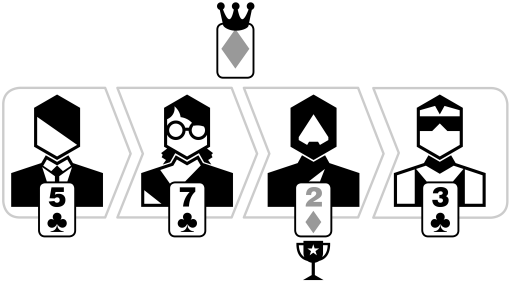
Players play cards from their hand to the table in a series of rounds or “tricks,” which are each evaluated separately to determine a winner and to apply other potential effects.
Discussion
Trick-Taking games are about 1,000 years old, and as such, there are many games, variations, and scoring rules. Covering all those possibilities is beyond our scope, and we will instead focus briefly on the core concepts. Trick-Taking games begin with dealing cards out. In classic games, like Bridge and Spades, all cards are dealt out evenly to the players. Some games have a betting phase in which players declare the number of tricks they intend to take. After this, players play in turn order, starting with the first player, called the lead. Many games require that players “follow the lead” or “follow suit,” which means playing a card of the same suit as the lead, if possible. The player playing the highest card of the lead suit wins the trick and becomes the lead for the next round. Often, one suit is the “trump” suit, and cards of that suit outrank cards of the lead suit, no matter their numerical value. Finally, players score for the number of tricks they’ve won. Designers have created variations of all of these core rules. In Diamonds, rather than dealing the entire deck, a subset of the deck is dealt out, which creates uncertainty and lowers the impact of memory and card counting. In
Sticheln, players do not have to follow the lead suit, and unlike most games, where off-suit cards are disregarded when determining the winner of the trick, here, they are considered trump! In The Bottle Imp, trump isn’t tied to suit at all. Instead, only a single card may be trump at any given time: the card closest to, but not exceeding, the value of the bottle, which begins at 19. As lower numbers are played, the bottle takes on the value of those cards. A related approach is featured in Little Devils, where the second card played to the trick will set the rule for the trick: if the card is lower, all proceeding players must play lower, and if it is higher, they must play higher. The game also features the variation that winning tricks is a negative outcome. Going back to Sticheln, players want to win tricks, but every round, all players choose a “pain” suit whose cards will count against them and try to win tricks while avoiding taking cards from their pain suit. Betting can also feature variations. In Bridge, for example, the bid for a contract includes the right to determine which suit will be trump. Only the team that wins the bidding can score points for making its contract. Trick-Taking games are often played in partnership, and the bidding phase will typically have players taking turns bidding, alternating between the two teams. In some games, like Wizard, the sum total of tricks that players bid cannot equal the number of tricks in the hand. This guarantees that at least one player or partnership will miss their bid. Another common variant is the impact of “overbooking” or “over-tricking,” which is collecting more tricks than the contract called for. Whether over-booking is more valuable, equal in value, or less valuable than the tricks contracted for varies from game to game. In “exact bid” games like Sluff Off, over-tricking may even be penalized. Trick-Taking games share many features and dynamics with both OnceAround Auction (AUC-07) and Sealed-Bid Auction (AUC-04), as unintuitive as that may sound. Readers curious about this should study Trick of the Rails, a card game that models 18xx-style games and uses Trick-Taking in place of auctions. A Trick-Taking game is similar to an auction in that players hold a hand of currency and bid that currency to win the trick. The currency is not consistent in relative value, because the exact same trick might be won by different cards depending on which card was led and what suit is trump. In addition, the lot up for bid—the cards of the trick—is also what’s being used to bid. This kind of dynamic is how a wager usually works; you commit money to the pot, hoping to win the pot, which is composed of all the bids. Trick-Taking games may be described as highly specialized auctions, at least mathematically speaking. From a game-design perspective, however, TrickTaking games typically emphasize hand-management and planning skills,
rather than valuation skills, and the experiential difference between a series of auctions and a hand of tricks is substantial as well.
Sample Games
18xx (Tresham, 1974) The Bottle Imp (Cornett, 1995) Bridge (Vanderbilt, 1908) Diamonds (Fitzgerald, 2014) Little Devils (Feldkotter, 2012) Sluff Off (Dorra, 2003) Spades (Unknown) Sticheln (Palesch, 1993) Trick of the Rails (Hayashi, 2011) Wizard (Fisher, 1984)
描述
玩家从手中出牌到桌子上,进行一系列回合或“墩”(tricks),每一个都单独评估以确定获胜者并应用其他潜在效果。
讨论
吃墩游戏(Trick-Taking games)大约有1000年的历史,因此,有许多游戏、变体和计分规则。涵盖所有这些可能性超出了我们的范围,我们将改为简要关注核心概念。吃墩游戏从发牌开始。在经典游戏中,如《桥牌》(Bridge)和《黑桃》(Spades),所有卡牌都平均分发给玩家。有些游戏有一个叫价阶段,玩家在其中宣布他们打算拿到的墩数。此后,玩家按回合顺序出牌,从第一个玩家开始,称为领出者(lead)。许多游戏要求玩家“跟牌”(follow the lead)或“跟随花色”(follow suit),这意味着如果可能的话,打出一张与领出牌相同花色的牌。打出领出花色中最大牌的玩家赢得这一墩,并成为下一轮的领出者。通常,一种花色是“将牌”(trump)花色,该花色的牌等级高于领出花色的牌,无论其数值如何。最后,玩家根据他们赢得的墩数得分。设计师已经创造了所有这些核心规则的变体。在《Diamonds》中,不是处理整个牌库,而是处理牌库的一个子集,这创造了不确定性并降低了记忆和算牌的影响。在
《Sticheln》中,玩家不必跟随领出花色,而且与大多数游戏不同,在确定这一墩的赢家时会忽略副牌,在这里,它们被视为将牌!在《The Bottle Imp》中,将牌根本不与花色挂钩。相反,在任何给定时间只有一张牌可以是将牌:最接近但不超过瓶子价值的牌,瓶子从19开始。随着打出较小的数字,瓶子具有这些牌的价值。相关的方法在《Little Devils》中具有特色,其中打入这一墩的第二张牌将设定这一墩的规则:如果卡牌较低,所有后续玩家必须打出更低的牌,如果较高,他们必须打出更高的牌。该游戏还具有赢得墩数是负面结果的变体。回到《Sticheln》,玩家想赢得墩数,但每一轮,所有玩家都会选择一种“痛苦”花色,其卡牌会对他们不利,并试图赢得墩数,同时避免拿走痛苦花色的牌。叫价也可以有变体。例如,在《桥牌》中,对定约的叫价包括确定哪种花色将是将牌的权利。只有赢得叫价的团队才能因完成其定约而得分。吃墩游戏通常以合作方式进行,叫价阶段通常会让玩家轮流出价,在两队之间交替。在某些游戏中,如《Wizard》,玩家出价的墩数总和不能等于手中的墩数。这保证了至少有一名玩家或合作伙伴会错过他们的出价。另一个常见的变体是“超额预订”或“超墩”的影响,即收集比定约要求的更多的墩数。超额预订是否比定约的墩数更有价值、价值相等还是更低,因游戏而异。在像《Sluff Off》这样的“精确出价”游戏中,超墩甚至可能受到惩罚。吃墩游戏与一轮拍卖(One-Around Auction, AUC-07)和密封竞价拍卖(Sealed-Bid Auction, AUC-04)共享许多特征和动态,尽管这一听起来可能不直观。对此感到好奇的读者应该研究《Trick of the Rails》,这是一款模拟18xx风格游戏并使用吃墩代替拍卖的纸牌游戏。吃墩游戏类似于拍卖,因为玩家持有一手货币并出价该货币以赢得这一墩。货币的相对价值并不一致,因为完全相同的一墩可能会根据哪张牌是领出牌以及什么花色是将牌而被不同的牌赢得。此外,待拍的批次——这一墩的牌——也是用来出价的东西。这种动态通常是赌注的工作方式;你把钱投入彩池,希望能赢得彩池,彩池由所有出价组成。吃墩游戏可以被描述为高度专业化的拍卖,至少在数学上是这样。然而,从游戏设计的角度来看,吃墩游戏通常强调手牌管理和规划技巧,
而不是估值技巧,一系列拍卖和一手墩之间的体验差异也是巨大的。
游戏范例
18xx (Tresham, 1974) - 《18xx》系列 The Bottle Imp (Cornett, 1995) - 《The Bottle Imp》 Bridge (Vanderbilt, 1908) - 《桥牌》 Diamonds (Fitzgerald, 2014) - 《Diamonds》 Little Devils (Feldkotter, 2012) - 《Little Devils》 Sluff Off (Dorra, 2003) - 《Sluff Off》 Spades (Unknown) - 《黑桃》 Sticheln (Palesch, 1993) - 《Sticheln》 Trick of the Rails (Hayashi, 2011) - 《Trick of the Rails》 Wizard (Fisher, 1984) - 《神机妙算》