Description
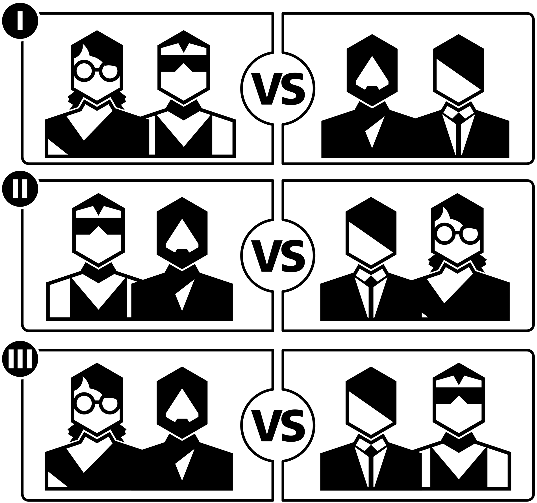
Players have formal relationships that may change over the course of the game.
Discussion
In pure Negotiation games (ECO-18), agreements to cooperate are informal and can be made or broken at will. This mechanism differs in that there is a formal step to enter into and leave an Alliance, and the game rules specify how the Alliance operates. For example, in Dune, each turn, cards are revealed from the Spice deck. If one of them is a Worm card, the players are allowed to make and break alliances. These alliances are in force until the next Worm card is revealed. Players that are allied may not attack each other, combine their score for winning purposes, win together, and may cooperate in other ways. When the next Worm is revealed, players may decide if they want to continue the alliance, ally with another player, or go it alone. Empires in Arms, a detailed
simulation of the Napoleonic Wars, has a robust and complex alliance system, with a variety of possible formal relationships between players. In Struggle of Empires, each Round begins with players bidding for the right to divide the players into two teams of their choosing. Like Dune, players who are allied fight together and may not attack each other. However, players still win or lose individually, which creates interesting dynamics. Cosmic Encounter has players trying to conquer planets from their opponents. Each time this occurs, there is a formal alliance step, where players may choose to ally with the attacker, defender, or stay out of it, and there are defined benefits and penalties if their side wins or loses. So this is a similar system, although it is much shorter in duration, lasting one turn. There are a variety of other takes on this system. Trough the Ages has Treaty cards that players can offer to their opponents to gain mutual (sometimes asymmetrical) benefits. The Trick-Taking card game (CAR-01) Mu has partners assigned for the hand based on a bidding phase. Hidden Role games (UNC-04) secretly put players on different teams.
Sample Games
Cosmic Encounter (Eberle, Kittredge, Norton, and Olatka, 1977) Dune (Eberle, Kittredge, and Olatka, 1979) Empires in Arms (Pinder and Rowland, 1983) Mu (Matthäus and Nestel, 1995) The Resistance (Eskrisge, 2009) Struggle of Empires (Wallace, 2004) Trough the Ages: A Story of Civilization (Chvátil, 1986) Werewolf (Davidoff and Plotkin, 1986)
描述
玩家之间拥有正式的关系,这些关系可能会在游戏过程中改变。
讨论
在纯粹的谈判游戏(ECO-18)中,合作协议是非正式的,可以随意订立或打破。此机制的不同之处在于,进入和离开结盟有一个正式的步骤,并且游戏规则规定了结盟如何运作。例如,在《沙丘》(Dune)中,每一回合都会从香料牌堆中翻出卡牌。如果其中一张是沙虫卡,玩家就可以建立和打破结盟。这些结盟一直有效,直到翻出下一张沙虫卡。结盟的玩家不得互相攻击,为了获胜目的合并分数,共同获胜,并可能以其他方式合作。当下一张沙虫被揭示时,玩家可以决定是否要继续结盟,与另一位玩家结盟,还是单干。《Empires in Arms》是对拿破仑战争的详细
模拟,拥有一个强大而复杂的结盟系统,玩家之间有各种可能的正式关系。在《Struggle of Empires》中,每一轮开始时,玩家竞标将玩家分成他们选择的两个团队的权利。像《沙丘》一样,结盟的玩家一起战斗,不得互相攻击。然而,玩家仍然单独赢或输,这创造了有趣的动态。《银河遭遇战》(Cosmic Encounter)让玩家试图征服对手的行星。每次发生这种情况时,都有一个正式的结盟步骤,玩家可以选择与攻击者、防御者结盟,或置身事外,如果他们的一方赢或输,都有明确的利益和惩罚。所以这是一个类似的系统,虽然它在持续时间上要短得多,只持续一个回合。在这个系统上还有各种其他的看法。《历史巨轮》(Through the Ages)有条约卡,玩家可以向对手提供这些卡以获得相互(有时是不对称)的利益。吃墩纸牌游戏(CAR-01)《Mu》根据叫价阶段为这手牌分配伙伴。隐藏角色游戏(UNC-04)秘密地将玩家放在不同的团队中。
游戏范例
Cosmic Encounter (Eberle, Kittredge, Norton, and Olatka, 1977) - 《银河遭遇战》 Dune (Eberle, Kittredge, and Olatka, 1979) - 《沙丘》 Empires in Arms (Pinder and Rowland, 1983) - 《Empires in Arms》 Mu (Matthäus and Nestel, 1995) - 《Mu》 The Resistance (Eskrisge, 2009) - 《抵抗组织》 Struggle of Empires (Wallace, 2004) - 《Struggle of Empires》 Trough the Ages: A Story of Civilization (Chvátil, 1986) - 《历史巨轮》(注:年份应为2006,1986可能是笔误或指早期版本?) Werewolf (Davidoff and Plotkin, 1986) - 《狼人杀》