Description
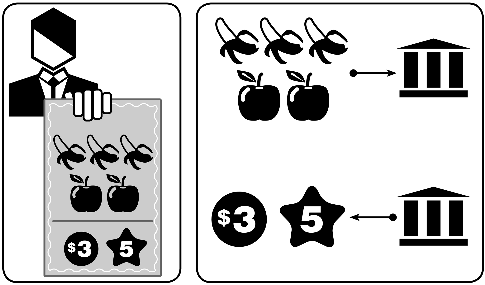
Players fulfill Contracts to earn rewards.
Discussion
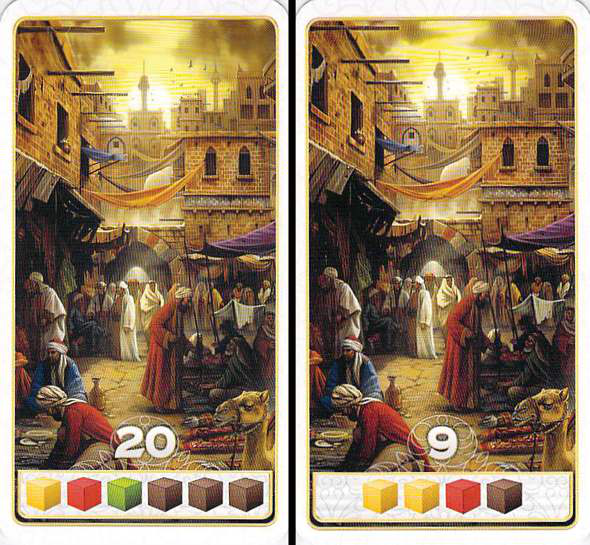
Typically, to complete a Contract, players turn in a specific combination of goods and earn a reward, which is usually money or VPs. Contracts can either be public or be private. Public Contracts are faceup and shared by all players who race to fulfill it first. Often the Contract is discarded, but sometimes, other players can fulfill the Contract later for a lesser reward. Century: Spice Road is an example game with Public Contracts. Private Contracts, by contrast, may only be fulfilled by the player that has them. Tey may be known to all or kept hidden until fulfilled. In Empire Builder, players have three Contract cards to deliver a specific good to a specific city. These are face-up so all players can see them, but only the owner may complete the delivery (Illustration 7.7). There are a variety of ways that players may obtain Contracts. Tey may be obtained via random draw (as in Empire Builder or Century: Spice Road), by selecting from a tableau, by drawing several and selecting which to keep and which to discard, by draft, or even by auction (as in Mow Money). Contracts give players immediate direction and goals, which can be particularly important for new players. Public Contracts increase player inter-action but also may lead to “feel-bad” moments if a player is really close to
completing a Contract but is scooped by an opponent at the last second— particularly if the second place rewards aren’t available. In these cases, it is helpful if whatever is used to fulfill the Contract is generally useful so that the effort to acquire that specific set of resources, or bring them to a specific location, is not completely wasted.
Sample Games
Century: Spice Road (Matsuuchi, 2017) Empire Builder (Bromley and Fawcett, 1982) Goa (Dorn, 2004) Mow Money (Saunders, 2016) Ora et Labora (Rosenberg, 2011) Schoko & Co. (Hirschfield and Monnet, 1987) Undermining (Tolman, 2011) Illustration 7.7 Two sample contract cards from Century: Spice Road. Paying the cubes shown on the bottom yields the victory points shown just above them.
描述
玩家履行合同(Contracts)以获得奖励。
讨论
通常,为了完成合同,玩家上交特定的商品组合并获得奖励,通常是金钱或VP(胜利点数)。合同可以是公开的也可以是私人的。公开合同是面朝上的,由所有玩家共享,他们争相首先履行它。通常合同会被丢弃,但有时,其他玩家以后可以以较低的奖励履行合同。《Century: Spice Road》是带有公开合同的游戏示例。相比之下,私人合同只能由拥有它们的玩家履行。它们可能被所有人知晓,或者在履行之前保持隐藏。在《Empire Builder》中,玩家有三张合同卡,要将特定商品运送到特定城市。这些是面朝上的,所以所有玩家都可以看到它们,但只有所有者可以完成交付(插图7.7)。玩家可以通过多种方式获得合同。它们可以通过随机抽取获得(如在《Empire Builder》或《Century: Spice Road》中),通过从画面中选择,通过抽取几张并选择保留哪些和丢弃哪些,通过轮抽,甚至通过拍卖(如在《Mow Money》中)。合同为玩家提供了即时的方向和目标,这对新玩家尤为重要。公开合同增加了玩家互动,但也可能导致“感觉糟糕”的时刻,如果一名玩家真的接近
完成合同但在最后一秒被对手抢先——特别是如果第二名的奖励不可用。在这些情况下,如果有助于履行合同的东西通常是有用的,那么获取那组特定资源或将它们带到特定地点的努力就不会完全浪费。
游戏范例
Century: Spice Road (Matsuuchi, 2017) - 《香料之路》 Empire Builder (Bromley and Fawcett, 1982) - 《Empire Builder》 Goa (Dorn, 2004) - 《果阿/印度》 Mow Money (Saunders, 2016) - 《Mow Money》 Ora et Labora (Rosenberg, 2011) - 《祈祷与工作》 Schoko & Co. (Hirschfield and Monnet, 1987) - 《巧克力工厂》 Undermining (Tolman, 2011) - 《Undermining》 插图7.7 《香料之路》中的两张合同样本卡。支付底部显示的方块会产生正上方显示的胜利点数。