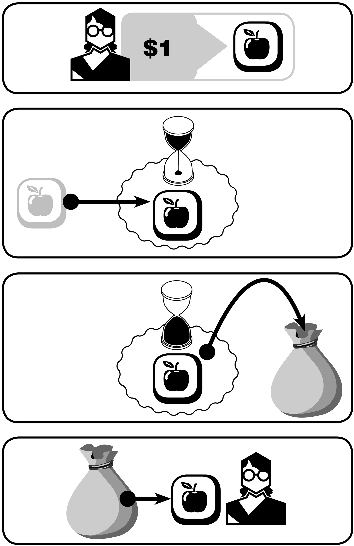
Description
Items that are purchased do not enter play right away but arrive on a future turn.
Discussion
In most games, when you purchase an item, it is immediately available to use. However, in the real world, it can take time to produce something, or get something delivered. Several games use this Delayed Purchase mechanic to force players to plan ahead. A simple implementation is to place purchased items directly on a turn track, and they become available when the turn marker moves into that space. This can also be done with a specialized production or training track, where units are advanced one box each turn. This was used in Time War, where Teams are trained by advancing them through a schematic
of a training facility. Each turn, they move one box through the facility, and when they reached the exit, they are fully trained. However, players can remove teams early, but then they are only partially trained and less effective. In Star Wars: Rebellion, ship construction is managed this way too. But various special cards can move ships down the track, accelerating production. Strategic war games use this production track mechanism but have wanted, for realism purposes, to have different durations to produce different units. For example, an infantry unit might take a month, while an aircraft carrier might take a year. Because of the number of units being built, moving tokens from box to box is unwieldy, so designers created the Production Spiral. When units are being built, the tokens are placed by following the spiral arm out from the current month until the matching unit type is found. The tokens are then placed in the section of the arm. When the Month marker is moved, all tokens in that wedge become available to the player. World in Flames is a good example (Illustration 7.2). Another way to implement this is to place purchased items into a discard area, as is common in deck-building games like Dominion. Here the delay before the purchases are available is randomized, since the discards are shuffled before creating the draw deck. This can create an issue with games Illustration 7.2 The build queue in Star Wars: Rebellion. Each unit takes a certain number of turns to construct and is placed in the appropriately numbered box when built. Each turn units slide down one box. When they move out of the “1” box they are placed on the map.
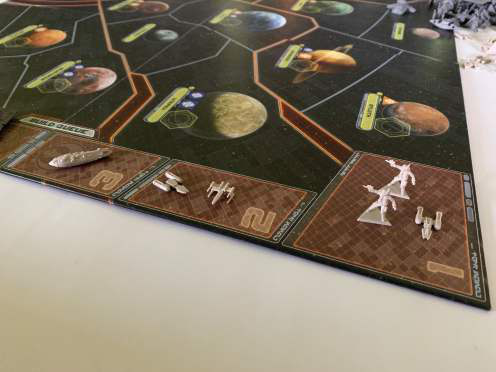
with a fixed number of turns, as items that are acquired late in the game may never see play. This can be avoided by making late game purchases just worth Victory Points, or by having a special shuffle toward the end of the game. Core Worlds uses that latter technique, as the discards may be shuffled in before the final turn, regardless of whether the draw deck is depleted or not. While not guaranteeing that cards purchased at the end will be drawn, it does increase the chances.
Sample Games
Core Worlds (Parks, 2011) Dominion (Vaccarino, 2008) Star Wars: Rebellion (Konieczka, 2016) Time War (Peek, 1979) World In Flames (Pinder and Rowland, 1985)
描述
购买的物品不会立即投入使用,而是在未来的回合到达。
讨论
在大多数游戏中,当你购买一件物品时,它立即可用。然而,在现实世界中,生产某些东西或交付某些东西可能需要时间。几款游戏使用这种延迟购买机制来迫使玩家提前计划。一个简单的实现是将购买的物品直接放在回合轨道上,当回合标记移动到该空间时,它们就变得可用。这也可以通过专门的生产或训练轨道来完成,其中单位每回合前进一格。这在《Time War》中使用,其中团队通过在训练设施的图表中推进它们来接受训练。
每回合,他们在设施中移动一格,当他们到达出口时,即为训练完毕。然而,玩家可以提前移出团队,但那时他们只是受过部分训练,效率较低。在《星球大战:叛乱》(Star Wars: Rebellion)中,飞船建造也是以这种方式管理的。但这各种特殊卡牌可以将飞船沿轨道向下移动,加速生产。战略战争游戏使用这种生产轨道机制,但为了现实目的,希望生产不同单位有不同的持续时间。例如,步兵单位可能需要一个月,而航空母舰可能需要一年。由于正在建造的单位数量众多,将标记从一个格子移动到另一个格子很笨拙,因此设计师创造了生产螺旋。建造单位时,按照螺旋臂从当前月份向外放置标记,直到找到匹配的单位类型。然后将标记放置在臂的部分中。当月份标记移动时,该楔形中的所有标记都对玩家可用。《World in Flames》是一个很好的例子(插图7.2)。实现这一点的另一种方法是将购买的物品放入弃牌区,这在像《皇舆争霸》(Dominion)这样的牌库构筑游戏中很常见。这里购买后的延迟是随机的,因为弃牌在创建抽牌堆之前会被洗牌。这可能会在具有固定回合数的游戏中产生问题(插图7.2 《星球大战:叛乱》中的建造队列。每个单位需要一定数量的回合来建造,并且在建造时被放置在相应编号的盒子中。每回合单位向下滑动一个盒子。当它们移出“1”盒时,它们被放置在地图上),因为在游戏后期获得的物品可能永远不会投入使用。这可以通过使后期购买仅值胜利点数,或者在游戏结束时进行特殊洗牌来避免。《Core Worlds》使用后一种技术,因为无论抽牌堆是否耗尽,弃牌都可以在最后回合之前洗入。虽然不能保证在最后购买的卡牌会被抽到,但它确实增加了机会。
游戏范例
Core Worlds (Parks, 2011) - 《核心世界》 Dominion (Vaccarino, 2008) - 《皇舆争霸》 Star Wars: Rebellion (Konieczka, 2016) - 《星球大战:叛乱》 Time War (Peek, 1979) - 《Time War》 World In Flames (Pinder and Rowland, 1985) - 《战火世界》