Description
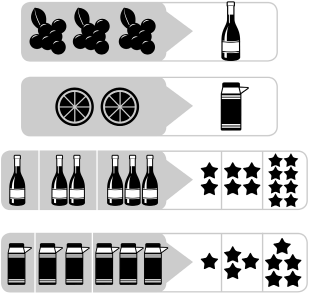
Players Exchange a set of assets for a different set with the bank.
Discussion
While traditionally this mechanism is thought of as Exchanging similar types of resources, for example, Exchanging two sheep for a wood at a sheep port in Catan, under the expansive definition of assets, it also covers purchasing as a mechanism. For example, in Monopoly, players exchange the asset money for the asset property. Similar considerations apply, so they are both covered here. Often there are fixed formulas for exchanges. Again using Catan as an example, a Road costs a Brick and a Grain, and a Town costs a Brick, Grain, Wool, and Wood. These types of requirements can be used to give relative value to different paths, or add an arc, as different resources may be required in different ways under different strategies or at varying points of the game. What was valuable early may become less so later on. Some systems feature a hierarchical organization of resources. For example, in Roads and Boats, Wood is used to make Boards, Boards make Fuel, Fuel and Gold make Coins, and Coins and Paper make Stock Certificates. As is typical in this style of game, each of these transformations is a one-way trip. Another example of hierarchical resources is Century: Spice Road. In this game, yellow turmeric cubes are the least valuable, followed by red saffron cubes, green cardamom cubes, and then the most valuable brown cinnamon cubes. In this case, exchanges are possible (and common) between all levels.
Certain cards allow the conversion of a brown cube back into several yellow and red cubes. Hierarchical systems give players a clear sense of value. However, if this value is too clear, other mechanisms need to be introduced to obstruct players from getting used out of that value. Otherwise, the resources are basically fungible like coins of different denominations. For example, in Century: Spice Road, players may exchange cubes for the Victory Card resource. The point value of those cards is strictly equal to the value of the cubes, from one point for yellow cubes, up to four points for brown cubes. Although not explicitly stated, this 1–4 valuation of colors helps players quickly determine the relative value of the converter cards. One that turns a green (value 3) into a brown and yellow (value 4 + 1 = 5) gives a net gain of +2. A card that turns a red into a green has a value of +1. While the value of the cards is known, the players need to collect cards that enable them to perform exchanges as efficiently as possible to get the specific set of cubes required by the victory card. Tus, time becomes another resource that players must consider when determining the value of exchanges. Non-hierarchical systems allow players to transform resources in different directions, laterally. The sheep port in Catan that was mentioned earlier is an example. At that port, any other commodity may be obtained by turning in two sheep. Permitting lateral exchange of resources gives a system more flexibility and allows players to specialize, as focusing on just a few resources will not limit them from getting others they may require.
Sample Games
Castle Dice (Peterschmidt, 2013) Catan (Teuber, 1995) Century: Spice Road (Matsuuchi, 2017) Concordia (Gerdts, 2013) Factory Fun (van Moorsel, 2006) Gizmos (Walker-Harding, 2018) Glass Road (Rosenberg, 2013) Monopoly (Darrow and Magie, 1933) Roads and Boats (Doumen and Wiersinga, 1999) Sidereal Confluence (Deichmann, 2017)
描述
玩家与银行交换(Exchange)一组资产以换取不同的组。
讨论
虽然传统上认为这种机制是交换相似类型的资源,例如在《卡坦岛》(Catan)的绵羊港用两只绵羊换一个木材,但在资产的广义定义下,它也涵盖了作为一种机制的购买。例如,在《大富翁》(Monopoly)中,玩家用资产货币交换资产财产。类似的考虑也适用,所以它们都包含在这里。交换通常有固定的公式。再次以《卡坦岛》为例,一条道路花费一块砖和小麦,一个城镇花费一块砖、小麦、羊毛和木材。这些类型的要求可用于赋予不同路径相对价值,或增添弧度,因为在不同的策略下或游戏的不仅同点,可能需要不同的资源。早期有价值的东西后来可能会变得不那么有价值。有些系统具有资源的层级组织。例如,在《Roads and Boats》中,木材用于制造板材,木板制造燃料,燃料和黄金制造硬币,硬币和纸张制造股票证书。这类游戏的典型特征是,这些转换中的每一个都是单向旅程。分层资源的另一个例子是《香料之路》(Century: Spice Road)。在这个游戏中,黄色姜黄方块价值最低,其次是红色藏红花方块,绿色豆蔻方块,然后是最有价值的棕色肉桂方块。在这种情况下,所有各级之间皆可进行(并且通常进行)交换。
某些卡牌允许将棕色方块转换回几个黄色和红色方块。分层系统给玩家一种清晰的价值感。然而,如果这个价值太清晰,就需要引入其他机制来阻碍玩家利用该价值。否则,资源基本上就像不同面额的硬币一样可替代。例如,在《香料之路》中,玩家可以用方块换取胜利卡资源。这些卡牌的点值严格等于方块的价值,从黄色方块的一分到棕色方块的四分。虽然没有明确说明,但这种1-4的颜色估值有助于玩家快速确定转换卡的相对价值。将绿色(值3)变为棕色和黄色(值4+1=5)的卡牌给予+2的净收益。将红色变为绿色的卡牌值为+1。虽然卡牌的价值是已知的,但玩家需要收集使他们能够尽可能有效地进行交换的卡牌,以获得胜利卡所需的特定方块组。因此,时间成为玩家在确定交换价值时必须考虑的另一种资源。非分层系统允许玩家横向地在不同方向转换资源。前面提到的《卡坦岛》中的绵羊港就是一个例子。在该港口,任何其他商品都可以通过上交两只绵羊获得。允许资源的横向交换赋予系统更大的灵活性,并允许玩家专业化,因为只关注少数资源不会限制他们获得可能需要的其他资源。
游戏范例
Castle Dice (Peterschmidt, 2013) - 《Castle Dice》 Catan (Teuber, 1995) - 《卡坦岛》 Century: Spice Road (Matsuuchi, 2017) - 《香料之路》 Concordia (Gerdts, 2013) - 《和谐罗马》 Factory Fun (van Moorsel, 2006) - 《Factory Fun》 Gizmos (Walker-Harding, 2018) - 《Gizmos》 Glass Road (Rosenberg, 2013) - 《Glass Road》 Monopoly (Darrow and Magie, 1933) - 《大富翁》 Roads and Boats (Doumen and Wiersinga, 1999) - 《路与船》 Sidereal Confluence (Deichmann, 2017) - 《Sidereal Confluence》