Description
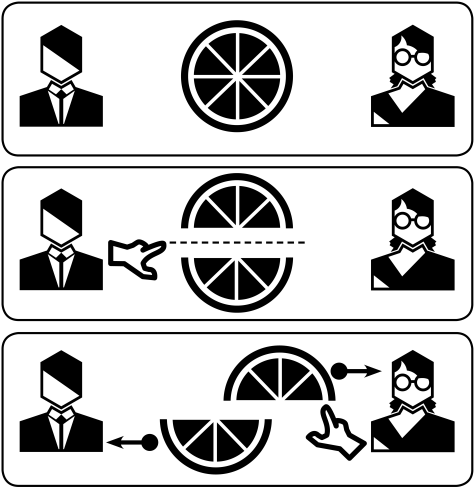
One player divides a set of resources into different groups. Other players have the first choice of which group to select.
Discussion
This I Cut, You Choose mechanism is based on a technique that parents often use with two children who are, for example, dividing up a bar of candy. One child breaks it into two pieces, and then the other selects which one they want. This ensures that the one doing the dividing is incentivized to make it as equitable as possible, because they know the other will take the larger piece. In general, when this mechanism is used, it is between two players. For example, in San Marco, players are paired up each turn, and one is designated to divide drawn cards into two stacks. Ten the other player selects which stack they want to keep.
This mechanism forces players to consider a wide variety of factors, both present and future, to put together offers that will entice the choosing player to pick the desired stack while giving them as little as possible. Some games, like New York Slice, extend this mechanism beyond two players. In New York Slice, one player divides a stack of pizza ingredients into several stacks equal to the player count. Ten, going clockwise, each player selects one stack, with the dividing player getting the last one remaining. In this multiplayer variation, it is next to impossible for four or more divisions to have even roughly equivalent value, so it is customary for each player to have equal turns being the divider. For this mechanism to be interesting, the value of each division can’t be obvious. True value for each player must be hidden or obscured. The most common way to do this is by integrating a variety of Set Collection mechanisms, which is the go-to method for having the same thing be worth different things to different players. See Chapter 12 for full details.
Sample Games
New York Slice (Allers, 2017) Piece O’ Cake (Allers, 2008) San Marco (Moon and Weissblum, 2001) Sundae Split (Bivins, 2017)
描述
一名玩家将一组资源分成不同的组。其他玩家有选择哪一组的优先权。
讨论
这种“我切你选”(I Cut, You Choose)机制基于父母经常对两个孩子使用的技术,例如,分一块糖果。一个孩子把它分成两块,然后另一个选择他们想要的那块。这确保了分糖的人受到激励使其尽可能公平,因为他们知道另一个人会拿走较大的一块。一般来说,当使用这种机制时,是在两个玩家之间。例如,在《San Marco》中,每回合玩家配对,指定一人将抽到的牌分成两堆。然后另一名玩家选择他们想保留哪一堆。
这种机制迫使玩家考虑各种因素,包括现在和未来的因素,以组合出能够诱使选择玩家挑选所需堆的报价,同时给予他们尽可能少的东西。有些游戏,如《New York Slice》,将此机制扩展到两名玩家之外。在《New York Slice》中,一名玩家将一堆披萨配料分成几个等于玩家数量的堆。然后,按顺时针方向,每位玩家选择一堆,分牌玩家得到剩下的最后一堆。在这个多人变体中,四个或更多划分甚至拥有大致相等的价值几乎是不可能的,所以习惯上每个玩家轮流做分牌人。要让这个机制有趣,每个划分的价值不能显而易见。每个玩家的真正价值必须被隐藏或模糊。最常见的方法是整合各种集合收集机制,这是让同一事物对不同玩家具有不同价值的首选方法。有关完整详细信息,请参阅第12章。
游戏范例
New York Slice (Allers, 2017) - 《New York Slice》 Piece O’ Cake (Allers, 2008) - 《Piece O’ Cake》 San Marco (Moon and Weissblum, 2001) - 《San Marco》 Sundae Split (Bivins, 2017) - 《冰淇淋快手》