Description
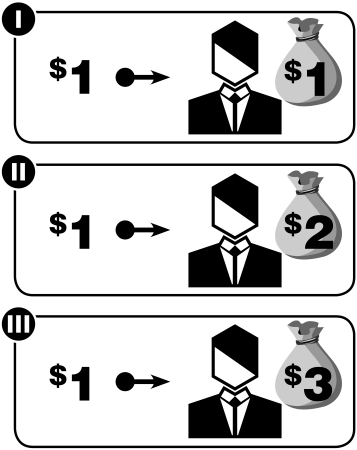
Players gain resources at defined times.
Discussion
To foster a sense of growth and forward progress, most games with economic elements have some form of Income, where players receive additional resources. This is a large topic, and several specific mechanisms discussed in this chapter fall into this category. See “Automatic Resource Growth” (ECO-06), “Loans” (ECO-07), “Exchanging” (ECO-01), “Market” (ECO03), and “Random Production” (ECO-12). However, there are some broad generalizations that can be discussed. First, the designer needs to consider the timing of when Income is received. It can be scheduled, player-controlled, or random. Brass and Eclipse are examples of games with scheduled Income phases. Tey come at a definite point in the sequence of play, and players can plan around that. Player-controlled systems rely on players to take actions that result in Income. Typically, it is self-controlled: a player makes a decision to take a
Production action that generates resources (as in Global Mogul) or sells something via a Market (ECO-03). However, in some systems, part of a player’s Income may rely on the actions of other players. For example, in Le Havre and Caylus, a player gains Income if other players use their buildings (ECO-14). This increases player interaction and rewards players that consider their opponents’ positions. However, this is typically implemented as only a portion of a player’s Income and not a significant one. There are games where all, or close to all, of a player’s Income is dependent on other players. In Container, players produce and ship containers. But other than taking loans, you may only gain money by enticing another player into purchasing one of your containers. As can be expected, this makes these games a lot less forgiving and subject to social pressures. Container in particular has this reputation. Income can also be random. Roll and Move games like Monopoly typically incorporate this. Players rely on others either landing on their property spaces or passing Go to collect money. But, there are other more sophisticated systems for randomly allocating resources. See Random Production (ECO-12) for details. Games can also be Open Economies or Closed Economies. In an Open Economy, there is a bank that pumps more resources into the game system. In contrast, in a Closed Economy, all the resources that exist are already in the player’s hands, and they just move between players during the course of the game. The vast majority of games are Open Economies. This helps foster a sense of progress and is easier for designers to balance. An example of a Closed Economy game is Dream Factory, which is discussed in detail in the (appropriately named) Closed Economy mechanism in Chapter 8, “Auctions.”
Sample Games
Brass (Wallace, 2007) Catan (Teuber, 1995) Caylus (Attia, 2005) Container (Delonge and Ewert, 2007) Dream Factory (Knizia, 2000) Eclipse (Tahkokallio, 2011) Global Mogul (Crenshaw, 2013) Le Havre (Rosenberg, 2008) Monopoly (Darrow and Magie, 1933) Nippon (Sentieiro and Soledade, 2015)
描述
玩家在规定的时间获得资源。
讨论
为了培养增长感和前进感,大多数具有经济元素的游戏都有某种形式的“收入”(Income),玩家在其中获得额外资源。这是一个很大的话题,本章讨论的几个具体机制属于这一类。请参阅“自动资源增长”(Automatic Resource Growth,ECO-06)、“借贷”(Loans,ECO-07)、“交换”(Exchanging,ECO-01)、“市场”(Market,ECO-03)和“随机生产”(Random Production,ECO-12)。然而,有一些广泛的概括可以讨论。首先,设计师需要考虑收到收入的时间。它可以是预定的、玩家控制的或随机的。《Brass》和《Eclipse》是具有预定收入阶段的游戏示例。它们出现在游戏顺序中的确切点,玩家可以围绕它进行计划。玩家控制的系统依靠玩家采取导致收入的行动。通常,它是自我控制的:玩家决定采取
生产行动来生成资源(如在《Global Mogul》中)或通过市场(ECO-03)出售东西。然而,在某些系统中,玩家的部分收入可能取决于其他玩家的行动。例如,在《勒阿弗尔》(Le Havre)和《凯吕斯》(Caylus)中,如果其他玩家使用其建筑物,玩家将获得收入(ECO-14)。这增加了玩家的互动,并奖励考虑对手立场的玩家。然而,这通常仅作为玩家收入的一部分而不是重要部分来实现。有些游戏,玩家的所有或接近所有收入都依赖于其他玩家。在《Container》中,玩家生产并运送集装箱。但除了贷款外,你只能通过诱使另一位玩家购买你的一个集装箱来获得金钱。正如可以预期的那样,这使得这些游戏更加无情并且受到社会压力的影响。《Container》尤其具有这种声誉。收入也可能是随机的。像《大富翁》(Monopoly)这样的掷骰移动游戏通常包含这一点。玩家依靠其他人降落在他们的财产空间或通过起点来收集金钱。但是,还有其他更复杂的系统用于随机分配资源。有关详细信息,请参阅随机生产(ECO-12)。游戏也可以是开放经济或封闭经济。在开放经济中,有一家银行将更多资源注入游戏系统。相比之下,在封闭经济中,所有存在的资源都已经在玩家手中,它们只是在游戏过程中在玩家之间移动。绝大多数游戏都是开放经济。这有助于培养进步感,并且设计师更容易平衡。封闭经济游戏的一个例子是《Dream Factory》,在第8章“拍卖”中对(恰当命名的)封闭经济机制进行了详细讨论。
游戏范例
Brass (Wallace, 2007) - 《工业革命》 Catan (Teuber, 1995) - 《卡坦岛》 Caylus (Attia, 2005) - 《凯吕斯》 Container (Delonge and Ewert, 2007) - 《集装箱/货运大亨》 Dream Factory (Knizia, 2000) - 《好莱坞/梦工厂》 Eclipse (Tahkokallio, 2011) - 《星蚀》 Global Mogul (Crenshaw, 2013) - 《Global Mogul》 Le Havre (Rosenberg, 2008) - 《勒阿弗尔》 Monopoly (Darrow and Magie, 1933) - 《大富翁》 Nippon (Sentieiro and Soledade, 2015) - 《日本工业革命》