Description
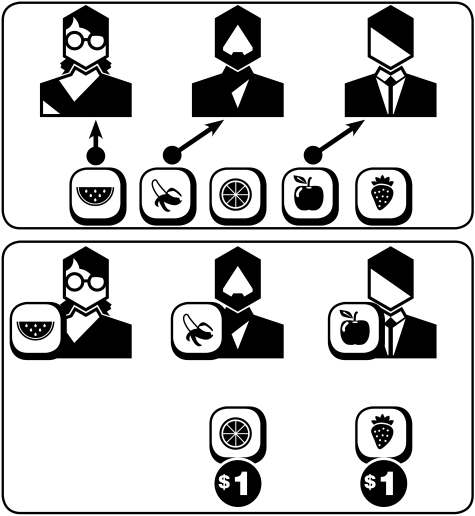
If players do not select certain Actions or Resources, then they increase in value.
Discussion
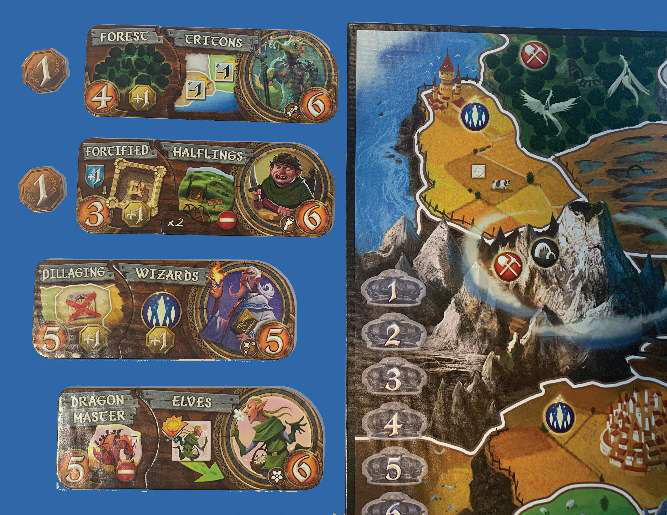
Puerto Rico is one of the earliest examples of this mechanism. Each player selects one role during a round, but there are more available roles than players. The roles that are not chosen gain a coin at the end of each round. In the future, when players select that role they also gain the coins on it. This mechanism is a specific type of Dutch Auction (AUC-08). Small World and Century: Spice Road also implements this system in a different guise. When players select a new faction in Small World, they select it from a queue. Tey may take any available faction in the queue but must place a coin on each one that they skip over (Illustration 7.8).
In Agricola, a worker placement game (Chapter 9), some spaces are stocked with additional resources each turn. If those spaces are not selected, they will accumulate more and more resources until a player claims them and takes all the resources on the space. These systems all have in common that they allow the players to value the choices. The value of unselected options gradually increases, until the value reaches a point that entices a player to choose it. While this doesn’t eliminate the need for the designer to balance options, it gives some flexibility to price options that have values that may change over the course of the game or are random combinations that vary in power (as in Small World). Illustration 7.8 In Small World, players select a civilization they want to play from a queue and must pay a coin to skip over earlier civilizations. In this example, the player wishes to take the Pillaging Wizards and so must place a coin on the Forest Tritons and Fortified Halflings. Those coins are earned by players that take those civilizations. If another player goes and also skips the Forest Tritons, another coin would be placed there, and the person to take them would take both coins.
Sample Games
Agricola (Rosenberg, 2007) Century: Spice Road (Matsuuchi, 2017) Puerto Rico (Seyfarth, 2002) Small World (Keyaerts, 2009) Vinci (Keyaerts, 1999)
描述
如果玩家不选择某些行动或资源,那么它们的价值就会增加。
讨论
《波多黎各》(Puerto Rico)是此机制最早的例子之一。每个玩家在一轮中选择一个角色,但可用角色比玩家多。未被选中的角色在每轮结束时获得一枚硬币。在未来,当玩家选择该角色时,他们也会获得其上的硬币。这种机制是一种特定类型的荷兰式拍卖(AUC-08)。《小世界》(Small World)和《香料之路》(Century: Spice Road)也以此不同的形式实现了这个系统。当玩家在《小世界》中选择一个新种族时,他们从队列中选择。他们可以拿走队列中的任何可用种族,但必须在他们跳过的每一个种族上放置一枚硬币(插图7.8)。
在《农场主》(Agricola)这个工人放置游戏(第9章)中,某些空间每回合都会补充额外的资源。如果这些空间未被选中,它们将积累越来越多的资源,直到玩家声称它们并拿走该空间上的所有资源。这些系统都有一个共同点,即允许玩家以此对选择进行估值。未选选项的价值逐渐增加,直到价值达到诱使玩家选择它的点。虽然这并不能消除设计师平衡选项的需要,但它提供了一些灵活性来定价那些价值可能在游戏过程中改变的选项,或者是功率变化的随机组合(如在《小世界》中)。插图 7.8 在《小世界》中,玩家从队列中选择他们想玩的文明,并且必须支付一枚硬币才能跳过较早的文明。在这个例子中,玩家希望带走掠夺的巫师(Pillaging Wizards),因此必须在森林海卫(Forest Tritons)和堡垒半身人(Fortified Halflings)上放置一枚硬币。这些硬币由带走这些文明的玩家赚取。如果另一位玩家也跳过森林海卫,那里会放置另一枚硬币,拿走它们的人会拿走两枚硬币。
游戏范例
Agricola (Rosenberg, 2007) - 《农场主》 Century: Spice Road (Matsuuchi, 2017) - 《香料之路》 Puerto Rico (Seyfarth, 2002) - 《波多黎各》 Small World (Keyaerts, 2009) - 《小世界》 Vinci (Keyaerts, 1999) - 《Vinci》